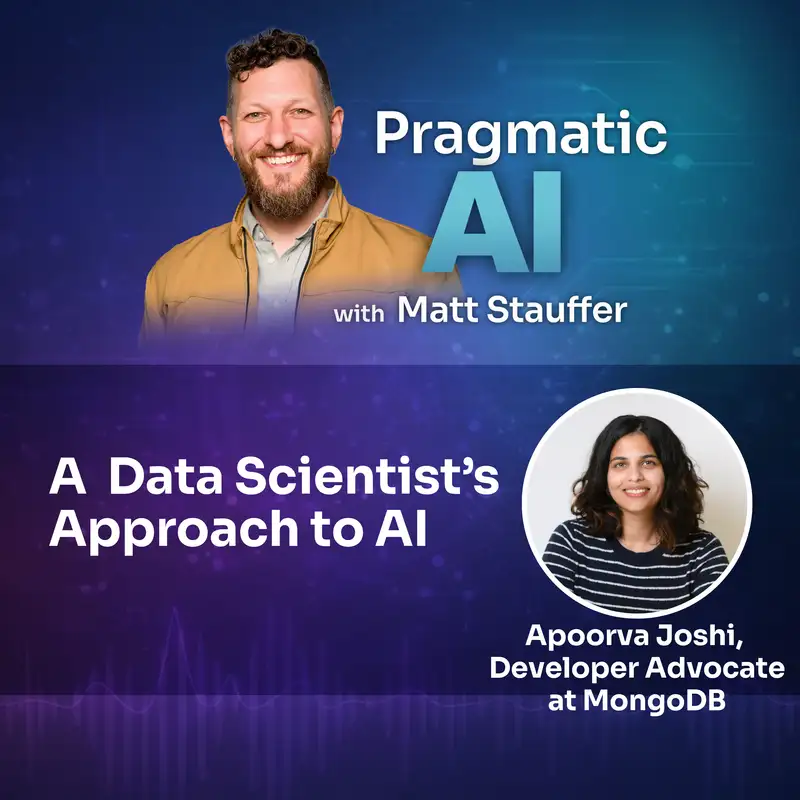
A Data Scientist’s Approach to AI
The Pragmatic AI Podcast is sponsored by Tighten.
T-I-G-H-T-E-N.
We will take your AI ideas, prototypes, or even vibe-coded apps,
and we'll take them to production.
Scalable and secure. Check us out at tighten.com.
Hey, and welcome to Pragmatic AI,
where we talk about using AI in the real
world,
what works, how to use it well,
and when it causes more harm than good,
practical tools and real trade-offs for
builders and business leaders.
And my guest today is my friend Apoorva
Joshi,
developer advocate at MongoDB.
But we're gonna talk about more than just
that.
That's what you actually do day to day,
but can you say hi
Ha ha.
to the people and tell them actually who
are you?
Because you're obviously more than just
that.
Thank you. Hi everyone. Thank you,
Matt, for having me here. Really excited
to be here.
so okay,
you introduced me as a developer advocate
at MongoDB.
Yes. Technically.
That is what I currently do. ~ my focus
is yeah. My focus is ~ still on AI here,
but the fun part is this is my first
DevRel role.
~ I was actually
Mm-hmm.
a data scientist in the cybersecurity
space for about seven years before
I took this devrail role.
so that's what I've been up to for the
first eight years of my career.
Seven years as a data scientist in
cybersecurity,
then ~ someone from MongoDB reached out
like,
Hey, you wanna do Debrel? and I'm like,
Do I? And I gave it a shot
Yeah.
and the rest is history.
Well, I I want to hear that story,
but I first want to start with data
science because both cybersecurity
and data scientists are things I feel like
so I've been a programmer for a while,
and we didn't have a lot of roles other
than
Hmm.
programmer and IT sysadmin, you know,
and there's so many more roles,
and and sometimes I find myself just
making assumptions about what
it means without fully knowing.
So I think I fully understand what a data
scientist is,
but because I'm not 100% sure I'm gonna
ask for the sake of the people.
What does a data scientist do day to day?
Okay, I I'm glad you asked that.
And I I really like your pragmatic
thinking on that
Ha ha.
front as well. But what I've learned,
~ I learned when I was a data scientist in
the companies I was at
is that data science also looks different
in different companies.
~ on it looks different depending on the
domain.
Like I was in cybersecurity, if I was in
healthcare or a different domain that
could
look different, ~ depends on the scale of
the company.
So, okay.
I was a data scientist in cybersecurity
companies.
These are mostly ~ medium-sized companies,
not super big, like about ~ 5,000-ish
employees.
But the data science teams that I was ~ on
were pretty small teams.
So what
Okay.
data science looked like on my team was ~
I was so typically a data scientist
is building machine learning models of
some kind.
with generative AI, I think ~ that is a
whole separate discussion as to what
a data scientist
Yes.
means. But back then ~ we weren't training
foundational models,
we were training ~ like either deep
learning neural network deep neural
networks
or tree-based models, simpler machine
learning models,
if you will. ~ and then your job was
basically,
yeah, like to train those models and maybe
evaluate them.
but because I was on a smaller team,
I think I got exposed to a little more of
the end to end.
So we didn't have a data engineer on the
team.
So I was also doing like the data
gathering,
cleaning, sanitizing, ~ then actually
training the model,
~ then actually evaluating that the
accuracy looks good,
but then ~ I would
also take it all the way to shipping the
model to production.
And what that looked like was at that
point like the production constraints
became
very real. So especially in cybersecurity,
a lot of times the requirement was ~
latency needs to be sub millisecond,
subsecond at least, right? So
wow. Okay. Yeah.
even if you built a perfectly accurate
model,
it might just end up being too big or too
slow,
especially with neural networks.
I those tend to be larger models.
So then you had to kind of like run
several rounds of optimization on that to
make sure that those constraints are met.
And then ~ I also got exposed to different
cloud services and
how to actually ~ package models to deploy
them to said cloud services.
Wow, huh.
So yeah,
I think it was definitely data scientist
plus plus.
Definitely a s yeah, super daunting role
Yes, there's a lot going on. And
to ~ get put into straight out of school.
Yeah. And did you study data science or
cybersecurity or was this all brand new?
~ cybersecurity happened very much by
chance.
It was just the first ~ the the company
that took a shot took a shot on me
~ when I was graduating, right?
So that happened very much by chance.
~ data science and machine learning was a
more intentional decision.
So actually my background during my
bachelor's and halfway through
my master's was actually ~ electrical
engineering.
But five years in I'm
Okay.
like
I don't think this is for me, you know.
So that's when machine learning was kind
of the hot thing.
So I'm like, let's see what this is about.
So I took a course, then I also had my
master's thesis to go.
So did a thesis in like data science,
natural language processing, machine
learning.
And then I'm like, okay, I think I like
this.
So let's do this, right? So
Yeah. Yeah.
~ yeah, that was more intentional.
Cybersecurity was a bit of a happy
accident.
Yeah. Okay. ~ my brother has a degree in
electri and he's a few years older than
me and I'm forty one, so it gives a sense
of the timeline we're talking about.
Ha ha ha.
But he has a degree
in electrical engineering and computer
sciences.
And so they would mix those together as a
single degree.
And it was always curious for me,
but I mean you you made a transition.
Did you find there was much overlap?
I mean, were you at least studying logic
and stuff,
or was it sort of like you're starting
over from scratch?
It was pretty much from scratch because a
actually going back to like high school,
I I had taken computer science as my
elective,
but ~ my
first foray into ~ software and computers
was Java and back then
we were writing code on paper.
So I was really terrified of like software
engineering.
So when I had to pick a major I'm like
anything but that.
and for
Yeah.
the most part, ~ the reason I thought
electrical engineering could work
for me was because it was so different
from ~ computer science.
So it was very different. ~ yeah.
Okay. And as a data scientist,
were you writing code or were you mainly
facilitating the movement
of data between systems? But like was
there was there a lot of code involved
in what you're doing, or is it mainly
'cause actually I don't know what I
we what it mainly would be. Was there a
lot of code?
There was a lot of code. It was very much
software and it was the thing that
I was running away from, got got put right
back into it.
Uh-huh.
But I think
~ there is like a ~ mathematical
statistics angle to it,
right? Like the packages and libraries
that you're typically working in
are a little different. So if you're
training like you're
typical regression classification models,
then back then you were doing like NumPy,
SciPy, ScikitLearn. Those were the
libraries.
Whereas ~ yeah, if you were a typical
software engineer,
backend engineer, you might be using a
different stack.
So I would say the stack looks different,
but you're still very much writing code.
And that that helps a lot because I've
found myself in situations where,
you know, you know, take those math
classes and everyone says,
We're never gonna use this ever again.
Why don't we have classes in accounting?
And that as a programmer, I'm like,
actually I frequently find myself needing
to figure out how to extract patterns
or whatever else, and I don't have
Yeah.
that training. And I've always imagined
that the data scientists are
the people who have that training and they
don't just understand how to
put the code together, they understand the
math and the research
and the analytics that pushes
you know, real life, real data,
real structures, real patterns,
together with the the coding that actually
makes it happen.
So it sounds like I'm at least kind of h
hitting a little bit right on what you
did.
Yeah. Definitely.
Okay.
Yeah, yeah.
So what does a transition from data
science to DevRel even look like?
Cause normally when I think of somebody
who does DevRel,
I think of ~ speakers, teachers,
people, people. And so if I imagine
somebody being recruited,
I'm like, this person must be super active
on YouTube.
They must be speaking at conferences.
Hmm.
So what was what who were you that got you
recruited to do devrel?
Is that is a very interesting question,
right? also because when I was a data
scientist and I was planning my next move,
I was looking at I was like, okay,
I want to do something fresh, I want to do
something different.
What are my options? And DevRel was
actually one of those things I'd looked
at and been like, okay, maybe that's not
for me.
Because ~ once again, DevRel looks so
different at different organizations,
right? Like a lot of places it is like
you're
hopping from one conference to another.
You're mostly like very public facing and
then yeah,
Yes, yeah.
even my perception
was like, okay, I need to have like a
solid YouTube following or I need to be
a ~ a tech fluencer or whatever.
And I was none of those things.
~ but ~ sorry, w w we're gonna say
something.
No, you're good.
so yeah, the VP of DevRel back then,
Matt Acey, if he's watching this,
he's like, ~ hey, you want to do DevRel at
MongoDB?
I'm like, ~ this is what I think of
DevRel.
I don't think it's more for me.
Is this any different? And then I learned
that he was actually hiring
for people who had been like AI
practitioners.
So he was in fact looking for people who
had been like data scientists,
machine learning engineers, people who
didn't necessarily
Who weren't Dev Rels but they had like the
subject matter expertise in AI,
Yeah.
right?
So I think that's where I came in.
~ like I had done like some conference
talks,
written a few blogs just out of interest.
So I had something to show for it.
But mainly, ~ I was like, okay,
I think I've done AI for a few years,
so I can do that. Definitely, ~ DevRel ~
I I like to write. I ~ I will hopefully
make a decent speaker,
so maybe I can do that. ~ and there was
one more part.
But yeah, I was very clear that I still
wanted to ~ be heads down writing code
for the most part. I I was like,
if this is about going from event to
event,
then that's not for me. ~ so but yeah,
all that looked good and I'm like,
let's do it. Yeah.
Yeah. Okay, cool.
So a lot of us who cause you know,
like as you know, one of the things I'm
trying to understand at the beginning
of the podcast is what's your journey to
get to where you are currently
in terms of your relationship with AI as
it relates to your specific,
you know, world and your specific career.
And a lot of us are telling these stories
about how,
well, you know, I was an early adopter and
two years ago I started using Chat GPT,
and that was before any of my friends used
Chat GPT.
Someone who
was recruited because of being an AI
practitioner doing machine learning
and data science, you're kind of coming at
it from a different level,
right? Because as you mentioned,
you were training models, it was just
different models.
You were working with train
Mm-hmm.
lear machine learning, but it different
machines,
you know, but it's there's still
Yeah.
a lot of overlap there. So what has your
shift looked like from being someone who's
working with a lot of these same or the
precursors of these technologies,
you know, five, eight years
Mm-hmm.
ago, ~
been towards someone who's now doing,
I imagine at least somewhat similar work,
but in a different world for two reasons.
Of course, one, because you now get to be
a little bit more creative
in what you're working on. It's what's
interesting.
Mm-hmm.
It's what the Mongo audience might be
interested in.
But also it's AI and which is not exactly
the same as machine learning.
What has that transition been like?
And have you found that it puts you in a
different position as
an AI consumer practitioner, et cetera,
versus those of us who really came to AI ~
when it became, you know, publicly
accessible through Chat GPT and copilot
and stuff like that.
Hmm.
Try ~ thinking how to put this.
In some ways, I think I'm still a I was a
consumer
of AI back AI models back then,
and I still am, right? So I was never on
teams that were ~ I wasn't
the one who created the classification or
regression algorithm.
I wasn't the one who ~ created recurrent
neural networks R and N's,
right? So that's how some other
lab did and then I was the consumer of
those models in that I was ~
on an applied machine learning team so I
was applying those models to solve
~ a problem in a particular domain which
is cybersecurity.
So in that sense I think even now I am an
applied machine learning person
except I now use these models to do do
things like technical writing or
I use models to create
~ demos or proofs of concept. So in that
sense my relationship hasn't changed that
much and maybe I'm in a similar boat as ~
someone else who's trying
to ~ apply these ~ new models to some some
problem.
Yeah. No, that totally makes sense.
And I guess that kind of leads me to maybe
the question that I didn't realize
was behind my question was does your
experience in working with these models,
whether today or or over the last eight
years lead you to interact with
AI in ways that you are you think maybe
different from a lot of other people?
And maybe maybe not different from people
who are in your exact same position.
But a lot of people listening are not even
in programming world.
You know, we like as you
Hm.
know, I've had educators and theologians
and stuff like that.
So
Does your practical kind of like hands-on
relationship with the science behind some
of these things? And like you said,
you're you're doing it applied,
but even being an applied machine learning
person is still a level
Hmm.
of connection closer than, you know,
your average human being. ~ does that lead
you to have a different relationship,
whether more positive, more negative,
you interact with them differently,
you use them for different things or
anything?
Does that kind of set you up for a
different foundation?
Or do you think you kind of end up
approaching it exactly the same as
the rest of us?
a good point. and maybe the answer is
everyone is doing this,
but I think the one thing is I can s I
think I'm very pretty grounded when
it comes to my usage of AI. Like I'm ~
just because back when I
was a data scientist, right? Like as a
data scientist w the very first thing
I would do when ~ a problem came to my
desk was like,
does this even need machine learning?
And my job
as a data scientist. Well, if it doesn't,
then I'm gonna tell you it doesn't.
I'm not going
Yes.
to try to force machine learning on this
problem.
So I think even now, ~ yeah,
it's just that. Like and I think that
helps me kind of ~ navigate
the hype a little better potentially.
Yeah.
Like the of course the d there's days when
I'm feeling overwhelmed.
I'm like, am I doing enough? Like
Yes.
I'm
unable to keep up and so on. But I think ~
just it helps me
get a better I think get a better handle
on where we are realistically with AI,
what's possible, what's not, ~ where I
should actually use it and where
I'm not going to see ~ good outcomes from
it,
I guess.
Yeah. No, that's really valuable.
I think that the question of is this
actually a good moment
for AI keeps coming up with my guests who
have real practical hands-on experience.
And a
Mm-hmm.
lot of the criticisms with folks who don't
is that they just see AI as just kind
of like a magic wand, like, you know,
just press the button and and it just AI
sprinkle on it or whatever.
Hm yep.
and one of my dreams for everybody is that
we all
Have a good sense of what it is and is not
good at.
Because if it's a tool and you have,
you know, like everyone loves to say,
like if you have if you're holding a
hammer,
everything looks like a nail, right?
Like an AI is that way, especially for a
lot
Mm-hmm. Yep.
of people in leadership positions,
where we're just going to throw an AI chat
on top of everything and then charge
you $20 extra dollars a month,
Right.
right? That's
when people are frustrated with AI,
more often than not, it's those
ham-fisted,
blind approaches to AI that are not
actually specific to what actually is
useful.
So, ~
~ you may not have an easy answer here,
and that's totally fine. But as you think
through evaluating whether something
is or is not actually a good candidate for
AI in that moment,
what metrics are you using? Is it is it
just a long earned gut sense,
or are there ways where you're able to ask
certain questions of it and say,
well, if it's this, then that,
if it's that, then this?
Hmm. It's definitely not that easy.
And I think it depends
Mm-hmm.
on what you're throwing this problem at,
right? Like, ~ for example, I use it for
writing and coding in my regular work.
And in places like that I can just afford
to ~ learn from lived experience.
Like, okay, I'll give it a shot.
I'll try writing with it and see what that
feels.
I'll try
having it write code and learn from that.
For example, with coding, I've now seen
that okay,
it's too verbose with the code that
Yes.
it generates. And I often have to go back
and ~ you know,
ask it to cut down and prune stuff.
So there's that with writing I've just
like trial and errored and found
out that it's pretty sycophantic,
if that's a word. like I can't
Yep, it is.
really use use it. Like I I used to my
hypothesis was that okay I'm going
to use it as
~ a partner in helping me pressure test my
thoughts and assumptions.
But a lot of times I see that it's not
really doing that.
It's agreeing with me. So with things like
this,
you can afford to ~ just like trial and
error it.
But if you're actually shipping these
applications in front of users,
then you can just do that. There you
actually need to be like,
okay, what
what business problem am I actually trying
to solve for?
From that, what is my success metric?
From that, what are my evaluation metrics?
from that, like yeah,
like how do I actually evaluate the
system?
So there it needs to be a more systematic,
predefined approach.
Yeah. one main thing I took a away from
that
was practical lived experience gives you
the ability to answer the question again
in the future. Right. Like having done it
allows you to try what works
Yes. Yeah.
and next time you know it works and so you
don't have to try it every time.
~
Yeah.
I I think that's the thing with new
technology.
Like you
Yeah.
like the success is just in starting
somewhere and usually starting
in places where there are no v ~ bad
consequences,
right? Yeah. And you're st a
Yeah. Mm-hmm. Yep. Yep.
and the good thing for us is we are able
to maintain human in the loop.
So knowing that makes me feel a little
more like,
okay, if it does something bad,
then I can fix it. Yeah.
Yes. ~
do you are you asked to ship any code
production in your role or is
the code you're writing primarily for the
sake of being able to teach things?
~ so I've tried to find things that are
kind
of ~ how do you say,
That our user facing or a user will feel
the pain if that system breaks.
Yes.
So for example, ~ I I design hands-on
workshops for our customers.
So these are customers coming to these
workshops.
And ~ for them to be able to use those
labs,
~ we don't want them to go through the
process of getting API keys
for different LLM providers. So I've
designed like a proxy for that.
No.
Like that proxy
cool.
is an important system, right?
It needs to sort of be able to scale.
It is ~ going to impact a lot of our
customers if it that workshop
is a bad experience for them. So I ki I've
kind of
Yeah.
tried to figure out these like real
infrastructural challenges for myself just
so to keep me on my toes a little bit.
To be like, Okay, my work is going to have
real impact.
So I need to, you know, ~
be way intentional when I'm designing
these systems.
I love that. And for those not familiar,
one of the shortcomings of being an AI or
being a programming or tech educator,
~ or influencer or dev rel or anything
like that is your job is to talk,
your job is to teach. And I'm not saying
your job,
Apoorva, but in general, your job
Mm.
is to talk and teach about these things.
But A, you know, there's only so many
things to be said about the things
you know really well, so you end up having
to teach often about things
you don't know as well, and B
~ if you were paid to talk and teach,
what you're not paid to do is build and
ship things to real users.
And so one of the shortcomings that a lot
of people struggle with
is ~ paid educators who don't actually do
the thing they're educating about,
right? And I know that exists outside of
the tech world.
That makes me very nervous.
Yeah. And I can see that you're being
really intentional about that.
You're like, I don't feel comfortable
being a person who's giving these seminars
unless I actually have my hands on things
that will have real practical,
How can you?
yeah.
Yeah. And that's the thing with DevRel,
I love that. I really appreciate that.
right? Like, ~
Mm-hmm.
I mean, if if you went to school and you
didn't feel confident that your teacher
knows their knows what they're talking
about,
Yeah. Yeah. Yeah.
that's not good, right?
So same thing. Like if I'm and I like to
put myself in the shoes of
the person who's listening to me.
Like I wouldn't want to listen to someone
who
doesn't know what they're talking about.
And and people are really good at knowing
when you're not making sense,
right? So that is like the biggest yeah.
Yes. Yeah, they can tell when you're full
of crap.
Yep.
So that makes me very uncomfortable.
I I'm like I don't want someone to Yeah
feel that way about me.
Yeah. Well, so one thing that's cool here,
so one of the conversations that's
happening a lot is ~ whose jobs
are getting replaced by AI. ~ and
Hm.
so if you're a writer, you're concerned
that people will do their writing with
AI instead of paying you. If you are an
actor,
you know, they're trying to put AI actors.
And a lot of times in programming,
the question is, you know, is all this
ability people are getting to be able
to code mean they're not gonna hire
coders.
And one of the things that's been really
interesting to me of late.
Is looking at the ways that there was
never code in certain circumstances
and now there is, rather than just saying,
Hm.
well, this the limited subset of jobs is
gonna be,
you know, is gonna be diminished.
And so one thing that's fun for me is
folks in roles that traditionally
are not thought of as being coding roles
who are coding.
Whether or not AI is part of what helping
them is helping them do it,
but I think it's often the case.
So for example, a sales sales engineer,
you know, who I had ~ on a different
podcast a while back was like,
Yeah, my job is to be the coder.
coding and sales settings. And was like,
I don't think of a sales person as doing
coding.
And you know, you're talking about the
fact
Yeah.
that you're building tools that are
enabling your team to
do education and relationship building in
a way that historically we would just say,
you know, and it's funny because devels
are almost always developers,
but still, if someone says what's the job
of a dev rel,
you don't usually say building user-facing
production applications.
And so I think it's very cool that part of
what you're doing here
is building applications. Do you think
that
First of all, A, that's that's the case.
I think it's cool. Second of all,
do
Thank you.
you think that access to AI is making an
impact for you or other people
in your position in your ability to
actually ship ~ production code in
a way that would not have been the case
prior to AI,
given that your day to day job is not
actually paid to be writing code forty
hours
a week? Or for you, is it like,
Hmm.
nah, it's kinda would have been the same
either way,
I just happen to be AI using it.
~ trying to think.
I think the opportunity I haven't seen
cases,
at least within my team, where AI ~
created an opportunity for us to
Mm-hmm.
ship production code. I think that was a
gap that a human identified and it's like,
Okay, we need to solve this gap.
So at least we aren't there yet.
But I have been seeing whispers on the
internet of people saying that ~ AI
is also f finding these opportunities.
~ I'm just
yet to see that on my team. ~ and yeah,
off the top of my head I'm not able to
think of anything.
For sure. And that is actually a great
transition to my next question,
which is ~ I just again on the Laravel
podcast,
I just talked to a friend, ~ Taylor,
who was saying he was trying to evaluate
his thoughts about AI.
And one of the things he said was,
well, I went to this event at Anthropic's
office and they're doing this,
so obviously ABC. And one of the things I
talked to him about
the podcast is sometimes the most invested
in the AI world people
are the least trustworthy people because
of course they're all in because it's
To their benefit, you know, and and he
mentioned,
and also they all get free free tokens and
the fastest best models,
and so they're having different,
you know, but it's it's to their benefit
to live in the world where AI
is going to do everything, AI is gonna
take care of everything.
And so it has helped me build a little bit
of a potenti potentially unhealthy bias
to assume that the more somebody works in
AI,
the more pro A the AI they're gonna be.
I don't get that from you. And you don't
work at an AI lab.
~
But your role
Mm-hmm.
is very AI focused and connected and
you're in the Bay Area connected people.
So like what what is ~ what is your take?
Like if if your friend who is not in tech
comes to you and says,
like, is AI gonna change the world?
Are we all gonna lose our jobs?
Is AI brilliant and amazing? Or is it just
another tool?
Like, where do you fall on that spectrum?
I think I ~ and as you were talking,
~ and because you mentioned Anthropic,
this came to mind as well. ~ and I was
actually just at I don't know
if I should name the conference,
but I was at a conference last week and
there was
Uh-huh.
~ it was a very high signal gathering of
AI engineers,
like who's who, ~ from Anthropic,
OpenAI, everyone was there. And I
What that what that made me realize that
so much of the discourse
in the AI community right now is around
coding agents,
which is actually a very a relatively
well-defined problem,
right? So when Anthropic and I think it
was folks like Anthropic factory
who are building like these software
factory kind of things where they're
saying
AI is actually able to find opportunities
for new work.
I think when they say new work,
it's mostly new work within their code
base or within the realm of coding agents,
right? And I think what's a little bit
dangerous about that kind
of discourse is that it makes you feel
that ~ or makes it sound like
we are there with AI, with everything,
right? ~ a lot of times
Yeah.
they don't distinguish between like this
is true for coding agents
or ~ writing versus
~ healthcare or something something else,
Yeah. Yeah.
right? ~ and
that was pretty re revealing to me.
So next time someone comes and asks me
that,
I'm gonna be like, I think that mo I think
we've made the most amount
of progress with coding agents,
which I think is still very valid and
amazing progress to see.
But pretending that that just applies to
AI in general is dangerous.
Yeah, that makes a ton of sense.
And I mean, we've said many ways what that
that AI can learn code faster.
One of them being that AI is written by a
often a bunch of coders.
~ that
Mm-hmm.
coding itself is, you know, relatively
deterministic.
And that also
Yeah.
that there is a world ~ there's a culture
defined in coding of
you teach everybody how to do it for free
and make those educations available
on the internet in text form in a way that
can be consumed by LLMs as they do.
You so like
Right.
There's so and and and also your your work
and the output of your work
and the eff efficacy of your work can all
be evaluated in computerized formats.
There's so many pieces that make ~ coding
Exactly.
the ideal world. ~ I but I'd never really
kind of thought to push back and be like,
Yeah, yeah, of course you can do that with
coding,
but what about the entirety of the rest of
the human experience?
Like how many things yeah.
Right. Yeah. And or
even ~ when you look at frontier labs,
right, their job is to be experimental.
Their job is to be on the bleeding edge.
So they are doing things like AI for
science.
There's so many AI for X, right?
Yeah. Yep.
~ economic
and just societal things. So they're like
their job is to do that.
But the reason that ~ they haven't ~
Yeah, not everyone is able to do that is
because still very much experimental.
I love that. ~ okay. So you have mentioned
a few times what your kind of
day to day relationship with AI looks
like,
but I am curious to dig a little bit more
into that.
So you mentioned mentioned coding,
you mentioned writing. What's your
preferred world?
what's your preferred constraints?
What's your preferred stack? You know,
like what do you trust it to do right now?
What do you
Hmm.
run away from it and wish people weren't
doing as
Ha ha.
much? Kind of just what's your day to day
relationship with AI?
Yeah. my relationship. So yeah,
for writing Actually wait, let me step
back.
There's the one thing that I'm really
paranoid about.
I don't know if it's paranoid.
I think it's a valid concern, but one
thing that's a genuine concern is
for me is just ~ my skills and cognitive
abilities atrophying.
Like I am very scared of that.
It's a real concern. That's not paranoia.
Yeah.
Yeah.
Right, right. So
~ at work I can't really afford to be
like,
okay, bye. I'm not gonna use AI.
Like, forget about that.
Yeah.
So, but then I try
to ~ especially like every task
in involves some form of thinking,
first and foremost, right? If I'm writing
something,
then I actually need to think about what's
my POV,
what do I actually write about?
So I try to not offload that thinking to
AI.
So so most people
~ use it to get a first draft,
but I actually give it my first brain dump
at least to be like this is my POV,
Yeah, yeah.
this is the angle I want to take.
now give me like a more polished words,
right? so I'm trying not to offload my
thinking there.
~ even with coding, ~ same thing.
Like wherever there's opportunities to
think,
I will try to selfishly keep those for
myself.
~ and finally I think just
Like these everyday kind of behaviors that
I've seen seen over time,
right? Like the sycophancy or ~ like just
like the daily brain farts.
Like every once in a while it makes a
small error here,
says something wrong there. So I think
trust level wise I'm still at I would
say a seventy percent. so yeah,
even though something like open claw and
all of these like fully autonomous agents
where you can hook them up to ev all the
different plugins,
connectors.
I know all that exists. I'm not at the
point where I feel confident automating
~ large swaths of my life with it,
giving it access to all my stuff.
So that's kind of where I am.
Yeah. ~ I had a previous guest tell me
about Claude Cowork,
which is their sort of like ~ business
friendly,
structured, a little bit safer,
more guardrails version
Mm-hmm.
of OpenClaw. And I've started poking at
it.
And one of the things that I've found it
is very helpful for me is
~ p imagining what are my particular
difficulties and shortcomings and
in what way would an assistant of and sort
any sort virtual ~ AI or human
in person ~
make me better at what I do in a
day-to-day.
So I'm, you know, if I find myself saying,
Ugh, I wish I would, then I say,
okay, can I can I get it to help
Yeah.
me? You know, for me, one of the things is
I wish I would on
a regular basis remember that I am trying
to get back into a practice
of sharing what I'm working on in social
media.
I used to do it really well, became the
CEO of my company and I had no time for
it.
I'm like, I'd really like to get
Mm-hmm.
back to that. So daily
It, you know, looks through a whole bunch
of ideas I've been sharing
and in various documents and says,
maybe there's this is something you might
want to share.
You know, it's something I'd almost asked
my virtual assistant to do.
And I was just like, I felt so bad asking
her to do something so mind numbing,
right? But I was like, great, mind numbing
for an AI,
that's great. and
Yeah, do it.
it it's been really fun having it just
say,
Yeah.
Hey, this is something you've been talking
about on YouTube.
This is something you mentioned in the
last three podcast episodes.
Maybe it's something you want to talk
about on Instagram or Twitter or whatever.
~
And that's been my fun, like kind of
little creative use without driving
the whole way down into open claw runs my
entire life.
Yeah.
are there any little things like that,
any little tips or tricks or ways that you
find that really matches very well with
Apoorva specifically, that you're like,
I'm glad that I discovered this this form
of interaction?
so I'm trying to get better at I I think
it stemmed from
I want to be able to keep up with what's
happening in AI.
So one goal I had set for myself was I'm
not super active on social media.
So ~ I was like, Can I bridge those those
those two things?
Right. So I'm like, every week I think I'm
gonna make one social media post.
~ and for that post I'm going to think
about
conversations I've had this week,
something interesting that I read about,
or ~ and then also have like an AI scrape
a few different ~ like blogs
or Twitter threads to see what the current
discourse is and then form my POV
Uh-huh.
on that and write a social media post.
So ~ I'm like I definitely don't want it
to sound AI.
So
Yes.
~ I created like a skill that ~ gave it my
voice.
I gave it like my fur
my most recent writing. I had it look
through what the LinkedIn algorithm
optimizes
for, ~ things like that, just to create
like a little social media agent,
right? So that's that's been useful.
Like it still helps me ~ it helps me
research what's happening in AI right now.
It still helps me maintain my POV,
but it helps reduce that time from ~ or at
least go from
not being active on
social media to at least like being a
little more intentional but still being
kind
of regular with it. ~ a colleague actually
did this the other day on
one of my blogs. I asked for a technical
review and she had like
a review agent take a first pass.
~ and I thought that was kind of ~ kind of
cool.
I
Yeah.
mean ~ my first instinct was like
What's even the point? But then it was
like
Right. I've got my own agents.
yeah. But I was like, maybe there's a way
to ~ you know,
again, ~ tell it what you care about when
you're doing a review and help
it save you some time. So things like
that.
~ those are two that come to mind.
Yeah.
Yeah, I I I love that second example
because so often there's
a conversation where we say, you know,
like if you just pasted the results of
some chat GPT lookup to a question
I asked I could have asked chat GPT in the
first place.
And I think that that is true.
But something unique that you just kind of
said was if we're talking about people
who are not just throwing the same prompt
into the same thing,
but they have done the work to embed their
knowledge and expertise
and preference into something,
and they
Mm-hmm.
use that training process
To get it to be to a point where this is a
unique offering that they have that
others don't, then
Yes.
offering that to somebody else is
completely different,
right? It's it's a way of distributing
their knowledge and expertise differently.
Yeah. That's a really good way to put it.
Yeah.
And that doesn't bother me, right?
If you say I just spent the last three
weeks,
three months or whatever training this
thing to have all my knowledge
and my preference, I say, sure,
give me the output of that. You know,
that sounds great. Assuming it doesn't
No.
just give generic crap. So
That is a really good point because now
that you say it,
the first question I asked that colleague
was like,
what ~ context did you give it,
~ give that review
Uh-huh.
agent? Because it's like, was it just like
generic like flag dashes
Yeah. Yes.
and things like that? Or was
it more like institutional context or your
personal context for what you look
for in reviews? And then like when she
said it was like some of that
~ actual context, I'm like, okay.
That's actually good. It was actually
really good.
Yeah. Yeah. That's awesome. So I don't
Yeah.
know if you have something the tool you'd
use for this,
but I I've now had multiple people talking
about training up a custom agent over
time that does X, Y, and Z. And when Chat
GPT first started offering that,
I don't even remember what n name they
gave for that feature,
but it went away. ~ maybe it was a custom
GPT,
fine tuning? ~ right right, yep.
I think they called it. yeah, that might
have been it too.
What would you use today if you find
yourselves in a circumstance where
you want to build an agent and
Preferably as little custom work as
possible,
you know, but well, ~ n I don't mean that.
~ as little administrative overhead to set
this thing up as possible.
So you were spending the majority
Mm.
of your time training the thing,
what would you reach for? Do you even have
a good answer for that right now?
~ so no fine tuning.
Like even if I kind of n no fine tuning.
No, fine-tuning is fine. But
Okay.
more more like I know how to spin up a
custom LLM and train the thing up
in a very programmery way, but I'm not
gonna go
Mm-hmm.
tell, you know, one of my sis si siblings
or cus or cousins who's not
in tech that well, I guess all my siblings
are in tech.
I would not go tell one of my friends
who's not in tech this is the way to do
it,
right? You gotta get this model up
Right.
and running locally and you gotta get the
custom you know,
like
So whereas if I tell
Yeah.
them, hey, there's this feature in chat
GPT,
which you know how to use every day,
that would allow them to
Mm.
do it. I knew that custom GPTs was the way
a while ago.
I don't know what the off-the-shelf
options are.
So I'm curious for you as someone who's
been training various types
of models for the last decade,
what do you reach for when you're doing
that?
Whether or not it's fine-tuning,
just kind of really what what makes sense
for you to use?
~ I So I recently saw a workshop by
someone from Codex
and I I thought they had some really ~
interesting things.
So the Codex app specifically,
so you could hook
Mm-hmm.
it up to different kinds of plugins and
connectors and you can also pin threads.
~ so basically you can just have the
example that they gave was like
~ like just prompt Codex to create a chief
of staff thread that'll wake up
~ every day at eight AM and give you like
a rundown of what you need
to do every day. So you've pinned that
thread so it's like a persistent thread.
And you also told it to wake up on a
schedule.
So there's like a I think they call it
heartbeat.
So I thought that was a pretty neat
feature.
And you could basically have it do all
that using just natural language.
So even if you're a non technical user,
then you could do it. And I think they
recently just merged the Codex
app with Chat GPT which I know
Yes.
People are kinda split on that,
but if Chat GPT is yeah,
Yeah. It does make it more accessible.
Yep.
where
you are, then I'm guessing you could use a
lot of those capabilities there as well.
Yeah.
That's cool. Yeah, it's what I'm
using ~ Claude Cowork right now is among
Mm-hmm.
them. hey, it's ~ every every Monday at 8
a.m.
tell me about my last week and tell me
about my upcoming week and you know what's
on our to-do list calendars, whatever,
it's very much a Chief of staff.
So ~ yeah, that's very cool. ~ okay,
how do you, as somebody who is in tech,
somebody who is directly connected to
these things,
feel about the impact of AI on the future
of our
Company on the future, our country,
of our world, of our children,
of our, you know, just like where where is
this taking us and how do
you feel about that?
Wow, like we are getting serious now,
huh?
Yes. Well we we got the the niceties out
of the way now.
Yeah, no, it's real shit. ~ honestly,
Yeah.
I do not know. ~ and I'm ~ I'm not even
gonna pretend I'm suspicious
of anyone who claims they do. ~ but
Yeah.
what I do believe is this, right?
AI has the potential to benefit our
society in ways that I can't even yet
imagine.
Most of us can't probably. ~ but what that
is definitely going to come with
is that we are going to have to grapple
with some really ~ extremely hard
and complex economic and philosophical
questions.
I I think about that part of it a lot.
Like I do think there are going to be
positive outcomes.
We are seeing that already, but ~ the flip
side of that is that it makes
me feel kind of existential about myself.
~ and
Yeah, like on a personal l note,
when I think about kids, I'm like,
okay, I don't know what my future looks
like.
I so how can I say what my kids' future
looks like?
if you're getting really deep here,
Yeah. Yeah.
right? So it's
like what does the economic model look
like in a world where machines
are doing most of our cognitive work?
Because at least so far, ~ the promise of
AI is that it's going to make room
for more creative and cognitive work.
But
Like it does look like we are kind of
offloading some of that to these
~ models as well, right? And currently our
economic model assumes that there
is some value to human intelligence and
human labor.
So what happens to that? And I think this
one ~ really makes
me kind of uncomfortable is like what does
like meaning and purpose mean,
~ when the thing that currently gives us
meaning and purpose is kind
of take away taken away from you?
Yeah.
Yeah.
and then yeah, there's that skills atrophy
thing because I see at least that playing
out in real time. So it's like,
what am I gonna look like in a few years?
Yeah.
Yeah.
Thank you for your transparency
Sorry.
of that. No, that's what I wanted.
I wanted that level. ~ and it's a lot,
right? And and I th a lot of people have
mentioned,
you know, as I'm talking about this aspect
of the story,
~ fearing for their job at some point
within usually within the last year.
They've said some some point within
Mm.
the last year I had a moment where I said,
I five years from now they're not gonna
need me anymore.
And a lot of people have ~ laughingly but
honestly told the story of then they
saw some
some way it turned out to be really
terrible at whatever.
And they're like, my job's safe.
You know, and and we do mean it.
~ but there still is an underlying
tension,
an underlying fear of the damage that this
might do to all of humanity.
And it's it's so interesting because we
can flippantly discard the threat by
saying,
well, everybody thought newspapers were
gonna,
everybody thought the printed press was
gonna,
everybody thought the iPhone was gonna.
~ and I I
What I'm still trying to figure out is the
line between ~ yes,
everybody thought those things were going
to make these drastic changes,
and so we will survive AI and be fine.
And also, none of them have had such
a potential to universally affect ~ I
wouldn't say every industry.
Like I don't think ~ you know,
trash.
Collection is probably going to be super
impacted by AL,
though it might be as well, because maybe
that now all of a
the trash collecting robots are going to
be smart enough that they only
I don't know. ~ but it but it does feel
like there's
a pretty significant existential threat to
all knowledge work,
all you know, white collar work or however
you to talk about it.
And that's a huge swath of the population.
Like a huge,
Mm-hmm.
huge swath. And also it's a huge swath of
the aspirations of the younger population,
you know, ~ with
Yes. Yep.
love and respect to people who collect
garbage.
Usually you collect garbage just because,
you know, it's because what you've chosen
to do in that moment,
which is fine. but people do aspire to a
large number of careers that yes.
So means to an end. Yeah.
people aspire to careers that may not even
exist five years from now,
~ ten years from now. And that's if if
you're not
That is a really good point.
if you're not wrestling with that.
Then the with what it does to the dreams
of people,
you know, then I I don't I think that
you're maybe a little bit of like
a ostrich head in the sand, you know what
I mean?
Yep. Yeah. No, I totally get it.
So I know you asked about like the
positive outcomes.
I'm like those I mean I those I'm just
assuming will be there,
but yeah, like it the philosophical
existential questions that
it raises are ~ yeah,
something we haven't fully grappled with.
Yeah.
Yeah. And to be clear,
I don't care about the positive outcomes.
I just care about where we're headed.
So I very much appreciate your
transparency
Yeah, okay.
about about the concern. ~ I have the
concern.
I run a podcast about AI and on almost
every single episode I go.
And also I it might be the end of the
world and I don't know,
you know? ~ and so part of me asking is ~
wanting to have
the conversation happen and part of me
asking is hoping that I will
be assured that it's not gonna go the way
I'm afraid it might go,
you know? Because I would
Mm-hmm.
I would love to
no longer have to ask that. I'd love to be
in a place where I was like,
I feel confident, you know,
Yeah.
that twenty years from now, my kids will
still aspire to be whoever they're
aspiring
to be. You know, we will not see this just
this massive because we've already seen
huge shifts of reallocations of wealth and
everything like that.
And and my my fear, my biggest fear is
that this will be a mover
of even another just massive kind of
reallocation of wealth to the people that
own the agents ~ and the people who don't
have any work anymore because
of the agents. So
~ okay. What are you excited about when it
comes to your world,
especially your world as it relates to AI,
but just in general? I mean, we've just
spent some time just,
you know, just looking at the the deepest,
darkest depths.
Ha
so I I think my kind of my next question
for you there would be like as
you look to the future, ~ what are you
hopeful for?
And AI related or not AI related?
~ like what what feels positive and
encouraging and hopeful for you?
What are you looking forward to?
I think ~ physical or multimodal,
that's pretty ~ untapped and new right
now.
especially physical AI, I feel like that's
just like a whole different world.
So different from coding agents.
I'm really excited to see how that pans
out.
Because like when we talk about agent
memory or ~ like because we are at
MongoDB,
these are conversations that we are having
right now,
like what does data access ~ or data
access patterns for
physical AI agents look like because right
now
Mm-hmm.
like the world is optimizing for ~ like
software AI agents,
if you will. Like we are optimizing
Right. Yeah.
the web, our content, everything for these
agents,
but like what does that look like for that
next iteration,
which is physical AI? I'm really excited
to see ~ how that pans out.
I'm gonna c claim ignorance. When you say
physical AI,
I hear two things and I don't know if
either of those are right.
I hear robots and I hear all those little
devices that everybody has that it's like
this is gonna be our AI and a little card
or whatever.
~ are you talking about either of those or
is there something entir else entirely?
robots, yeah. Robots, but yeah,
Okay, got it.
yeah.
Yeah. But but robots more than just a
humanoid robot in your house,
but in the general direction of something
that okay.
Yes. Yeah. Like how
Cool.
will that impact society? Yeah.
Yes. I am
fascinated to hear about that.
~ are you a sci fi consumer? When you say
that,
are you thinking do Androids dream
electric sheep and you know,
I human? Or like what where does your
brain go when you think about those
things?
Mm.
I mean, I'd love a robot to cook stuff.
I hate cooking. So if I I
Yeah. Yes.
think that's the thing, right?
Right now, ~ we just assume that AI or not
assume the we've only seen
AI help us when we have a screen,
right? But
Mm-hmm.
there's so many like touch grass kinda
tasks that we do that are analog ta like,
Yes. Yes.
yeah, analog
tasks, right? But we haven't really seen
or felt AI's impact and things like that.
there's so many
Yes.
like mundane activities that you don't
want to do with your hands.
I would love to see ~
Mm-hmm.
AI help me with that.
so one of the things ~ as as I was
thinking about you talking about
the the the humanoid robots, there are a
couple that I feel like are going
on sale within the next very short period
of time,
right? Like within the next year.
Are you gonna have one of those?
Are you in are you in queue to buy one of
them and see what they're like?
~ no. Because right now I know that they
can't go beyond like taking
two steps on their own. And they have
horrible dance moves,
Yeah. So how are you gonna trust them?
so I'm gonna wait till that improves.
That's that's how I'm gonna measure them,
Yes, absolutely. Yes.
right? The way the minute I like their
dance moves,
I think it's reasonable. Yes. I'm
I'm in.
I'm here with that as long as humans don't
get judged that way because otherwise
I'm I'm very untrustworthy. I gotta be
honest about
Yeah.
that. I my dance moves are if it is a if
it's a line dance,
which means it is specifically
Mm-hmm.
defined what you're supposed to do,
I'm good. I can do that all day.
But if it involves any kind of creativity,
I'd honestly prefer the robot.
Yeah.
So yeah, so we're getting towards the end
of time,
but before we wrap, I just want to check
in.
Is there I know we talked ahead of time
about a couple different topics.
Is there anything you hoped we would get a
chance to talk about today that
we didn't that you want us to bring up
here before we wrap?
~ I think we've pretty much touched on
everything.
I was really ~ hoping to talk about like
just how ~ kind of applied
AI or machine learning has changed and
just that end-to-end system design kind
of thinking. So ~
Mm-hmm.
I think we kind of touched on that and
that's my ~ strongest area
of expertise, I'd say. So ~ thank you for
giving me a chance to talk about that.
Course. Yeah. And thank you. And so if
people are fascinated by you,
want to learn more about you and want to
learn more about MongoDB where should they
go to do that?
like I said, I'm trying to post at least
once a week on LinkedIn.
But other than
Mm-hmm.
that, ~ I publish a lot of stuff to
MongoDB's builder blog.
~ that should tell you when I'm right i if
there's an article there that's by me.
that should be pretty clear. ~ I also post
on
~ third party channels like Datacamp,
towards AI and things like that.
But yeah, if I do that then I typically
post on LinkedIn.
So that would
Okay.
be the best way to keep up with me.
Okay, well we'll make sure that the
builder blog and your LinkedIn are linked
in the show notes. And ~ for
Perfect.
now, thank you so much for hanging out.
I really appreciate you spending the time
to share all this and all the work
I know you did prepping ahead of time.
You were very, very thoughtful in your
presentation and your ~ your just thoughts
ahead of time. So I really appreciate it.
Thank you so much. No, this was great.
I didn't even know how the last hour went,
so
Right.
I was just like, it has not been an hour.
~ all
Yeah, that was great.
right. And for the rest of you,
thank you so much, and we'll see you all
next time.
Thank you.
Creators and Guests