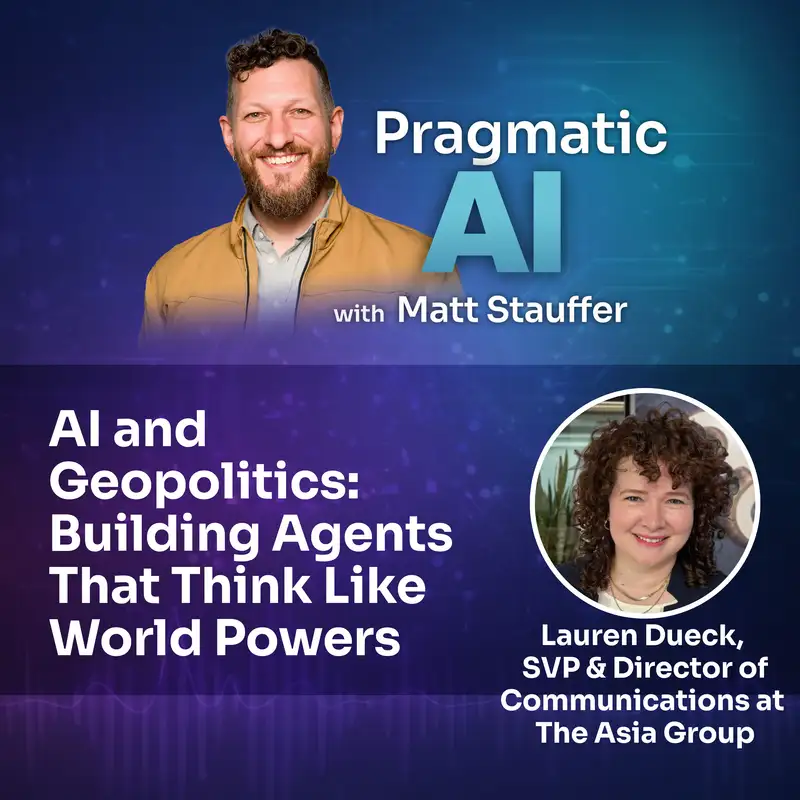
AI and Geopolitics: Building Agents That Think Like World Powers
The Pragmatic AI Podcast is sponsored by Tighten.
T-I-G-H-T-E-N.
We will take your AI ideas, prototypes, or even vibe-coded apps,
and we'll take them to production.
Scalable and secure. Check us out at tighten.com.
Hey, and welcome back to Pragmatic AI, where we talk about using AI in the real world,
what works, how to use it well, and what it causes more harm than good, practical tools
and real trade-offs for builders and business leaders.
And my guest today is Lauren Dewick, uh director of communications of the Asia Group.
But also I just realized I keep introducing people as like my old friend and you know,
like these are people I've known forever.
But I think you are the person I've known longer than maybe anybody else in this podcast,
because we've known each other since 2000.
Yeah.
thousand nine?
Yeah, a long time.
Another lifetime.
Two lifetimes ago.
Yeah, exactly.
So anyway, Lauren, thank you so much for coming to hang out.
would you mind saying hi to the people and tell a little bit about uh who you are and what
you do?
Yeah, of course.
Well, Matt Matt, first off, thanks so much for having me.
It's really lovely to reconnect in this way.
As you mentioned, I'm the director of communications at the Asia Group, which is a
geopolitical consulting firm based in Washington, DC, with 14 offices around Asia.
And our job is to help companies and business leaders navigate geopolitical moments and
geopolitical crises.
So take advantage of opportunities to navigate risks.
And my job within that context is to help communicate uh where geopolitical risks are
headed and how
our expertise can be useful to people in the real world.
Okay.
Um there's so many things to talk about, but I do just want to make sure that the people
who don't have your LinkedIn open in a side tab also are aware of the fact that recently
you've also been director of communications for the NOAA Satellite and Information
Service, natural so we're talking national weather folks, the director of communications
strategic strategic initiatives for the Office of Community Services at the US Department
of Health and Human Services.
Uh and and on and on and on.
Carnegie and Gowament for International Peace.
I remember there was some nuclear
things at some point.
So you have been doing these communications policy related, uh, you know, like things for
quite a while at quite senior levels.
Before we even talk about AI and its its impact there, I just kind of want to talk through
like what does what leads you to a place of being at such a senior level
at such large organizations, because I think we need to understand, like as we're talking
about how AI impacts your day-to-day world, I want to understand what is your world,
right?
Uh and not to say that they're not important people listening to the podcast, but you were
probably the most nationally prominent person that's ever been on the podcast.
And so I'm just curious about like what's your world like being in a in a role like that.
Yeah, I mean, good question.
I I've been really privileged to be in a lot of really interesting places with lots of
really interesting people and the reason I like doing my job and I think what makes me
good at it and probably what makes me good at and interested in AI too, is that I'm really
curious.
Um
I really love learning new things.
I love learning new things from experts.
Um and the cool thing about my job is I'm in all of these positions where I'm I'm I'm not
the expert, but I get to work with the leading expert in a given field.
So I get to work with nuclear scientists, I get to work with, you know, atmospheric
scientists and satellite developers and builders and um public health officials and all
these sorts of things and listen to them really well, think about and understand their
work and why it matters and what is most important to them, and then figure out how to
communicate.
That to other people who, like me, are smart, interested, and curious, but don't
necessarily have the opportunity to sit down with that expert for 20 minutes to talk it
through.
So the thing I love about my job and the different places that I've been able to do it is
that I get to work with so many fascinating people who have decades of experience in some
of the most interesting and complex issues in the world.
And I get to have a front row, front-row seat with those people and help more people
understand why that work matters, how it matters to their daily
and what they should be doing in light of sort of all the things that these experts know
and navigate on a daily basis.
So yeah, so it's it's a it's a really, really fascinating place to work.
it's a fascinating career to pursue and I'm really grateful that I've gotten the chance to
do it.
Yeah, I appreciate you sharing that.
I mean, we talked a little bit before the podcast about how I felt myself un unexpectedly
aligned with what you're saying.
I'm like, Yeah, I'm I'm the guy who understands complicated programming concepts and tries
to retell them in a way that everybody can understand so that newcomers can onboard into
our world of technology.
But I hadn't really kind of labeled it until you said yours.
And I'm like, Yeah, that's I like doing that too.
So um but let's talk about the Asia group because again, everything's gonna be in the
context of the Asia group.
So if
I think it'd be a lot easier if you were at NOAA to say, Okay, we understand what NOAA
does, you know, but what does the Asia group do s that you're communicating about?
Yeah, so the Asia Group, you know, our job is to work with the world's top companies and
to help them uh navigate the geo various geopolitical moments of our time.
And as I'm sure you can imagine, given the geopolitics of today, that is a an in-demand
skill set.
So we have we hire the best people and the best experts, um, many from from all across
disciplines, many former government officials, people from various industries, and we
bring them on board with the goal of understanding the geopolitical moment we're in and
working with.
With our clients to help them make the best decisions for their business in those moments,
especially across cultures, right?
So our expertise is in Asia, although we are that is broadening.
We just recently opened an office in the Gulf.
We have a new Europe program that we've recently launched.
So uh our view is that the Indo-Pacific is the most important region in the world for the
global economy.
It is the engine of the global economy, it will lead the future.
And so as businesses navigate the situation in Asia, the geopolitics of Asia, the
complex you know countries and and um economies of the region uh that will help them
navigate sort of the future of the business.
So uh that's where we're at, that's what we do, and it's a fascinating region to work on.
Yeah.
And so you are a director of communications.
So uh it's not director of marketing, but what does a director of communications do?
Obviously that's distinct from marketing, like who who are you targeting with your kind of
communications?
Yeah, great question.
So a lot of what I do is I work with media because of the nature of the experts that come
to tag, they have expertise that is obviously incredibly pertinent to our clients, but
it's also pretty pertinent to reporters and journalists and influential thinkers.
ah And so what I do is I help reporters understand, you know, what is the expertise that
various people that I work with can bring to bear.
Um if they have a question about, you know, how should we understand a new tariff policy
that the the Trump administration has passed?
Or, you know, what are the implications, for example, of the closure of the Strait of
Hormuz for sulfur flows, which you had never think are important, or I wouldn't have
thought were important.
But sulfur, it turns out, is crucially important for making sulfuric acid, which is an
essential component for developing critical minerals and mining and refining critical
minerals, which is that a hugely important uh industry for many reasons, but not least of
which is electrification, uh you know, clean energy.
energy build out AI infrastructure and data centers.
So you know
as as reporters have questions about that, I connect them with the right expert who can
give sort of their the information that needs to go into those stories so that they're
useful uh beyond our client set.
And then the cool thing about that is our our clients and prospective clients hopefully
also get to see the kind of expertise that we can bring to bear for their business
interests and in that sense, hire us, right?
It does it has a marketing impact.
Yeah, that's absolutely true.
Um but it's more focused on sort of the big ideas, the big policy questions and thinking
about, you know, how do we demonstrate
Our work on a on a on a big scale so that the companies and the business leaders that we
hope will want to hire us can come in the door.
Yeah.
was really clear.
It's like it's almost like it's your job to communicate things very clearly.
I am I imagine we probably ha at least have kind of like three prongs of the conversation
around AI.
And one of them is what I do with everybody.
Like what is AI, you know, the w in introduction of AI into your personal life look like.
Um but from a business perspective, I imagine you have at least two.
One of which is what a lot of people were grappling with it, which is uh how do I continue
to do the same job I was doing before, but now incorporate AI?
But another one is what are the offerings of the organization I'm working with uh that now
take advantage of AI?
And you know, I I'll have a sneak preview that I know that that's something you all are
doing in general, but I do want to start with the personal so we can kind of have some
background.
You already mentioned that you're curious.
Um, you are always trying new things.
So I definitely have been imagining you as an early adopter and you know you use Chat GPT
when it launched and all kind of stuff, but I'm I'm curious, like what has your personal
experience with learning AI and LLMs and other tools like that been?
And like what's the history there?
Yeah, no, good question.
It's taken a lot of sort of twists and turns, as you can imagine.
I think one of one of the disadvantages of being an early adopter is that I got to see it
when it was kind of bad.
So like some of my early experiences um were not necessarily the most exciting.
Yeah.
but I think the value of being curious and being able to admit when you're wrong is that
you can keep coming back to it and say, okay, well let me try again with fresh eyes and
see what's happened and and that has been uh an advantage for me because it has my my use
has changed over time and like many people I think the thing that really was the moment
where I was like, okay, yep, I can see this for daily use for more than just like a search
engine substitute um was uh Claude Co-work, right?
Um and that was sort of the version where I was like, okay, yep, I see how this works.
And the way I have used it professionally has been candidly, you know, I'm a lean team of
one and a half people.
Um and so
uh what I have used it it for is to basically be an assistant to organize my junk files,
right?
To like and that's that's sort of where I started was to say like, okay, how can I the
stuff that I just will never get onto my to do list of things that need to happen, how can
I make it useful and sort of optimize in those ways?
Um down to I was w launching a really big project.
This is a very silly use of AI, but I d I I I swear it is true.
I was launching a really big project a week ago, had a ton
Just like crazy hours, was working a ton, and I just had no decision-making capability
left.
And so I opened Claude and I was like, Claude, find me lunch at this location.
It needs to have these parameters, right?
X, you know, high protein, high fiber, whatever.
Pick me something.
And so it's like, okay, here we go.
And then it gave me a restaurant, and I was like, no, I want a menu item.
And so, and so then I I I no, I just don't want to make a choice at all.
And it looked at
It was like, yep.
And so then I went downstairs and I ordered that thing and I ate it and it was great.
And so, like, I do use it as someone I have to make a lot of decisions a lot of the time.
And if there are like low-cost decisions that I can eliminate, like that is one of the
ways that you know it's cheesy, but it is actually like a really practical use.
Similarly, right?
Like, I use it when I'm doing a lot of comparative shopping.
Like, I was trying to buy hiking shoes for a trip I have coming up, and just going through
all the various websites.
And I don't necessarily use it to like tell me what to buy, but I will screenshot a
selection of items and say compare these for me.
Like what are the pros, what are the cons?
What's the best buy?
What's the best deal?
Because it just saves me so much time in terms of like the manual work of digging through
the internet to try and find better offers.
So those are like, you know, dis uh reducing decision fatigue has been a major use of AI
for me.
Love that.
Yeah.
And and then consolidating information, synthesizing information, um
Typically I I don't tend to rely on it for um just like a raw output.
So I don't tend to come in and ask just ask it a generic question and then trust the
output.
But what I will do is I will upload very dense reports and say, compare these two
documents, tell me what the differences are are between them, like what are the main
takeaways.
because one of my core learnings about AI is that the outputs are only good as the prompt,
right?
and
And the more generic the prompt, the less useful the output, at least in my field, which
relies on a high degree of specificity and clarity.
And so I tend to make sure that when I am when I am using it, especially for anything
that's higher stakes, I'm I'm thinking carefully about how I'm prompting, I'm putting in
good inputs, I'm giving it good comparisons, and I have a degree of faith and fidelity in
the output because I know what the input was, if that makes sense.
Yeah, hundred percent.
And I mean if you don't have the inputs yourself, then you're relying on either A, what
it's trained with, or B its ability to search effectively and get the results it needs.
And if you've used them at all, you know that both of those are limited, you know.
I did that comparison shopping literally this morning and I once again I really appreciate
the way that you're putting language to something that I know but didn't have the words
for 'cause yeah, uh I decision reducing decision fatigue is not something people talk
about often enough.
Because usually if we're having a conversation around AI making decisions, we're talking
about how you shouldn't outsource AI you're thinking AI, which is true, but I'm perfectly
happy to outsource the the choice of which travel protein powder I'm going to pick when
I've got a full day ahead of me and I need to make that decision this morning before I go
on a trip next week.
And I'm just like, I didn't have to decide.
I just said I literally went to Amazon, typed the thing, screenshotted it, pasted it into
Chat GPT exactly as you said.
And I got some protein powder that's in the mail and I don't have to think about it.
So
hundred percent.
And like and being able to sort of I I think w what you what you one theme you'll hear
from me is that I think that AI is an incredibly useful tool and the important thing about
tools is knowing how they work and knowing how to use them.
Right?
So it's not like it's not a panacea, it's not the solution to all problems, but yeah, man,
there's some low stakes decisions that I don't have to make.
Yeah, let's do it.
Yeah, a hundred percent.
Absolutely.
I love that.
Um, yeah, I harp heavily on the tool thing because I'm like, just like any tool, it's
useful for things.
But if you, you know, we we joke in our programming community, if you you're holding a
hammer, then everything looks like a nail.
And people have been doing okay, so people have been talking about that with AI and I
like, no, it there's it and the problem is, the difficulty is a, of course a lot of people
think it should solve everything in AGI, but the second problem is you only know what it's
good at by
By using it.
Nobody can tell you.
There is an intuitive understanding from having taken experience with it.
So the people most critical are the people most infrequently using it.
And it seems so absurd to say, just use it, trust me.
And yet there is an element of just like you only understand how to prompt it for your
specific needs well when you have had that experience trying out and figuring out what
works and what doesn't and being curious about it.
Yeah, 100%.
And I think one of the one of the big props I'll give to my own company, the Asia Group,
is that as we were moving towards sort of being an an AI forward firm, consulting firm,
which is we can talk about AI and consulting, which is a whole thing.
But uh one of the things that that the company did is that they realized that this is
going to be a really crucial tool for all of us, no matter your level, no matter what
space you're in, it's gonna be a really crucial tool, so you need to learn how to use it.
So they hosted a 10-week training session where we had different experts from
Different parts of the company come in and talk about what the AI is, how it works,
different prompting strategies, and then specific use cases, right?
So, like how do you use AI for writing, and how do you know uh if the AI is an author or
if you're the author, and how do you make sure that you're not sort of just falling into
the laziest use case because you haven't, you know, understood how to most effectively use
it.
And I think, you know, this is again a very uh specific example, but I'm I'm also like a
fiber artist.
So I
I do a lot of like knitting and crocheting and handiwork.
And one of the things that, you know, when you learn a new technique um in something
you've done before, like it takes practice.
You don't just sort of automatically look at a sweater and go, yes, I know how to make
that.
You have to read a pattern.
You have to sometimes look up, you know, YouTube tutorials to see how a certain stitch is
made.
And in a similar vein, right?
Like you, to your point, you have to try it and you have to intentionally learn about it.
And you can't just sort of plop it on your desk and expect it to work for you if you
haven't put in the work to sort of be a good user.
And I think that um
that AI as a tool is is like particularly important when you're thinking about the
geopolitical space because to the point of inputs and outputs, right?
Like one of the things that I find a lot when I'm using it for research or for, you know,
drafting documents, which I almost I I almost never put out a document that and I just
don't say I shouldn't say almost never, I never put out a document that is fully AI
drafted.
There's always human review.
But one of the things that I found is that I actually can't just ask Claude for example
example to draft something for me because one of the things that's really important in
geopolitical events is timelines and AI is very bad at telling time.
And so I'll give an example.
I was drafting uh a pitch or press release for this report that we published last week
about this the the the conflict of the Strait of Hormuz and sort of its consequences for
Asia.
uh
And the training data that my version of Claude has expired or ended, I think, in like the
fall of 2025.
And I've gotten that prompt several times.
Like this is, you know, the training.
So I every time now, before I use it to generate any sort of text for me to look at or
start with, I will first tell it to research the events of at the conflict of the Strait
of Hormuz since February of 2026 to assess and then give me a readout before I even tell
it to do anything.
Re research this, assess the current situation, look at the
major dynamics and sometimes I'll say, right, look at the economic implications.
Sometimes I'll say look at the military implications.
uh But and before I even give it the prompt of what I want it to do, I almost sort of
pre-fill its its working memory with current events.
Because otherwise it's very bad at telling time and it's very bad at um knowing what
really matters in a given situation.
um So to the point of inputs, right, like you really have to draw that out to make sure
that the what it's working from is
is good enough for the kind of output that you're looking for.
Well, and it's fun because speaking of the experience of learning how to work with the
thing, so you did that you're you know, it probably took a couple times of realizing it's
it had the cutoff date and realizing we weren't getting stuff to figure out that first
step of a prompt.
But the prompt you gave it the first time to research it probably got better over time,
and the prompt you're giving it today might be different.
And you might eventually build a skill or you might even build like a local markdown
document that is the results of that prompt.
So next time you'll say
Hey, go just go read this document.
It's gonna give you everything you need to be up to speed.
And that's what the experience of working with these things looks like is you just that's
a skill, right?
A s not a not a Claude skill, but a personal skill.
Yeah, well and this is actually like my summer project that I haven't had a chance to work
on yet, but my summer project is like I need to do like one of those like six or eight
hour
you know, YouTube videos that's like, here's all the best, like here's the skills you
gotta build in Claude or here's the things so that I can so that I don't have to do it
every time.
Cause right now I'm sort of hacking it.
I know that there are tools built in to work better, but I haven't figured out how to use
them yet.
So I wanna make sure that um and again to the point of like I need to have trust in the
information that I'm getting out.
And and so I'm I'm probably a little bit more controlling than I should be.
Um but
I mean or not.
Yeah.
yeah, one of the things that I'm enjoying a lot right now is discovering that uh 'cause a
lot of people are afraid of there's there's there's a lot of fear, right?
Like I'm gonna lose my job or whatever else.
And so one of the things that I'm really enjoying is the way that AI enables people to do
the thing that they love doing, the thing that they're paid to do, in a way that they
couldn't beforehand.
Um and so for example
previous episode I or one of my previous episodes I had the VA on and she talked about how
she can do more for her clients than she could before.
As a programmer, I'm often thinking about how can I enable people to use AI better because
of things I'm capable of doing.
So you said that my first thought was like, well we'll build a little tool locally that,
you know, just runs on your computer or runs on l some local server that is running
through the prompts that you want, set up a skill for you, and I'll use my programming
expertise and but it's gonna take two hours.
to do something that only I can do, to set you up so you can do things that only you can
do.
I'm like, this is so fun, right?
Like there's so many opportunities for creativity and problem solving here because it's
not a defined answer here, right?
That's right.
That's right.
And and one of the ways I'm gonna borrow a a line from from Hank Green now, the way that
he talks about, noted science communicator, Hank Green.
he talks about uh AI as like i it we're still in the experimental phase, right?
and I think that's one of the things that I see in the public discourse and in the
marketplace about it that's a little bit I don't think it's commonly understood, but my
sense of it is
It's still we're s it's still new.
It's still early.
Like
And and Silicon Valley will tell you no you're five years behind or they'll have all sorts
of doomsay things about this and um and I'm sure that there are aspects of truth to that,
but I don't think any of us really know yet what a fully AI empowered world is gonna look
like in the same way that like in two thousand one no one really knew what the internet
was gonna look like in twenty twenty six, you know?
People had lots of ideas, some of the ideas were right, some of them were wrong, some of
them went really well, some of them failed.
And I just I I feel like that's where we're at with um
with AI as well, right?
We're in the early phases where we just don't know yet exactly what it's gonna look like
and some things are gonna go well and some things are not.
It's gonna have lots of consequences.
But it's I I'm a little skeptical of the folks who
are either who say that it's going to ruin everything or it's going to destroy the economy
um or it's going to destroy jobs, although I'm sure it will destroy some jobs, right?
at the same time, I'm skeptical of the folks who are like, this is the entryway to
paradise and now you'll only have to work four hours a day.
Cause that's just like that's just not how humans are or how society operates.
So I just, you know, I think
I'm treating it in my own life as an experiment and as a tool that I can get better at.
And some use cases are gonna go well and some use cases aren't.
And candidly, I'm gonna have to change the way I use it in six months to a year because
the product is changing, the tools are changing.
and so what I use now and the skills I build now are gonna have to continue to remain
flexible for, you know, the foreseeable future because these things are all gonna change.
So
Yeah.
A hundred percent.
Um, I want to talk about this further, but I think we should probably switch to talking a
little bit about you mentioned kind of AI and consulting.
And I know at least part of that for you guys is building AI-based tooling.
But I before we even kind of dive down that road, I'm a consultant in a uh of of a of a
form, you're a consultant of a form, and I talk to a lot of other um agency owners who are
more kind of in the tech space, and everybody's still trying to figure out like where AI
should play a role.
I do think a lot of the agency owner questions are usually like
If we're now ten times faster, how do we charge?
Or a lot of those kind of how do I get my staff to d agree to use these things?
And is there a point at which people should be let go if they're not choosing to adopt
these things?
Uh, I'm curious in your world, because we're not exactly the same type of consultant, uh
what what are the do you see any kind of like broad shifts to the way that AI has impacted
consulting as a whole for y'all?
So good question.
you're right in that, you know, certainly the there's a lot of conversation about the
impacts of AI.
I think especially for the big, you know, the big four firms, like the big professional
services firms, and they have obviously started to make a lot of moves toward that.
I think
In the space where we operate, which is uh adjacent but slightly different in geopolitical
consulting, you know, we are we have certainly fully embraced AI as a company, and it has
changed a lot of the ways in which we operate, um, both in terms of you know um
efficiencies internally, you know, automation of certain products uh and processes, uh,
especially for internal uses.
Um, but the other thing is that I think geopolitical consulting is a little bit of a
unique bear, right?
Because the work of Geo
Politics is inherently human, right?
It is the conversations that happen between individual people who then go and make
decisions on the basis of those conversations.
So my maybe contrarian take on how AI will impact our industry in particular is I actually
think that it's going to make human expertise more valuable and more expensive and more
elite, right?
uh Because while I think
think it will make geopolitical analysis more plentiful because it'll lower barriers to
entry for a lot of folks, for writing and, you know, content and that sort of thing.
But I think that it will make real insight and wisdom, um
Yes.
Yeah.
therefore in higher demand and more expensive.
So the people who actually have the on-the-ground experience, right?
The diplomats I work with, you know, my one of my bosses is Kurt Campbell.
He's a former deputy secretary of state in the Biden administration.
He's got decades of experience.
He is he's known for um the pivot to Asia, right, in the Biden administration in the sorry
in the Obama administration, where talking about like how we needed to start paying
attention to the Indo-Pacific as a country with our foreign policy.
That his expertise
will never be substitutable um with AI.
And the kind of information that he has is not found on the internet, right?
so my contrarian take is that as much as that one, the AI will come into the industry, it
will make many changes to the industry.
I think it will make many changes, especially to the jobs of folks at
at the entry level and mid-level, like how they work and the kind of work that they do.
But I think that it will make human expertise increasingly valuable, increasingly
important.
Because there's gonna you're gonna people, business leaders are gonna need to find ways to
cut through the noise and figure out what's real and what's not real.
and the only way to do that in this space specifically is with the people who are in the
room, the people who are having the conversation and who've had the handshake and who can
make the call to, you know, to the policymaker and say, hey, what's going on?
What are you thinking?
right?
Those are the sorts of those are the sorts of things that just you can't replicate with
AI.
And I don't think you'll I don't think it will ever be able to.
um So that's my take on at least my sort of small corner of the consulting world.
I mean, I agree.
one of the things I've been saying a lot to people is, I mean it's I don't wanna just
resay everything you just said, but in our world.
But yeah, like the the more uh fungible your work is, uh, with other people doing the
exact same thing, the more likely you are to be replaced.
If you are turning widgets, whether it's in programming or in writing or whatever else,
then yeah, the AI can turn widgets better, faster, cheaper.
Uh if you were bringing unique human perspective
from experience and uh from your intelligence and from your expertise, then AI is not
gonna be able to do that.
And it's it's really not aiming to do that particularly.
It's it's it's more about generalist capabilities.
and so yeah, we've said the same thing.
We we haven't been established as an expert firm since since day one.
Our thing has been, you know, we might be a little pricier than somebody else, but you
know, you know no matter what that when you come to Tighten you are gonna get the absolute
best output from the people who speak at the conferences, write the books, right?
Like like lead the things.
And so when you need that, you come to us and you don't always need that and you might
just, you know, whatever.
And so I've often said like we're we are switching from being the experts that manage uh
you know cheap offshore work to the e experts that manage AI work.
But in the end, we're still managing and getting you at you when you're at the point where
you really kind of need the best of the best.
And so that doesn't mean that nobody's gonna have a negative impact, right?
There the people who are not expert does d doesn't mean that they shouldn't be considered.
but I do hope it's a a space for them to shift into something that focuses more on their
expertise because anytime you're fungible, you're gonna be replaced by whatever's cheaper,
right?
That's what fungibility literally just means uh a race to the bottom in terms of price.
And so maybe you got replaced by an AI instead of someone who came along and offered the
the stuff a little bit cheaper, but in the end, fungibility is not a way to to keep a
effective kind of like a especially in the consulting world kind of gig.
So I don't think it's just your section of the world.
I think this is a pretty universal thing.
Okay.
That's that's good to know.
I mean, and I think, you know, to the I I am worried from a macro level, this is not this
is not specific to my company at all, but I am worried about what happens to the to the
fresh college grads and right, I have two kids and luckily they're a lot younger, so I
I've decided the world is gonna look very different by the time they're old enough that I
have to worry about it.
So I'm not I've decided not to ha to bring that anxiety on myself for now.
But I do think that like the kind of work that um
that I was doing in my twenties, right?
Which was, you know
database coordination and management, which is important stuff.
You gotta do it, you gotta figure it out, you gotta make it happen.
Like that is gonna change a lot.
And I think making sure that um or finding ways that we as a country, as companies, are
thinking about how do you develop that next generation of talent.
Because the last thing you want to do is cut that off at the knees, right?
And then when your established experts retire or move on, like you don't have a backbench,
right?
So we're gonna have to change the way that we think about building expertise and building
the next generation of experts.
m But I yeah, I just I I really just don't think it's gonna um I I don't think there's a
world in which expertise goes away.
In fact I think it becomes more important.
No.
okay.
Uh because we're as far along as we are, I do now want to give some space for you to talk
about the actual tooling that you all are building.
I know you're working on AI powered stuff.
Yes.
So please please tell us about this project.
a beautiful transition because I think, you know, to the point of
what we've talked about already, you know, your outputs only go to your inputs, the need
for experts to weigh in on what's actually happening on the ground, on the way that people
react.
You know, we are really thinking hard about how do we bring together an AI empowered AI
forward firm with the scale and scope of the human expertise we have.
So um one of the projects that we worked on and and also sorry, just before I get to that
Noting that what AI is really good at is harnessing and leveraging lots of information.
Um
And making it manageable, right?
So one of the things that's a common happening, uh a thing that happens in in both in
government but also in in companies is war gaming, right?
Especially geopolitical war gaming.
So the idea of like, let's take a given scenario, let's play out what might happen, right?
Let's play out what might happen.
the classic example, the reason it gets his name is the military does this to say, okay,
so what would happen in a conflict with Taiwan, for example?
but what we have started to do is you started to say, okay, well what would happen if what
what if we could take our experts who know how these different countries work, who know
the intricacies of the various power players in country, um, both you know their
preferences, their what levers they have, the ways in which they impact and influence each
other.
What if we could build agents that were have a lot of fidelity to sort of how these actors
behave in real life based off of the inputs of our human experts?
And we could build agents that can then simulate out what might happen in a given
situation, how those players might respond.
uh And so we we did this recently.
I've mentioned this a couple times.
We issued a big report a couple weeks last week, excuse me, called No Safe Harbor, the
Asia's continued exposure to the volatility in the Strait of Hormuz, where we looked at uh
two countries.
We looked at South Korea and then we looked at India.
And in both situations, we modeled the behavior, we simulated the behavior of major
power players, so you know, heads of government, parliaments, um the Reserve Bank of India
was one of them, uh, major corporations, small and medium-sized enterprises.
Five we modeled five players in the case of India and four in the case of South Korea.
And we simulated what would happen and how they could how they might respond.
uh
In the case of an extended closure in Hormuz.
So what if a month ago when we were coming up with this project, it was a crazy idea
because we had just signed the MOU?
What if the can what if the conflict continued?
I don't know if you're following the news, but Iran did strike a ship this morning.
So we were we were quite prescient that the conflict, or at least the disruptions in
Hormuz, will continue.
So what if instead of resolving quickly, they continued for the next six months?
So we modeled doubt behavior bit from mid-June to mid-December.
And we had these basically these agents interact with again the parameters that had been
set up by our human experts, who also, of course, defined the terms of the conflict and
what sort of commodities you're watching.
And what what we found was really interesting, because we were able to run this not just
once, which most of the time when you run a war game like this, you lock a bunch of
experts in a room, they play for a day, and they have one scenario that they've modeled
out.
But we were able to run it 50 times because again, we could harness the AI to run the
simulation out.
And what we
Saw is we were then able to say, like, okay, in every single turn, for example, this actor
did this thing, right?
In ever or in, but in 30% of turns, they did this other thing.
So we could model then not just one outcome, but like 50 plausible futures and look at the
spread of how what was more likely, what was less likely, what were outlier scenarios that
were nevertheless concerning to look at.
And because we built this, again, with those human experts who know the geopolitics.
Of the situation so deeply, it really provided a value add, right?
They they were able to look at this and assess, yes, okay, yep, these are the things that
we could see happening.
Here is an indicator that things might be going off the rails.
And I just think it's a really fascinating example of how you can bring to bear the kind
of experts that I work with, the e the expertise that they uniquely have, with the kind of
scale that you can achieve with AI.
Um
And and and that sort of agentified simulation was so interesting to watch play out.
And I think that that's something that's something we're, you know, thinking about
bringing how do we bring this to bear for our clients.
Um, but I also think it's a really good s case study of
using AI as a tool in the context of a very complex but also intensely personal to my
earlier point, interpersonal discipline like geopolitics.
which was it was it was really fascinating.
And in both cases, for what it's worth, we found out that both countries managed the
crisis really well with lots of stockpile and reserves until about mid-September.
And then when, especially in South Korea winter heating season became an issue.
And in in India it was a food crisis, but like mid September is sort of the point when
things start to look a little rough.
I'm fascinated by this in so many ways.
The first one is Did I understand correctly that there is an independent agent
representing each of those players?
And you train that agent to basically look at the behavior, public statements of these
players, and like this person or this bank or this whatever would, based on everything we
know, probably you and or I guess you wouldn't say you'd say here's what you know about
it, and then you'd feed it scenarios and say, What would you do as the bank of whatever in
the scenario?
sort of.
So what we did is we basically provided
Um to the game, right?
The c a context document, which is like here's the situation at the Strait of Hormuz, here
are the commodities that are constrained, sort of the status quo going into the going into
the simulation.
And then for each a for each agent, we build a dossier for the for the entity that they
were representing.
That included, you know, their preferences, their limitations, their levers of power, like
what do they have power to influence?
For example, Reserve Bank of Ind of India can raise interest rates.
Um, for example, the Blue House in Korea cares a lot.
about inflation, um but can't actually directly impact interest rates.
And so then we had those, so each of these each of these players had, and to be clear, I
should clarify this, we ran one simulation for India, so it was within the borders of
India.
We ran another simulation for South Korea, so they didn't overlap in that way.
um
But yes, and then each of those agents interacted.
So there's actually like when I I go to our engineers and they show me the back end,
there's actually like little chats going back and forth with the various things that
they're doing.
And then there is a an adjudicator agent who sort of at the end of each turn re you know
says, okay, here's here's the reality in the world based now, based off of the decisions
that you made.
And then the other thing I think is really interesting is in talk is as our team was
developing this.
We had to recognize that like the the situation in the strait is subject to a good degree
of randomness, right?
There's people making decisions there who were not necessarily the most predictable, shall
we say.
Um there are events that are happening that, you know, are not necessarily within anyone
with within anyone's control.
So basically the way they set this up is they ran it for six turns.
Each turn was a month long, and at the beginning of each turn, there was sort of a random
factor built in to either improve or deteriorate the situation by some margin.
amount within a standard deviation to account for sort of that randomness of the real
situation on the ground.
So it took a it it takes a and this is I think going back to the question of what kind of
work you know newer, younger staff in in my industry could be doing.
I think this is such an interesting example because instead of you know generating a
generic re writing a generic report about or a memo about what, you know, what
something has happened in geopolitics, this could this is this could be the sort of thing
that they're working on, which is like, okay, how do we build in realistic parameters for
a simulation like this that means that there's some degree of, you know, familiarity and
some degree of realism to what to the outputs.
Hmm.
Um
What I love is when I have a conversation and I'm like, I wanna get off the call and do
something like that now.
I'm just like, I don't even I don't even know what it would be.
But that is such a fun concept and the idea of and there's so many pieces.
There's the expertise of the people who are able to train it.
There's the vision of the y'all who came up with this thing and were able to say, Well,
they would have to talk together in this way.
There's the the technical know-how to be able to
train LLMs, to have them talk to each other, to expose their conversations in a way that
you all, you know, kind of are able to see them.
The adjudicator agent that you mentioned, there's so much expertise and so many different
pieces there that again, I don't ever want to be reductionist, but to say, we're all going
to lose our jobs and to see everything that's going on, that's that's human excellence
right there, right?
Like, yeah, it's facilitating the operation of of AI, but none of that happens without
brilliant
Curious, creative, experienced human beings all throwing their brains together to do
something new and fun.
And I'm like, I just love that.
That's that's that's what I want to see it doing.
That and of course reducing my decision fatigue.
the other thing is I I asked our engineers yesterday to give me a peek in inside the the
tool and it the different agents would have like back channels with each other.
So they would make like official statements, but then they would also have back channel
conversations.
But like, so if you guys are gonna do this, I think we should do this.
It's like it was very it was very it was very cool.
It was very creative.
It it cr it just produces
And this is I think a beaut the beautiful synthesis, right?
Because it is the scale that we can achieve with this in terms of giving our clients
better information, more fidelity, right?
Like but it's also like it challenges our own thinking, right?
Like, um
And it helps us be more creative about like what are the unique and interesting ways in
which our you know, we haven't considered how how we could approach a problem like this.
So yeah, it's I think it's a really it's a really interesting and cool example of how um
of how we are at least trying to bring together, you know, second to none human experts
with with AI.
Um, so I have some questions I I like to generally ask folks, and I think I probably have
a guess for the answers in some of these, but I want to poke anyway.
What do you think about the future of the human race as a result of AI?
Do you think this is a net positive, a net negative?
I don't think you do the thing that, but like, do you think it's mixed?
Like, what are you concerned about?
What are you excited about?
Not just in the specific world that you're in, but as as especially as in you're in
geopolitics, but just also as human and a parent and stuff like that.
Like, how do you feel about the impact of AI on our world?
Yeah.
I I think it's mixed, right?
Um I think it brings a lot of advantages and it's a it's it is a generationally
transformative tool.
I don't know if generational is the right scale there, but it is a transformative tool.
It will change the way that we operate.
It brings with it so many advantages and the capability to do things that we hadn't done
before.
Mm-hmm.
it brings with it all of the shortfalls and the downfalls and the tragedies that we've
seen with other major technological changes in innovation.
So I don't think it's exempt from any of those.
I am a skeptic of both the messianic claims about AI and the fatalistic claims about AI,
partially because like
I think I have a decent grasp of how humans operate and the way that societies behave.
And I think the messianic claims are overly optimistic and and are often motivated by
financial profit motivations, right?
The people who are making those claims have other motivations behind making them.
And then the fatalistic ones, like I just don't I
I don't think that we as a society and I guess we're not talking about one society if
we're talking about the human race, but like people don't tend to just let those the worst
things happen all the time, right?
And I think that we will find new ways of coping and understanding and mitigating some of
the harms um that inevitably will come from AI.
And there will at the same time be really big and real damage that it does.
Um
And it will take up it will take time to understand and to mitigate, right?
So in my space, one of the things I think a lot about is misinformation.
in the communication space, right?
Fake deep fakes and all of the damage that those things can do.
I think, um
We are probably approaching the phase of maximum damage that those things will have
because we haven't yet really built the cultural cognizance and awareness of deep fakes
and the kinds of things that we need to be cautious about.
It's it's changing more, right?
Like people are still suspicious of things that seem AI generated, but we don't quite have
that intrinsic like mm question mark that comes up for us yet.
That will change.
We'll get better at that.
Yeah.
But we're gonna the the the the period of time between now and normalization, whatever
that looks like, is gonna be long and it's gonna be difficult.
but I think the conversation that we'll be having in ten years or fifteen years will be
very different and the world will look very different than it does right now.
Yeah.
with kids, uh are you excited about their interactions with AI in any way, shape or form?
Are there any positives there?
It's a good question.
ah my kids are very young.
I have a two year old and an almost five year old.
Um so they have minimal interactions with AI.
But the thing the one I will say th when they watch like YouTube videos, there's a bunch
of YouTube channels out there that now have like clearly AI generated like m knockoffs of
Paw Patrol or whatever.
I don't know if you've ever seen them, but they're so weird.
I believe it.
you think that slop like this is the sloppiest slop.
so like that part I'm not excited about.
I think, you know I I I'm grateful for the fact that my kids are the ages that they are
because I do think even in five years, w I hope
But I think we'll in five years we'll have better ways of understanding and coping with um
all of the transformation that this brings for education, for, you know, civic life, all
those sorts of things.
And to be honest, like, yeah, I've decided I'm not gonna worry about it yet because it's
not like it it it's it's something that will change.
Yeah.
Yeah, yeah.
You know, I I
good.
think I'm excited about like the new horizons that it could open for them, right?
Like there's so many fascinating applications of of AI for science, for research.
and I think we're gonna have a whole new era of sort of human discovery, which will be
really fascinating.
And that will be that that part of its presence in their lives will be something that is
exciting, right?
So yes, I'm excited about that for them for the future.
maybe not for their immediate interactions with it.
I think I wanna I want it to get a little bit I want them to get a little bit older.
I want to be able to do a little bit more thinking and experimenting myself so that I can
guide them more effectively in navigating a world filled with AI.
Yeah.
I hear you.
I mean my kids are nine and thirteen, so they're not at the my god, am I they are they
gonna get a job, but they are in the especially in high school, you know, like uh are they
gonna be tempted to use this instead of doing their actual work or you know, like we know
people who whose kids have like almost romantic relationships with an AI chat, you know,
like what how do you feel about those things?
So yeah, there's a lot of things to be scared about, which is one of the reasons why I'm
like, what can I be helpful about?
And I love your your telling there 'cause the the there's
Plenty to criticize the maximalists for.
Um, but one of the things that they do well is point to the fact that there are actual
practical benefits that are happening in in scientific uh advancement and other types of
research as a result of AI.
And so it's it's nice to be able to say, I am concerned and critical, and also I celebrate
these things and and I'm happy that they're they're gonna be a part of my kids' lives.
Yeah, yeah, I think that's right.
I'm I'm I'm working to channel that optimism for them.
And I don't I think one of the things I would hope is that they're not scared of it,
right?
Um, but that they see it again as a tool that they can use to expand their minds, to
learn, to grow, to try new things, and all the things you want for your kids, right?
And so I think as they get a little bit older, that will be a conversation an ongoing
conversation that I'm gonna wanna have with them over time.
Yeah.
so at the end of the podcast, you know I read something from the community, but before we
go there, I just want to check in.
Are are there any topics you wanted to cover about AI that we didn't and or is there
anything where you're just like, you know what, if if people take one thing away from, you
know, like from what my experience with AI is or what I think people should try, is there
anything that you're like if you listen to one thing, it's this one thing.
I should you should try this or you shouldn't do this or whatever.
I have one thing to your first question and one thing to your second.
To the point of the the maximalists and the enthusiastic adopters, I think one of one of
the things that I've seen with the adoption of AI is sort of this desire to push it into
every field without understanding what's useful in that field and how it can be used.
And so this goes back to the point of like human expertise and how how
how human experts are essential components of integrating useful AI into a given
discipline.
I, you know, I've had some interactions with folks who are very senior and who don't
necessarily understand the areas that they're working out of and, you know, say, well, I'm
sure we can just identify that.
And my response is like, I don't think you know what agents are.
Like I don't think you understand how AI works actually.
Nor do you understand the system you're talking about.
So there is sort of like a magic wand phenomenon that's like, well of
Course, you AI can fix it, it's so powerful.
But the thing is, like, it's not it's not a spell book, right?
It's a tool.
And this gets to the second point that you asked, like, what is one thing I want people to
take away?
AI is an extremely powerful tool when it is used well.
And it can be damaging
distracting, time consuming, the opposite of efficient when it's not, right?
And so using AI effectively in service of some end is I think the skeleton key to this
whole conversation.
Using AI for the sake of using AI
To me, that's that's less important, less valuable.
But once you know what you're using it for and how to direct it to the purposes you're
trying to achieve, then it can be incredibly valuable.
It can be incredibly, you know, it can amplify your efforts, it can make you more
effective, more efficient.
Um, and all of that I'm a huge fan of.
But it it you can't just sort of say, well, AI will fix it, right?
It's just not how works.
Yeah.
And I I think a lot of public criticisms of AI come from experiencing places where that's
what people did.
They just threw AI at something, it didn't work, it didn't help, and that you're charging
more money without any practical benefit.
And I'm like, yeah, because nobody said there's a need that is better met by this well
reasoned and understood application of AI.
People just said, Oh, gotta put AI banner in our title.
And add an AI chat bot because that's what Silicon Valley wants us to do, or that's the
what the investors have pressed us on.
So
Mm-hmm.
Yeah, no, absolutely right.
Yeah.
Um, okay, I did ask you this, but I'm gonna ask one more time.
Is there anything else you wanted to cover before we start wrapping?
I think that's it.
Okay.
Um, well, I'll do my thank you and follow up so first we gotta talk.
So we got a member of the community, Will King, friend of mine.
He said three points.
He said and so for those who don't know, um I asked the community on a regular basis, uh,
just community being people, random people on Twitter, um, what are practical day to day
uses of AI that you're using this for?
And the last time I asked was probably six months ago.
So it's actually curious to kind of watch some things that at that point were just like
Wow, this is transformative.
And now we're yeah, we kinda all do that.
So uh Wills are you know, I've had multiple people mention this since.
He says I used it to generate coloring pages of my kiddos doing stuff they're interested
in.
So he's like contextualizing them into their coloring pages.
Used it to help name characters for a game I made.
And this one I wish I'd asked him for clarification.
He said I used it to make custom mugs of a watercolor version of my house.
And I don't actually know where I don't know if it did the wall watercolor conversion or
what.
Um, but I'm curious for you, do any of those have you been using AI to make stuff for your
kids?
Are you using it in your I know you do fiber work.
I I actually I know that you're an award winning fiber worker, is what I saw somewhere.
Uh are you using it yes.
Are you using it for any of these things in these ways?
Yeah, so it's it's a good question.
I haven't used it to make coloring pages for my kids, but I probably should, because they
would love that.
So I'd love that idea.
I have used it to experiment with illustration.
I feel like I'm not using the right tools, because every time I've had them do it, I've
like, Whoa, no, thank you.
and I'm not I'm not an artist or a graphic designer, and the more I the more I dip my toes
into that world, the more I know I am not.
um so it's interesting because uh
In the fiber world, actually, AI patterns are a big problem.
Um, because that people have peop you can sell patterns, so people use AI to generate
patterns, and there is a trend, this is probably a very niche internet thing, but there is
a trend where someone will download a clearly AI generated pattern and will make it and
just see what happens.
And it is the most ridiculous objects that come out of that.
Because at least
to date and I I'm sure that this is a place because there's a degree of math, right?
To a lot of fiber patterns.
There's a degree of math.
It it will figure it out eventually.
But at least to date, like, you know, it'll make a mouse and the body is this big and the
ears are this big.
So, you know, it's it's just they look ridiculous and silly.
so I haven't used it for that very much, but you know, I think that it it will come into
those spaces.
I think
it will be curious to see how it how it impacts them and and it will get more effective.
People will get more effective at using it then.
I'm also curious and we didn't talk about this, but I'm curious to see how the AI backlash
is gonna play in some of those, like crafting spaces in particular, because the value of
them, even like online shopping took a long time to take off in some of those places
because you wanna touch the yarn you're gonna be working with, you want to touch the
fiber.
So like I just I think it'll that that's something I'll be watching closely is to see
Is it gonna be a space that embraces it?
Is it gonna be a space that sort of makes itself a walled garden, right?
and how effective is that?
And and then how long is that?
'Cause my if I had to predict, I would guess that it will be a walled garden for a while,
but that after five, six, seven years that will that will change.
So
just get used to it.
And I mean
that's the other the other point, right?
Is like there's a reason that that widespread AI use didn't take off when it was just co
pilot.
Like sorry, sorry, Microsoft.
I'm sure it's gonna get better, but you know, it it took it took a good product for people
to be excited about it.
Yeah, and there's there's an element of what's good and there's also an element of finding
the fit, right?
Like people will throw AI at anything, especially if it involves replacing humans, because
that's just like people's instant responses how can I not pay somebody instead have AI do
it?
so interesting, isn't it, that that's sort of the place we gravitate toward, right?
Like why why not say like, Hey, I wonder if I could use this tool to make to make these
people better at their jobs rather than saying, Can I use it to kick out?
Yeah, and who knows what the answer there is.
But I I imagine in the fiber world there may end up being a you know what?
Turns out the AI making the templates was not actually the right one.
But look at this way that is enabling people to make fiber art or fiber templates,
whatever else that never could have before.
Because and example, maybe it was really hard to build them in a really high quality, but
now somebody used AI to build a system that allows a human
To do the human work much better than they could have before.
Great, that's still AI, but it's AI in the service of humanity instead of the replacement
of humanity.
So Okay.
we'll see.
I'm curious to see how it goes.
Yeah.
Um, I had a great time talking to you.
I really appreciate you making time for me.
I know how busy you are.
If people are interested in you and in the Asia group, how can they follow you or get in
touch?
are so I'll I'll give two specific shout outs.
One is theAsiagroup.com, is where you can find us if you want to work with us or our
company.
Um the other point, if you want to read our report that I worked on around the the
Straight of Horror Moose, it's straightofformoes.tasia group.com.
That's where you can find sort of the big takeaways and the simulations that we ran.
and and and you know, what we learned from doing those simulations, which I think was
really interesting.
Um you can find me on LinkedIn, you can find me on Twitter at Lauren Dewick, and I would
love to see you there.
Okay.
And we will make sure every single one of those is linked in the show notes so you don't
have to write them all down right now.
and Lauren, thank you so much again.
It was such a pleasure having you and getting to reconnect with you.
You too.
The rest of you, we will see y'all next time.
Creators and Guests