AI in Elementary Schools: A Principal’s Take
The Pragmatic AI Podcast is sponsored by Tighten.
T-I-G-H-T-E-N.
We will take your AI ideas, prototypes, or even vibe-coded apps,
and we'll take them to production.
Scalable and secure. Check us out at tighten.com.
Hello, welcome back to Pragmatic AI where we talk about using AI in the real world.
What works, how to use it well, and when it causes more harm than good.
Practical tools, real trade-offs for builders and business leaders.
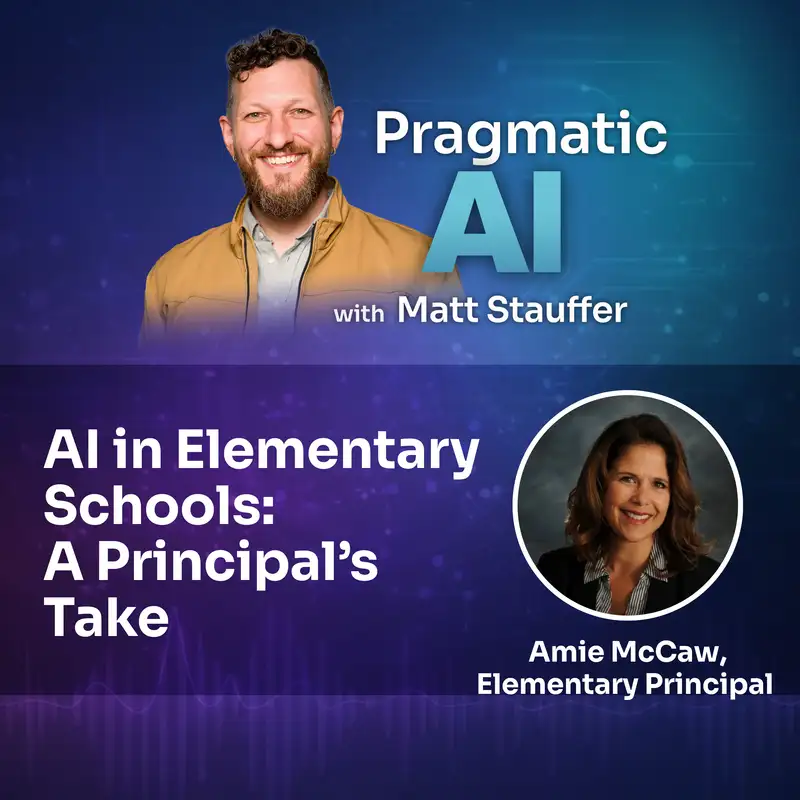
And my guest today is Amy McCaw, who is an elementary principal in Southwest Michigan.
And she's not a business leader, but she's certainly building things.
And I need to update that intro because I'm like, my vision for who's here is expanded as
we've been recording.
And I was telling you beforehand, Amy, I was just like, I was talking to some friends of
mine about like, I need people who are in...
other industries and educators and my friend Jordan was like, my gosh, you got it.
You got to meet Amy.
She's, know, so I'm so happy to have you on.
Could you say hi to the folks and just kind of tell them like, who are you and what are
you doing a day to day?
Hi, I'm happy to be here, Matt.
uh Amy McCaw, as you mentioned, I've been a principal for 19 years.
I am in Southwest Michigan.
I've been pretty involved in the state of Michigan when it comes to, I've been known as a
seeker where I'm kind of like, what's the next thing?
What's the next thing?
And so right now I'm at a K-5 building.
It's my 11th year, K-5 building, but I'm actually working on my dissertation, my PhD, and
I'm retiring here soon.
But I'm working on, it's kind of ironic, I'm working on like the other AI, oh appreciative
inquiry.
My research, my, have you heard of it?
Okay.
Appreciative inquiry is under the area of positive psychology.
It's a framework and that's what my dissertation for my PhD is focused on.
And it's really talking about the Ds, the five Ds.
It's a define what you're working on, discover what's already working well.
It's really strength-based versus deficit-based.
Dream big.
then design it, and then destiny.
So I started this work eight years ago.
And when I talk about AI, that's my AI in inquiry.
So it's kind of a joke around here because I have different staff members have different
opinions about artificial intelligence.
so, but proud principal of elementary school, K-5, we have a mix of veteran teachers and
new teachers.
And like I said, if.
kind of been involved with different state organizations.
Our principal state organization, I've been on the board.
was president for in 22, 23.
And yeah, I think, I guess that was my introduction.
I don't know whether, but I really am glad when you hear so much about AI, artificial
intelligence with the business people and all that and the money and all the other things,
but my goodness, it starts here in schools.
Like we've got to know what we're doing here in schools and how we're gonna get our kids
ready.
Yeah, and so many of my so many episodes of sorry to interrupt you so many episodes prior
to now we get to a point at the end of the episode where the person says, so I don't know
what the future looks like for my career.
But what I really don't know is how it's going to impact my kids.
I feel like that's happened on more of the episodes with than it hasn't happened on.
And so that's when he said elementary principal was like not just a principal, but
principal who's thinking about like the broader things and talking to us like we've got to
hear what.
What is your world like right now?
Because my, so my kids are nine and 13, so they're in elementary and middle school.
And I, now I'm sure they've heard it, but I have not heard a single word from their school
about AI in any positive or negative form.
Which on the one hand, relieves me a little bit, because I'm like, just keep teaching the
way it's teaching.
But we all have this like, when are they gonna introduce it?
How are they gonna prepare them for it?
What parts am I gonna hate?
know, what's gonna be impersonal?
teachers already aren't paid enough and now you're gonna be expecting to do more.
It's just like there are so many concerns I have here.
So I'm curious, like from your perspective, in what way does your world interact with day
to day definitively right now?
Like some ways you might deal with AI is more perspective theoretical, but what's your
actual day to day interaction?
Sure, So, principal hat first, then I'll talk about teacher hat.
Principal hat really, I mean, I will say it has helped me with communications.
The amount of emails, the amount of newsletters, the amount of things that we are trying
to communicate has really, really expanded and increased in the last, I would say my last
eight years so much.
And even since, you know, our COVID years, we kind of have pre-COVID school, post-COVID
school.
The amount of communication that we need to do is constant.
communications.
And so sometimes when I'm stuck with making sure that my wording is just right, I'm gonna
ask.
I'm gonna like reach out to, you know, right now Gemini.
Sometimes it's Perplexity, sometimes it's ChatGPT, but I would say for schools right now,
Gemini is one of our leader AI because we have Google Suite.
Schools have lot of the free and so that's been a piece.
So for communications, I would say
It's been very helpful instead of the blank page of how to start a tough email, maybe like
something like that.
So that's been something that's been helpful.
Behavior plans.
I was just actually, actually I was in a special education meeting the other day and I
didn't know it, but one of my teachers, she had to write up some goals and I did not know,
but I'm like, I looked and she's like, she just, she used how to write this goal.
And it was, it just makes things faster as an educator right now.
So I can tell you that.
The how we're using it day to day is kind of the, I would say communications and trying to
make things a little bit faster.
Like we need to make a behavior plan.
We can put in, we have the specific details of a five year old who's struggling at
lunchtime.
You know, we kind of say, create this.
um Another way as a principal hat is my observations.
I always tell my staff, I want the feedback to come from me.
And so I write up my observation with a form I use using that positive psychology, because
I'm a believer in that.
And then I will ask Gemini, and I will ask to say with our Danielson framework, that's the
framework that we use for evaluation feedback.
Using the Danielson framework, domains two, domains three, I'm going to get into
educationese, sorry.
Using that, I would like to hear the growths and the strengths based on my observation
notes.
And I always, always have it separated from my notes.
And I always, always tell the staff, this is my words, and this is, read them together.
Yeah.
this morning, just today, I was with a teacher and I'm like, oh, I would not know.
I did not take that out of there.
But this one really, like this really accentuates it.
It matches it really well with our framework.
So it just helps me put it to the framework and it does it faster.
It does it so much faster.
So I would say as a principal, it's making some of my tasks quicker for sure.
It's helping me.
Yeah.
and thank you.
This is a really good intro.
In the programming world, one of the things we're running into is uh in theory, these
tools know all of our programming knowledge because we all put the programming knowledge
publicly and they can consume all of it.
And then so in theory, it should be able to write code at the same way we're writing the
code.
But if we were to say, here's a thing that I have to do as a part of my regular job.
And then I said, I would just ask it to do it.
We are finding that the
quality of work that it's generating is significantly below the quality of work that
humans are generating and so a lot of the process is figuring out what are the processes
by which you can rely on the tool some, evaluate its work and only keep some of it.
And I started hearing you kind of saying parts of that, but when you said like, you know,
to generate a behavior thing, I'm like, at what point and have you had to run into a thing
where you're saying, y'all, you can't just blanket take the output of this thing or is
that something where everyone's already very discerning?
Okay.
always.
um And we share that.
Like I was actually at a principal meeting just we talked about evaluations as one
example, but with a behavior plan or with a parent newsletter or email or whatever.
I've never been able to feel like it's it's nailed it.
I've been to say it helps me get started.
It takes a white blank page and helps it not be blank anymore.
So, yeah.
something for you to respond to.
And like you said, you just get stuck there and sometimes you're like, I'm exhausted and I
don't know how to start.
Whereas like if you give you something and saying, I can, that part's good, that part's
not good.
I'll fill this in peace.
Our brains can function with that.
And I mean, you, know so much better than I do, but like I've experienced the thing that
you're talking about.
Uh, so yeah.
Okay, cool.
with teachers about that, we have to remind them, you guys got to be careful.
You cannot just blanket, like say that with it.
You have to make sure that you're vetting through and reading it carefully.
don't just trust.
Do you not just trust it because it's not you.
And the next thing you know, it may have said something that was off and then a parent's
calling.
So I've never experienced it where it's nailed it.
I've never experienced it where I wouldn't put my own.
It just helps things get started.
A behavior plan specifically, like it could get us started with some ideas.
Scheduling, we're working on schedules for next year.
And there was a program that came out to say, you know, use AI for scheduling.
It's always a piecemeal with an elementary schedule.
You've got, you know, 21 different classrooms, you got music and art and you know.
And so we plugged it in with this one that was recommended.
But I will say, like we ended up going back to what?
we were using because it just didn't know enough.
It didn't know enough that recess and even though we felt like we really put in a lot of
the foundational things into the prompt, um it maybe gave some ideas.
The reason I like perplexity personally because it gives the resources of where to go to.
So that's something like if I ask the AI resource of perplexity, I might not really like
the answer, but it'll get me to another
resource in another article and then I can find the research faster and then I know where
it's coming from because I also don't want to just take a blanket like where is this
coming from so I like it.
In Gemini does that sometimes too where it says where the resources are.
Yeah so I don't know other questions on how to.
no, that's really helpful.
I mean, one of the things that we are working on is trying to get it set up where people
are both seeing AI tools as something that can make them more effective and also be aware
of where's the limit, where where's the edge where it's too much, right?
It's too much just fully relying on it.
You've taken the human out of the system.
And part of the issue we're running into is the individuals, right?
The individuals.
turn in something generated by AI without looking at it.
But part of it is the motivations that are encouraging them to do so by saying go faster,
faster, faster, more, more, more AI.
Their people are getting fired because they don't use enough AI.
So I hear you saying we are trying to get our teachers to do a good job here.
But that tells me that there's some principal somewhere that's not telling them that.
And there's some teacher somewhere that's not being encouraged to use AI responsibly and
to review the thing.
And ah I'm not asking you to speak poorly of any other school or any principal but
Is it to the point where you're like, yeah, I actually already know what's happening
somewhere where I've seen it in the news or we've heard or is it sort of is this new
enough where you're just trying to do the best with what's in front of you and we don't
even really know what's going on elsewhere?
it's interesting.
So it does remind me of a story.
Just recently we had a district AI day.
So professional learning, we are taking a half day.
Our teachers are getting training and the topic was AI.
And so we have, you know, teachers from kindergarten through 12th grade, you know, and we
have, like I said, we have vetted teachers and we have some very brand new teachers that
are just, you know, Gen Z.
So there's definitely the different generations in my building have different feelings
about this.
On that day.
um Afterwards, then we did, so it was like a breakout with everybody and then we came back
to our own building and we had a discussion about what we learned, how do we see it.
um Overwhelmingly, my building was um pretty anti about it.
um They are, there's the younger ones definitely, the younger Gen Z were definitely
feeling like it's not good for the environment.
They definitely felt very, um very strong about.
the responsibility of using it.
And so we had some really good discussions.
I was proud of the staff to be able to meet each other where we're at with different
feelings about it um and letting each other have different feelings about it.
um But I think going back to when you're asking about how it's being used, it did make me
think about it because one of my brand new teachers who just graduated from college last
year said we had so much of this in our introductions of teaching, like they had a lot of
it.
m
They just were kind of over it and they're 22 years old.
You know, they were saying it's like, let's make sure that we keep it in contact, like,
like keep it in check.
Right.
So that was a 22 year old brand new teacher.
He's doing great.
And he's, know, but he is saying we covered it in the university level a lot, which I was
surprised.
I did not know that they were doing that as much as university level.
And I'm sure it changes from, you know, university to university, but.
um He is shared.
He goes we've we've done this we've talked about this and we've done it enough in our
district like can you know we want some other things so I thought that was interesting
coming from the teachers um And then another story I guess that makes me think of when you
ask that question about other districts or other I've like I mentioned I was um I've been
very involved in the Michigan Association Principal and so I have been also very involved
in our annual conference have been on the
committee and last spring a year ago spring we were meeting for the conference that would
have been in December of 25 and we were talking about making sure there's enough breakout
sessions of AI because educators are going to need to know this and we were meeting and
this is a Michigan elementary middle school principal so it's K8 and there were quite a
few talking about the student part of the students learning AI and I was like
I still want my K-5 kiddos to know how to write a sentence with capital.
I sounded really old, so this is kind of like, my gosh.
And I thought it was principals from middle school that were talking like, what, like Amy,
you know, and you know, I know these people.
And I definitely felt like I was in the minority.
It was a virtual meeting.
I felt like I was on the minority when I spoke out like that.
because they're like, our kid's already using it.
What are you talking about?
And I assumed I was talking to the middle school principals, but I was not.
I was talking to some other principals of elementary two.
It did, I'm gonna be honest, it did alarm me a little bit.
I, one, I thought, okay, the train is left, know, I gotta get on this train.
But part of me was like, oh So talking with my own staff about it, we are kind of in this
place where right now with our elementary children,
We do want them to be able to think for themselves.
We want them, of course, we want that for everybody, but we want them to be able to not
just turn to an electronic so quickly.
Like grit, resiliency, those are things that we are really focusing on.
So grit and resiliency is a big priority for us.
And so if we are starting too early with just introduction of just go to that as an answer
to when they're trying to solve.
complex problems that concerns us.
So we want critical thinkers, so we need to help them become critical thinkers.
And so I think that's where we're at right now in my world.
And I would say most of the principal friends I have, most of us talk that way.
If we're going to get them to be critical thinkers, we have to give them the experience to
be critical thinkers.
Not to say efficiency isn't great, but
We gotta get them in a place where sometimes it's uncomfortable to learn new hard things.
We can do hard things in something we say every day.
You can do hard things.
You can do hard things.
yeah.
First of all, thank you for doing that because like I said, I've got kids and I'm just
like, oh, I hope they have people around them who want them to have integrity and grit and
hard work and critical thinking skills, whatever.
uh My favorite teacher, well, one of my two favorite teachers growing up, he was a math
and calculus professor and he would not let you use a formula unless you'd learned how to
do it by hand and proven in tests that you know how to do it by hand.
And then now you can use that formula and now he's going to teach you the next thing.
And I always loved that.
He's like, you will understand what you're relying on.
You can't use the calculator until you understand what the calculator is doing.
And so in programming, that's been a really important thing for us saying, like, I don't
want you using a tool unless you understand what that tool is doing, because if something
goes wrong or if you don't understand the ramifications of combining with this other
thing, or if down the road you're now the person responsible, like, there's so many
reasons why that's the case.
And so we've had a lot of people who are encouraging people.
saying, look at all the things you could do with AI that you couldn't do without AI.
Therefore, you should now do them even though you don't understand them.
And one of the twists is we're trying to the point is, first of all, you should understand
the core.
And then maybe it might teach you in our world it's a different language or something.
But even then, we use your exposure to that to teach you.
what the different languages using concepts you understand.
But if you don't have those concepts, if you don't have the core understanding, you don't
have the critical thinking skills, how are you gonna evaluate the output of writing if you
don't know how to write in the first place?
How are you gonna say that sentence communicates what I want or not if you don't
understand communication?
like writing especially.
I mean, we know, I mean, that's such a big piece that we are continuing to work on and try
to improve, at least personally here.
Like we, there's a lot of data out in education world about reading data and math data.
And when it comes to writing data, it's a little bit harder.
And so we're trying in school ways to try to figure out what's because there's so much
subjectivity, you know, like how can we be more objective and how can we be more specific?
So
Can AI help us with that?
I think there will be ways that we can help us do our job, but we don't want to introduce
just students using AI to write until we know they have the foundational skills to write.
uh Another point in that direction, then I'll let us move on.
uh I do hiring at my company.
And one of the things that helps me understand uh my interest in hiring somebody is their
writing.
And I learn their writing immediately by the emails that they send me because we are a
remote company.
uh Everybody, you know, communicates asynchronously through Slack, whatever else.
uh But also, you need to be able to communicate to our clients through writing And it
helps me understand your attention to detail and your critical thinking skills.
We've said these things for
two decades of running this company.
And all of a sudden I'm like, oh, every email I've gotten from this person has all been
either through or generated entirely by AI.
And so my ability to understand your communication skills on the day-to-day moment is
completely gone because this is, I'm not talking to you.
I'm talking to Claude.
Yeah.
is, yeah, it's, we sometimes we laugh.
I, I've gotten some parent emails where I can like, Oh, all of a sudden, all of a sudden
the communication is different.
Um, so it's, you know, it is, it, know, when it's not the person.
And I think that's the lack of the human connection part is it's, I'll just be honest, the
fear part for me.
Um, I have a grandchild and I have, you know, like the, what's the next generation going
to see and experience.
And so.
When I think about the future of this, just making sure like it's it is something that can
help us, but it's not the solution to what we're doing.
It's a it's a it's a tool.
We continue to talk about it as a tool, but it's not going to solve all the things like
our scheduling.
Like someone's like, well, just was going to put it in a eye and you know, and like there
it's it's more complex.
It still does not know.
You know what?
Our kindergartners need this.
We need like, you know, so
So it's a tool um and I think it's going to help in different, it has helped in a day to
day basis, it helps.
But there is a fear um and I show my age, I am retiring this June, so sometimes I'm like,
thank you.
But sometimes I do wonder, if I were a principal in 10 years, it's gonna be very
different.
But how we shape it and what we do with it right now.
requires these conversations.
Like I mentioned, our staff had this conversation.
And my younger teachers are the ones that were kind of pushing back a little bit, which I
thought was very interesting.
Well, and we talked about the principal hat for a little bit.
We did talk about teachers a bit, but I want to kind of expand the teacher hat moment.
As a teacher, what, A, kind of what are you seeing their interactions with AI looking like
overall?
You mentioned there's a few specific things that they're looking for AI help on.
You mentioned specifically some of the younger ones are pushing back.
what's the kind of, is there a broader picture that we haven't kind of covered about what?
what they're doing, what you're resourcing them to doing, what you're telling them they
are absolutely not allowed to do.
Like what does a teacher's healthy interaction with AI look like and what are the
temptations that aren't healthy, you know?
very good.
True about the temptations.
I think the healthy ones is the healthy situations are healthy examples would be when um
they're kind of stuck.
Well, here's an example.
I have a teacher that was trying to do a little bit.
It goes back to writing.
He was trying to get feedback and it was taking him a long time.
And so he was able to kind of put some
I think it was Claude used, he was putting some of the students writing in and he would
put in their responses and he would ask for an evaluation from the AI because it was
taking him a long time.
But he told me he is reading through all of them, but it's helping him, uh a teacher that
may have, it's not an unknown joke that sometimes teachers that are checking writing, they
carry the bag of
25 pages home and then back and like, it's it's reality sometimes it takes a long time to
go through writing.
And sometimes because he was motivated, because it made it a little bit more fun, he
really has really picked up his response to students.
His feedback is quicker.
Kids are getting feedback with their work and he's checking through it.
but it is helping him get his job done in a time that works for him.
And he has found a way that I think is a healthy way, like it's helped him in a healthy
manner, um tackle some things that were kind of dreaded earlier, he was teaching math, but
he doesn't love teaching writing, but it's a fifth grade teacher.
so, so like it helped him with some of the dread of that.
And he used it and he shared with me.
um He also uh learning targets.
We're working on trying to be more specific with the learning target and the why.
So when we're telling students you're going to learn, um let's see the X, Y axis and Y and
so that we know, you know, and so we're learning to get our learning targets more specific
as to what they're learning, why they're learning it, and when they're going to know they
learned it.
So he's been able to put in a standard, like a standardized um outcome.
He puts it in and he asks,
Why is it that a student would need to know this?
And when do we know a student has learned it?
And he's been able to say, okay, kiddos, this is like to his class.
This is why.
And he gives us really good examples.
And then we know you've learned it when this has happened.
So it has really refreshed him.
He's a more of a veteran teacher.
It's refreshed him and it's helped him find some things that maybe he didn't always put as
much attention to.
And it has helped him in a healthy way.
So.
That's fascinating.
Because when you say that, the first thing I hear is the warning signs.
And I'm like, man, what is my bias here?
Because you say he has the, you know, the, has him help review the writing.
And I'm like, and then then he's not going to do the job of actually caring about their
writing.
And you're you're keep talking about this nuance.
And I think part of it is maybe teachers are not trying to get like if you're trying to
get an easy life, you don't become a teacher.
Right.
Like, you know,
100%.
ah I mean, teacher burnout is real.
Teacher burnout is real.
And um if we can help, if AI can help in a healthy way.
But I talked to him, you know, we had a conversation about it.
Like, he goes, this is what the response they gave me.
And so I will tell the student and he, you know, he's able to have a conversation with the
student.
He's telling, you know, so I think that's the other uh big important piece.
just like I shared with you that if I'm getting feedback um from uh an AI source, I would
never just call it my own to a teacher.
would say, is my feedback.
And it literally says Gemini feedback, and I put it in a different font, and I put it
here, and we talk about it.
I would never want, same with my teachers for the kids, like for their students.
We are not gonna trust.
Another source where trust you're the you're the professional teacher.
You're the expert.
You've got this job.
You're in front of your kids for a very good reason.
um And there's a trust factor between a principal to a teacher as well, right?
When we say use this, but use it with this, this and this in mind.
So I think, you know, seeing I think of him as a person that has it's like it's really
helped him in areas that were not as much of a strength.
Help him find ways to bring it up, because maybe he was maybe he was
less and less, maybe the writing feedback was longer periods of time, maybe he was giving
less feedback, you know, and now I hear him interacting and giving more responsive, like
timely responsive feedback is critical when it comes to teaching.
And so giving timely responsive feedback, as long as it's vetted through the teacher's
eyes and not just trusted to an AI source, I think is, is okay.
Thanks, very cool.
And I mentioned earlier that in programming often we're saying, you know, use AI to let
you do something you couldn't do before.
And I'm wary because if you couldn't do it before, then how effectively can you evaluate
the quality of the output?
But this is a world where it's like he always was capable of doing it.
He's always capable of delivering understanding kind of and delivering good feedback to
its student.
But it is helping him do it in a way that is a little bit more rounded and maybe not his
kind of
core capabilities space and also in a way that is little bit less exhausting on him
without uh removing any of the quality standards for him being the final buck stops here
of the quality.
And I'm like, that's a really nice framework for thinking about how it can help us without
basically us just fully delegating thinking.
Yeah, and I think with, you know, that's the difference of elementary and secondary
teacher too.
Like when you're talking about a fifth grade, fourth grade teacher, the content starts to
get heavy with science and social studies and many of the teachers have kind of their
favorite passions.
Like they love teaching math and they are on and they are like so, you know, and when
you're in high school and you're only teaching math, you're in your game, you know, like
that's your, that's your joy and you're, know, but if you're, passion is math and you are
teaching all the subjects,
Is there a way to help lighten the load of all the things?
So that's what I have seen that as a way that it's helped.
um But I've also seen then also when teachers are talking about, well, another one would
be data, um being able to take our data, like let's say students just completed a math
test or science test or something.
em I have seen teachers kind of take it and ask for strengths of like, let's say the unit.
And so they put it in like what have been the strengths.
And so that helps them understand what they've taught well and what kids still need some
more time on and in just a faster way.
It's not that they couldn't have gotten there, but it might help them with their data a
little quicker.
I'm finding myself confronting a unrealized bias in the span of this conversation.
So thank you.
Which is that I constantly see people taking AI as an excuse to do less work.
And I'm just like, that's what everyone's going to do.
You know, your teacher's going to get it and anybody else, they're going to get it and
they're going to use it to do less work.
And that's not what I'm trying to do.
And that's not, you know, that's not how I think about teachers or any of these other
groups I'm kind of making the assumption about.
But there's just this
I don't know, this prevailing idea that AI is an opportunity for us to make work life
worse, to make work life output worse for the sake of whatever, do you wanna call it
capitalism or whatever else?
And so just, it's helping me reframe it as like, I keep telling everyone AI is a tool and
just like any tool, you should know what it's good at and what it's not good at.
But then therefore I should look at it like we look at other tools, which are hopefully
they allow us to accomplish our end goals better and the goals of teachers is to teach.
Yeah.
we're teaching more effectively in ways that are more sustainable so we have less burnout
and so the kids learn better.
I'm like, great.
Well, and I know AI is a different ball game when it comes to this, but it does make me
think when I was doing my student teaching, and I was kind of a non-traditional, I was in
another career and I came back to education.
When I was doing my student teaching, this shows me the age, email coming into schools was
a big deal.
And one of my research projects was, and it was a veteran teacher, she was quite a bit
older.
And I was a young younger person and I was doing research on how emails could help
teachers.
And there was a veteran she was against.
Like there is no way I should have email as a teacher.
Like I am not going to be doing, you know, like there's something that's, know, and I know
that AI is a whole different ballgame, but it does sometimes make me remember.
Like there was once upon a time we weren't going to, we had computer labs.
didn't, we didn't want kids to have, you know, so.
I'm not saying it's the end all be all by any means.
I just think it should be a tool.
We need to know what its strengths are, but it never will replace the human connection.
And when it comes to teaching, the teacher knows that child better than any Claude or
anything that's going to read a person's paper.
um But when it comes to the load of teachers and how we can help them, um
I'm all for that because I see teachers really being burned out with some of all the
different demands and the amount of communication that a teacher has to handle today
compared to when I was in the classroom.
mean, families want to know 24-7 what's going on and so there's different tools that can
help them get, you know, help with that and if it can help them that an email a little bit
quicker, a little bit easier, I think it could be a good thing.
Bye.
uh
Thank you.
Okay.
We talked about students a little bit.
You talked about the fact that elementary school students in some places are, you know,
using AI and you're like, really want to make sure that they are able to write and think
critically.
How are you all approaching the introduction of AI into your schools right now?
Is there any places where you use it at all?
would say for the most part in this building it's um gosh, I I'm trying to think of some
of the things that they may have been.
Maybe it's like for fun or like pictures like fun.
Yeah, yeah, more middle school in our district.
I think is where it's happening, but I will say there's another district that I was
talking to and I didn't feel comfortable with this.
It was using it when it was needing um a student to reflect on maybe a behavior going back
to behavior.
and it was putting in a scenario, the student would put in the scenario of what it was
like feeling or put in this little, yeah, like let's say the child lost their temper in
the playground and they kicked somebody and then they were using, I was kind of perplexed
a little bit about it, um and they were using AI to kind of give feedback to the child
about what they could have done or something.
And I really don't have interest in going down that path.
But I'm sure there was more to it than I understand.
Like, I'm sure there was like there's programs coming out all the time, right?
Like there are programs all the time about promising you this and promising that and SEL
and like social emotional learning and how we can, you know, so I don't, you know, I think
kids that are struggling with behavior, they need that person.
They need relationships and connections and people.
So I know that that's happening out there.
starting to happen, but it's not, I don't know.
That's not something that I we're doing, but I think that's something out there like how
a, well, like let's say a middle schooler does a check-in in the morning.
Like we just check in, how are you doing?
And there's programs out there that will come back with, you know, kind of a chat bot type
thing with a response.
so, you know, maybe, but we do know our children at this age are feeling like this is
personal to them, right?
Yeah.
they're going to get a response.
So that's something to be aware of.
I think we need to make sure that we're planning for our future kiddos about who are they
connecting with?
What chat bot is going to know that child better than their teacher or a trusted adult in
the building?
And so having a trusted adult when it comes to the social-emotional behavior, that will
never be replaced, in my opinion, with a chat bot or with something like that.
And when I said behavior plans earlier, it would be something like, OK, here's the
schedule.
How can we create a schedule with some breaks and things like that to help with that?
um So it wasn't a prescriptive thing that we used to respond to incidents.
It was more like that, like that kind of behavior plan schedule.
Because it just has to be.
Typically, it's usually a child is doing that because they're looking for attention.
and they need the right kind of attention.
Right.
um Now that makes sense.
ah
As I asked about the three groups, the first question was how are principals, teachers,
and students using AI in your world?
But now I think the last thing I want to land on with that is as you think about preparing
students for a world in which AI has an increasing part of jobs and education, everything
like that, you mentioned a little bit.
You said, want to make sure they have critical thinking skills.
But are there any other things where you think as I'm trying to send these children off to
a world that is different than the world that it
was 10 years ago.
Are there any other things you're thinking about and trying to make sure that you're
helping prepare them for in order to get them ready for that world?
I think it's the trust part of, and we've had these conversations with kids that just
trust what's on their computers and trust, like, making sure um that they are, like, same,
you know, you hear about the scams, you hear about the things that people are getting
taken on the computer with, you know, fake things.
The kids, too.
Like, you we, you hear a lot about senior citizens and what we can do to help them.
But the children are also being scammed.
They are also, like, they're very, they can be...
prey right?
And so I had a conversation with a parent, her first grader, this was a years ago
actually, her first grader had Snapchat.
And we've been trying to talk about what's responsible when it comes to social media.
And I know this isn't AI, but it's related in it because of all the things that social
media can do with AI now.
um And the parent was like, well, yeah, she has fun with her aunt.
And so they just do these little filters and she has fun with it.
And the
first graders like, yeah, but I have all these friends, Mrs.
McCaw, I have all these friends.
And so like she had, you know, these 50, 100 friends, I think maybe was 100 friends on
Snapchat and her mom did not realize that.
I said, you know, it's, she's not meant, it's not meant for a first grader.
And just making sure that we are, our eyes are open, like we need to have our eyes wide
open to protect them and to make sure not only are they critical thinkers to solve
problems, but critical thinkers when it comes to trusting.
what comes on the screen, like what comes on their phone, what comes from the, like when
they're reaching out to things, making sure that they are able to have a voice and that
they are um informed enough and informed and knowledgeable with enough wisdom to know this
doesn't sound right, this isn't right, like this might, know, like making sure they're
kind of, which is kind of sad to say, because I'm a trusting person at heart, but to make
sure that
Our kids are a little bit like, like, I guess, hesitant to just trust what comes across on
their Chromebook or their phone or their computer screen or whatever it might be that they
need to make sure.
And again, that's what I like perplexity AI and it's not a commercial for them, but I like
to say, I'm going to check the resource.
I'm not just going to trust it because it just came on a computer screen.
Like we need to trust where it came from.
And we've definitely have had those experiences where we found that's not.
what, where did that come from?
And so just because we don't want the kids just to trust it without checking, without
being critical on that too.
I think that when I think about our kiddos that are kindergartners and first graders who
are going to just know this, that this is just gonna be their world, and making sure that
they are kicking back and thinking back a little bit like my young teachers are, like
we're not just gonna like, just don't.
trust it like I you know the Gen Zers I think you know things tend to sway back and forth.
um My young Gen Z teachers are like they're not just going to trust it just because so I
think that's healthy that we're not just getting on that you know on that bandwagon and
going with it so I think for children all ages I really hope that we can instill a sense
of critical thinking before trust it.
One thing I like about what you just said there was you mentioned critical thinking.
We think of critical thinking without always taking apart the word critical.
Critical thinking is the ability to think deeply and creatively.
Exactly, all kinds of stuff.
But it's also critical, right?
It's critical is the ability to evaluate whether this thing should or should not be
listened to and is this a good resource or bad resource, a good output or a bad output.
I appreciate that because yeah, you want to have people who believe, kids who believe that
they can trust and that they can feel safe and also that they have the ability to
critically evaluate things that are coming their way to decide, yeah, this is actually
right for me.
Is this actually good?
Yeah.
As a parent of a nine and 13 year old, and I'm especially thinking about my nine year old,
I'm very grateful for, like I said, for obviously she's not in your school district, but
still I'm grateful for this desire for kids to be able to handle all this stuff well.
uh And it really is motivating me to make sure that I have done, you what I want to do,
you know I'm a tech guy so I understand their tech pretty well, but I'm still like how
much have I taught them or trained them?
I am seeing glimmers of hope in that they are more critical than most people I know of a
lot of very, you know, technological things.
They are super critical of social media.
I'm to be bit more creative.
Waymo.
We got Waymos in Atlanta.
They're like, I'm never getting in one of those.
And I'm like, really?
I thought as a kid, you'd be so excited about the latest technology.
And they're like, nah, I don't want anything to do with it.
So yeah, the pendulum's real.
I mean, I'm a millennial.
the internet came public while I was in my teens.
And so it was trust.
You know every single person.
And we watched that shift from trust to
know, scam manipulation, all kind of stuff happen, you know, through adulthood.
So, yeah, it's very interesting to see what not just internet savvy and social media
savvy, but now the new world of AI and chat bots savvy kids are going to do better than
we're doing.
And they're going to laugh at us because we don't understand how to talk to Gemini right
or whatever.
Yeah.
OK, so we have covered the kind of the majority of the work that that I wanted us to get
to today.
If you had another educator listening right now, whether they're a principal, elementary
school, whatever else, if there was one thing that you would want them to hear, one note,
one piece of research, one uh charge that you would love for them to hear, what would you
want them to hear from you?
Hmm.
That's a good question.
Um, especially I've been doing a lot of reflecting cause I am coming up to retiring after
my years.
Um, I, I definitely, it goes back to what we were just saying.
I want them to not just, I want them to, as an educator, I want them to be able to go
forward with believing in themselves, knowing that no, no resource, no box is going to
replace them.
They wouldn't, you already said it earlier.
You went into teaching not because it's easy, because it's a passion.
so trust that.
Stay with that core of your passion.
You're there to help change lives and you're there to help change lives for the better.
And so with that, trust in yourself in the relationships first.
It's always about the human connection, always about the human relationship.
It's always about that child in front of you knowing that you care and love them.
no matter what is going on.
Like that is, you know, we, we, we love our kids here.
Like we have to make sure that the kids know they are loved by a human.
Um, and so I think any educator, like all the things that are going to be coming at them
with resources and tools and the tools are good because you're going to need to know how
to make your job sustainable.
It's, it's a long, hard grind.
So make sure that you use the tools to help it sustainable.
But at the end of the day, it's you and the student.
Yeah, I love that.
I appreciate that very much um We had an agenda ahead of time, which I didn't look at once
after we started talking.
I think this was great But is there anything that was on that agenda or anything else
these topics that you wish we'd gotten to today that we didn't get a chance to
Okay, you did talk, there was a question about how it's changed, um, my, my opinion, and
how, you know, I would say, because I kind of even gave you some examples of how I've seen
teachers be able to use it, like the other day, I was shocked when I saw my special
education teacher use it real quick to create a goal for math, and it's like, that just
helped her a lot.
So there, it has changed.
I was also biased, you talked about that earlier, like,
It has changed that I've been able to see it um again help the educators who are have a
heavy load.
And I've seen that help them um make their load a little lighter.
So my opinion over the time that is that, you know, really, I think this is a short amount
of time for me really that I've seen it, because I still think the original AI is
appreciative inquiry.
And it's like a positive psychology.
so it's like I had to change my gear.
of that, changed my thought of that, like AI kind of took that from me.
I'm like, my goodness, like what's going on?
Artificial intelligence, yeah.
But so I will say that over the time, my opinion of it with a principal hat, I have seen
it help my teachers carry the heavy load.
So I have, like it's here, we gotta figure it out.
And if we don't, that's.
I don't think the right way to go because it will figure it out for us, right?
Like, like as an educator, we need to figure out what we want in our buildings, what we
want for our communities, what we want for our schools with AI being a tool.
And so we have to, we have to address it.
We have to talk about it.
And so even the teacher that like, she gets irritated every time the word comes up, like,
like I say to her, it's gonna, it's here.
Like, you know, we're gonna have to make sure that we're, our eyes are open to it.
Like we're,
It's not going away.
So I think my opinion, that's something that I saw on your agenda as a question.
We have to, I'd rather us figure it out than not, because.
Proactively.
yeah Yeah, it's uh, it's here to stay uh and we have to decide to respond to it is one of
the Notes I hear a lot from guests and it is something that is New in the last three or
four months.
I don't think a lot of people were saying that six months ago And so that's why I was
like, wow, we really are in the middle of a pretty meaningful shift where six months ago
It was it's here
I guess, you know, it's pretty crappy.
Most people don't have access to it.
Most people know some nerd who's working on it.
And now it's just like, no, it is in our industry.
It is in our world.
It's in our entertainment, it is in our relationships.
And so it's now just like, how do we develop a healthy relationship with this thing that
is definitively here?
Yeah.
In 2024, was able to go, Salman Khan was speaking at a conference at the National
Principal Association and it was in 24 and it was right before, was it 3.0 or 5.0?
Right before the big, big shift of GPT, I think it was 3.0.
And he spoke to it and it was really before Conmingo came out, which is something that
he's...
And he has a daughter, he had a daughter, and he talked about how it kind of woke him up
with his daughter wanted to write about this fairy tale story and she didn't know how to
start it.
And they sat there and started a story with using artificial intelligence.
And he's like, it really helped evolve and kind of develop her writing skills and then she
started really utilizing it.
He, you know, it was really about, it could revolutionize in a good way.
It doesn't have to be.
And I had a lot of respect for the way he brought it up, because he wasn't, I didn't feel
like he was trying to sell something.
I felt like he was, uh to just say, this is coming, you know, and that was in 24.
uh So it was interesting.
Well, and I love the idea of being able to see it positively in a world.
mean, you didn't say that the students or the younger teachers are concerned about energy
usage and they're just wrong because we just have to love it.
Like, we can see the positives, we can see the values, we can understand the shortcomings
and then feel hopeful that we are going to see positive benefits in people's lives.
I mean, you've talked a lot about how teachers who are overloaded or who are having
trouble with something
are having easier time.
I'm like, great, that sounds like a really positive influence on the school.
And obviously there's other concerns, but I'm like, that's uh something that the AI
maximalists should put on their list of benefits that are happening.
It's just kind of like, yeah, I would come out of this interview being more pro AI than I
would come into the interview.
And that says a lot.
So, okay.
that's how I have shifted as well, because it's been, you know, you hear about the burnout
in education right now, and so if we're able to utilize it without never losing the point
and the focus of the human connection, maybe it's all gonna be okay.
I love that.
That's a great.
mean, I still want to see if there's anything else you want to talk about, but if not,
that's a great ending.
OK.
Well, Amy, I deeply appreciate you taking time in the middle of school day.
For those who are not watching, there is a very clearly school cinder block wall behind
her that we got the call and instantly I was taken right back to elementary school.
ah Be you work hard, stay humble.
That's perfect.
Yeah.
So so thank you.
We'll be kind.
be kind.
Yeah.
I love that.
um So thank you so much for taking time out of your day, for sharing all this stuff.
And like I said before, thank you so much for the work you do for those kids.
My kids not at your school, but there's a whole bunch of kids in your school that are
benefiting from it.
And hopefully more voices like yours will be a part of um this conversation about helping
our kids and our teachers.
So yeah, thanks for hanging out today.
All right.
working your schedule with me too.
Yeah.
Thank you.
Bye.
Creators and Guests