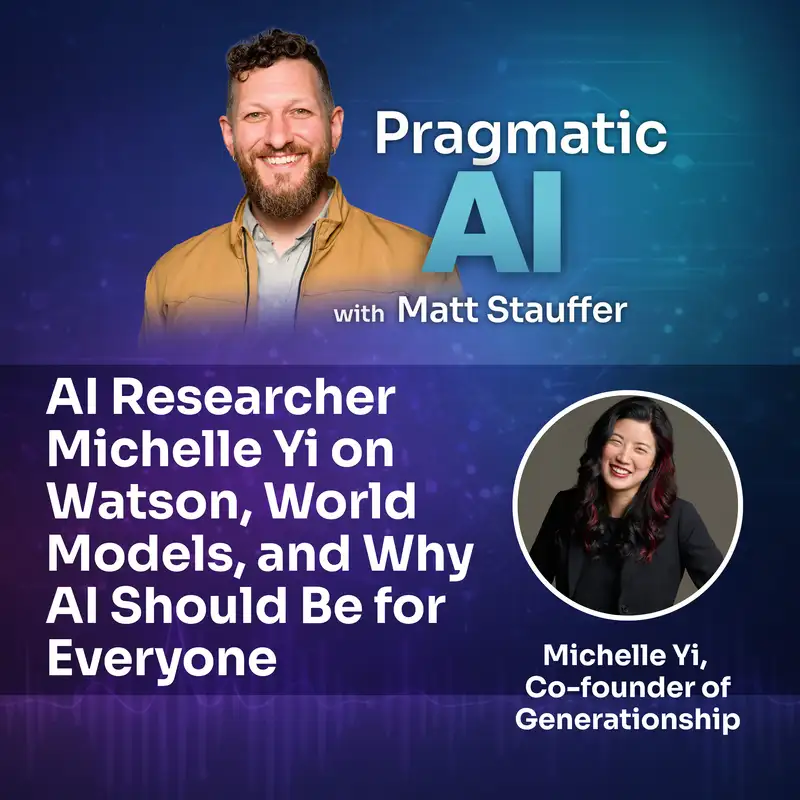
AI Researcher Michelle Yi on Watson, World Models, and Why AI Should Be for Everyone
The Pragmatic AI Podcast is sponsored by Tighten.
T-I-G-H-T-E-N.
We will take your AI ideas, prototypes, or even vibe-coded apps,
and we'll take them to production.
Scalable and secure. Check us out at tighten.com.
Hey, welcome back to Pragmatic AI, where we talk about using AI in the real world.
What works, how to use it well, and when it causes more harm than good.
Practical tools and trade-offs for builders and business leaders.
My guest today is my friend Michelle Yee, co-founder of Generationship, board member of
Women in Data, and AI researcher at Basis Research Institute.
And if you have been listening to the podcast, you know that I've been trying to get like
the real AI OG nerds.
And Michelle is one of those, so I'm so excited to have you here today.
Michelle, would you mind saying hi and telling everybody what you do on a day to day?
Yeah, hey everyone, thanks so much for having me on the show, man, I'm really excited to
be here.
Yeah, I guess, I mean, you kind of gave an intro on sort of the different various hats and
roles that I have.
maybe just if we want to go into a little bit of background by way of introduction.
So I originally started out in computer science and undergrad and grad school.
I spent 10 years at IBM research.
I worked on Watson, which aired on Jeopardy in 2011, which was a really wild time.
And back when we thought expert systems were the way to go with AI and people were like,
forget about those deep learning neural network things, like whatever, that's not useful.
Right.
and then quickly
that became not the case.
Then after 2011, I left to work in industry for some years, and then I had two startups of
my own.
And then most recently, about two years ago now, I co-founded Generationship with my
colleague Rachel Chalmers, where we invest in early stage female founders building in AI.
um So you just gave a I mean you you mentioned Watson in 2011 so you were working before
2011 So we are at 15 to 20 years of work in a world that the majority of us have entered
within the last you know 12 months So this podcast is not long enough to cover all the
things I'd like to ask and learn from you.
But I do want to kind of start back at the beginning.
So you mentioned Watson.
I am familiar with Watson as IBM's AI
Offering 15 years ago before any of us even thought about AI and it was supposed to be
very kind of businessy and enterprise stuff like that And that's the limit of my like deep
knowledge so if if someone were to never heard of Watson whatsoever or you know like As
you reflect on Watson given the language and the understanding we have of where AI is
landed today Can you kind of tell us a little bit about less about Watson and more about
like what were you doing in a day to day and what Was you know your and your team's
relationship to AI at the time?
Yeah, my focus back then, my initial focus or area of research was really around language
or natural language.
And I guess now bucketed under kind of natural language processing.
And like I said, different techniques, including like expert reasoning uh or expert
systems and like basically how do experts reason about the world.
uh And so this was manifested in a very focused, questionably uh impractical project,
right?
Because I do find like as I talk about
a few or fewer people remember this uh event, but essentially it was the first time like a
machine went on jeopardy and beat Ken Jennings at the time who was like the most winning
as person.
And really what we were trying to tackle was, which we take for, I think we take a bit for
granted now with like the transformer models and like Chat GPT et cetera, uh is like, can
we have machines sift through vast amounts of information and do question answering?
So basic, but and yet this is like the first major hot use case that came out of like
language large language models today.
So but back then it looked, the stack was completely different.
There was a lot more engineering work that had to happen in terms of, because you know,
you're building on mainframe of all things.
And so, you know, for all of you fellow Fortran and Cobalt developers out there, like I
see you, I understand you.
You know, this was pre cloud.
pre-Python also.
Yeah, yeah.
And so there was a lot of machine level engineering that had to happen to make this work.
Good old fashioned sequel.
Yeah, and so we had one of my friends on recently.
He was telling us about like how vector embeddings work and they're sort of like taking
taking in content, understanding the sentiment and then trying when you ask the question,
you're trying to find like the similar mathematical mathematical representation of your
vectorized question in the vectorized answer.
Was it all related to that or is it quite completely OK?
So similar underlying tech.
Yeah.
in NLP, like OGNLP, you still have like tokenizers, you know, but the way that you built
things was a bit different.
We also focused a lot more on like building out a corpus was the old school terminology.
This is in the modern era.
You just called us like your pre-training data, which is essentially the entire internet,
but you know, we couldn't do that uh in the past.
And so you had to be a lot more thoughtful about how you were curating things.
um
Now there was a lot of duct tape and maybe a bit of cheating in terms of like well We know
what kinds of questions are on jeopardy, right?
And so we could sort of backwards engineer like the types of data we should have some
distribution of in particular like we also had access to historical Jeopardy Q &A and so
we could see like there's a lot in geography or world politics and right and It also helps
that majority of jeopardy answers because we didn't have LLMs
back then.
So we had to be very, very specific, but the majority of the correct answers were, you
know, like a couple of words.
It's very rare that you needed to have like a whole, yeah, and like, then explain how
something works.
Like all the things LLMs can do, like we, really couldn't do that much of back then um
because we're, yeah, again, it's very, very limited and this is what was feasible to get
to work.
And the amount of effort that took as well um was
extremely, ya know, few companies could have done that at that time.
And so it's amazing to see what we're able to do now that we have the Transformer
architecture and modern uh compute and technology.
Yeah.
So you were doing that then, and at that point you were kind of working at IBM and then
you transitioned to work in the consulting world.
um What was, like, what were you looking for?
Like, what did you walk away from that experience saying, here's what I think is next for
the world, for technology, for me, for the industry?
Yeah, I'll say we had a big impact, I think, with, and even if you went back to prior to
Jeopardy, there was also Deep Blue, which is the whole AI chess showcase, oh I think with
Kasparov back then.
um But one thing that, and of course we had a big impact in that people could see
potential in what AI at that time might be able to do.
But one thing that I always felt was remiss from that was the way that AI went to market
after that, because everything was tied.
You know, back then it was no open source.
Forget about open source.
That was a no go.
It was all about uh core IP and patents.
And that's also how you got promoted back then um was just about like patents and then,
and protecting that.
So going to market with this amazing
technology at the time was pretty restricted to selling mainframe.
And what that meant was like AI was a technology for a very small number of people.
And so I thought my mental logic at the time was, hey, if I could better understand the
business side, because I spent, you know, a decade just trying to be extremely hyper
focused on uh developing my technical research in
language and reasoning, I thought, well, if I could just understand the business side
better and really do applications of back then machine learning and statistics, not
really, you know you can really do a lot of Watson stuff in industry at that time.
But that's why I kind of went to consulting was to see like, how could we get people to
adopt machine learning statistics, eventually AI in the real world to help
everyone not just people who can't afford to buy main frame.
I love that.
And I have so many questions I want to ask about what, like NLP versus machine learning,
for those who are not aware, NLP is natural language processing, what we were talking
about earlier.
NLP versus machine learning and what the technology, like kind of what it felt like to
fall backwards in the technology you're working in.
But one thing we have not done yet is talk about what got you to those 10 years of
research and development in the first place.
What is your kind of background?
Like what...
when did you first start getting involved in AI and research and technology and kind of
like where'd you come from that led to the point where at a pretty young age you were
working on pretty groundbreaking stuff?
Oh yeah, for sure.
I am, I mean mostly via education, but so I'm originally from South Korea and at the time
I was
largely self-educated.
I grew up pretty poor and then, and so I spent a lot of time at the library.
And that's where I got interested in computer science in the first place.
Also shout out to Starcraft Rude Wars because I was basically, sometimes I wasn't the most
studious person and I was using the library computer to play video games.
But you know, it's almost like.
so...
That's it.
was like, dang, this computer, like, what if I, how do I make something like this?
And then, you know you start reading about mathematics and computer science.
um And that eventually led me to fast forward through a lot of things.
And I eventually ended up skipping high school.
I wanted to start, you know, making money and being financially independent.
um And when I went to university, I officially enrolled to study in computer science where
I was really excited about the potential
potential for this like combination of at the time like more statistics, linear algebra,
etc.
And how that could be applied uh more pragmatically through programming.
uh
The AI piece was quite interesting because it's not something I like intentionally.
There were, it was very niche and people were like, oh, if you go to AI, you won't make
any money.
Like it was a very niche thing at the time.
But I really got interested in it through both us, professor whose class I took, and then
more so when I went to the career fairs because I started to look for internships and like
work.
And then through grad school, I eventually focused on AI.
But I think initially it was also through conversations, through meeting people at the
career fairs.
That's also where I met IBM recruiters.
Okay, and I'd sorry to dive really deeply in this but I was just telling somebody a friend
of mine like how I went to school for English and I learned almost nothing about English
but there was a few professors I had who are really nerdy about other things like one of
my English professors was a big nerd about muds and moos and so I learned about multi-user
dungeons and hypertext and all these things that
are still a part of how I think about programming today, even though it wasn't in the
context.
So when you had that kind of that school experience, was it a class specifically about AI
or was about something else and they just happened to kind of bring it in?
No, was like data structures and algorithms.
I mean, it was probably the most boring, well, in undergrad anyway.
I think it's probably one of the less exciting.
When you talk about those topics in grad school, it becomes way more interesting.
But yeah.
what an undergrad CS major is really looking forward to doing.
But that professor brought it in somehow for you.
Yeah, and I forget the exact like story at the time.
I don't know if you remember your story, but like what they were saying.
But okay.
Not really.
What I remember for me at least was it was like a very thinky academic professor who was
sort of like, I have to teach this base curriculum.
I'm an undergrad professor in this particular moment.
But how do I make it something that I would actually like to learn?
And so he was just sort of like, oh, well, when we're going to learn about Baudrillard,
first of all, he picks Baudrillard versus somebody else.
But when we learn about Baudrillard, we're going to talk about how that's relevant to this
other thing called hypertext.
And we're going to learn about, you know,
I that the guy who talked about the maps was that Baudrillard as well?
But anyway, he's like, I have this kind of core structure that I have to teach you, but
there's so many different ways I can do it.
Why don't I do it in ways that engage like my love and my delight, which I love because
I'm like thinking about a talk I'm going to give at a conference this summer.
And I gave them like 20 talk options that are sort of like useful for the industry.
And then there's one where I'm like, I'm excited about this.
Like, please let me give this one because it's going to be passionate.
It's going to be excitement.
It's going to be fun.
It'll be more fun for me and hopefully everybody else.
So I was curious if it was one of those like your professors like, well,
Here's what we have to do, but here's my love infused in it, you know?
Yeah, 100%, I think so, because we, I mean, it has nothing to do exactly with undergrad
level data structures, but you know, and yeah, so I guess it just goes to show how, you
know, one person at a key moment in your life can make such a huge difference.
I love that.
Okay, so you got into, you did AI in grad school and then you worked with IBM for 10 years
and then you entered in the industry.
So you had been, I don't know if I, you would have called it leading edge, but for the
normies, what IBM was doing was certainly leading edge, right?
And you talked about that at that point, it was only available even for people who had
mainframes as the top of the top.
And then you stepped back not only into a world where people didn't have access to that
technology from a, like from a research perspective, but they also probably didn't have
access to
that level of compute power and everything like that.
So what was it like to have spent 10 years in this kind of like leading edge thing and now
step not back into just like we can't do it, but also we didn't even know how to use it in
the first place.
Was it like pulling teeth?
Was it miserable?
Was it like going back to the stone age or how did it feel?
It was shocking, I will say initially because I guess I had this idea in my mind that a
lot of industry operated a lot more efficiently than it actually does.
Right.
I have, I just also to caveat when I started at IBM, I was 16.
I know you and I had talked about this, but like, so in my mind I was like, yeah, everyone
has it like figured out.
know what they're doing, they run a business, right?
It's a billion dollar business.
Oh yeah, they must be like so, you know, on top of things.
Um, my gosh.
And so the reality of like just the tech debt, the organizational issues and, but, but
these are all real problems that, you know, every organization has.
Um, of course IBM also had it by the way in droves, but does, um, but that technical
advancement was really lacking, um, in a lot of places.
But, um,
I think what's really fun, and maybe this is from just like a personal preference or like
from my time in university, is actually helping like...
And I think this word is a bit overused nowadays, but you know, like really democratize
and like teaching uh people because there's so much low hanging fruit in industry.
At that time, I'm sure maybe this is true today.
It's also fun, but especially at that time, I just thought, even statistical modeling
would really help them.
And so it's just starting with teaching people how to do some basic inference or
predictive analytics as a start.
And then, you know, as
like cloud technologies, so this is like early days of cloud also.
But as that started to mature, then machine learning started to evolve.
And then um we got into more advanced applications.
uh It's funny though that it's really only now that we're getting to like language and
retrieval with like RAG and things like that.
But this is what we were doing essentially at IBM back then.
Yeah.
And that's what I was imagining.
You said, you know, that was, yeah, 10, 15 years ago.
I can imagine it's taken at least that long to catch up.
Cause you know, I work with, with businesses today who come to us and say, we need AI or
five years ago they came to us and they said, uh, you know, we need machine learning and
language, natural language processing.
And I would say 99 times out of a hundred, they just needed some business rules, some
really basic, but they didn't even need like statistical modeling.
They literally just needed to write out, you know, a couple of work UX diagrams,
workflows,
purely, you know, programmatic code and deterministic code and that was it.
And so it's just sort of like, yeah, I can imagine first just helping people understand
what is there and what do you have going on?
What do you actually need?
um That alone is such a challenge.
You know, my wife and I are often, she'll often say like, I just can't believe, I always
imagine that business owners, not even necessarily specifically like the industry, but
they must know what they're doing, right?
And the answer is no, usually don't.
We're usually flying by the seat of our pants.
very, very few people running businesses actually went to business school and made the
five-year plan.
even then, how much do you learn in business school?
okay, so you spent good.
Oh, I was just going to say, but you know, like, um, I think we're finally at a point
where it's like, always envisioned a world with AI where like we, we, we would make AI for
like dentists, you know, like just, and I think we're finally like almost at a point.
I mean, of course dentists and like others can use LLMs now, but I mean, to really make it
useful to them.
Um, and I feel like we're almost finally getting to that point.
And I guess the other thing that came to mind as you were talking was like, um,
in terms of how we were sort of reverting in some ways.
But I guess one key difference is that uh even though it was an archaic method now to do
expert systems, uh the starting point for AI back then was really more from domain
knowledge.
whereas now we've kind of gone fully to the other side, and I suspect we'll meet somewhere
in the middle.
But anyway.
I've heard the phrase expert system, so if you were to say it, I would know what it's
connected to and that's it.
And I'm sure other folks are the same way.
Could you kind of talk through kind of what the differentiator is there?
It's exactly what you were just saying.
starting with your domain knowledge about, like, oh, let's you already know how uh a
certain vertical operates.
So you have these, you understand the business rules, right?
Like, like you were saying, right?
And how, and you know how to codify these, sorts of like rules.
And so, and that could look like many things nowadays, including like a knowledge graph or
graph structure.
It could look like SQL.
It could look like, you know, whatever.
But that's essentially kind of the crux of.
you know, starting from domain knowledge is like, how do we have a model of kind of that
expertise area of expertise?
And can we update it?
And then you get more into like Bayesian methods and things like that.
and that's more stats.
yeah, and one of my recent interviews, my friend Ian was talking about how um he's very
excited about the world of chat GPT for doctors.
He's like, they just released the healthcare version of it.
And there's these points that are kind of very exciting about that.
And then there's also these points that are, you know, we'll all see, you know, when
people are crying, AI they'll say here, you know, they introduced AI into this particular
X-ray system and the number of mistakes the doctors have been making because they rely on
this and it's not right and it's replacing human intelligence has skyrocketed like how do
you as somebody who understands the capacity and capability of things these things has
been thinking about these expert systems because a lot of us are really talking about like
just general LLMs.
Like how does chat GPT with no special training assist me in my general day-to-day tasks
and I think there's definitely a separate set of context of how do we use it especially in
politics and health related and these things that have these like there's a lot of weight
behind them.
How do you feel about it?
Are you excited?
Are you hopeful?
Do you think we're getting to it too early?
Do you think ever we're there already?
I think it's, think in general I'm optimistic.
Of course I recognize that there are truly a lot of flaws in the modern methodologies
we're using and the way that it's being implemented or regulated slash non-regulated in
some instances.
Like especially I um get a little concerned with in particular like the video gen, some of
these types of use cases right and like I know that there's a lot of bad actors out there,
always have been, but you know they tend to
evolve just as quickly, if not faster than the rest of us.
And so I'm really, I do have genuine concerns about a lot of like safety and responsible
AI issues, but overall I'm still very optimistic about the direction things are heading.
In particular, I'm excited about this convergence like around.
um
you know, the term world models is being thrown around.
And so, you know, I think LLMs are a starting point, but they are truly flawed in many
ways, just as natural language was in many ways also.
uh But I think like where it gets interesting is like, well, world models is like, all
right, what can we backwards learn about specific...
uh
facts or ways that we think about the world, including things like physics, like, you
know, and being able to understand.
So there's some world models that more about that, but world models can also, and this
goes more into like some of the work that we're doing at Basis, it can also mean about
like how humans reason about the world mathematically or like in different types of, in
different types of reasoning than just like video or the natural world itself.
And so I'm pretty excited about where that's
going and the potential that has to unlock things that you and I can practically tailor
and use to our, you know, in our expertise or like day to day.
Okay, I want to ask more about that, but I realized that I paused and we stopped at your
work in industry and there's probably several things that lead up, but we definitely get
to the point where there was three items on your list when I introduced you, ya know,
three items that you're working on.
So can you kind of walk us through the transition?
Like when did you step away from consulting industry work and kind of what did you step
into at that point?
Yeah, well, after consulting, I do feel like my main goal there was to better understand
the business side and the operating model of how businesses work, uh and then the best
ways to drive technology adoption.
uh And then I went into, I thought, all right, let's do the startup thing.
So I had a couple of companies.
what you learned.
Yeah, exactly.
And so I had a couple of companies, both in the AI space, one em in infrastructure, and
then both are still kind of going on.
And then one back in my core area, which is reasoning and planning.
em
And so yeah, those are both still going on hopefully well and continue to survive.
But that's kind of the direction I took it in.
And I was really excited to take my learnings and actually like build something to take to
market and go to things.
Yeah.
When you started, how much of a plan did you have of like, cause it sounds, you know, in
hindsight or in retrospect, it sounds very much like, I spent my 10 years doing research
and then I spent my 10 years doing consulting.
And then I applied them.
Like how much of that was a plan you made upfront and how much of it was like, are you
like, you know what?
I've done this for a little while and it's time to, I'm missing this and now I'm going to
try that.
And then I'm missing this.
you know what I mean?
I see, yeah.
No, for me it was like a very deliberate plan from the time that I started to feel like...
um
IP and just like the way that AI go to market was working.
uh When I started to feel a bit disenfranchised with that model, I em think this is when I
really started to kind of like have a focused plan about how I wanted to make a bigger
impact in the world.
And it's just funny because over time it's like more and more closer to the business
actually than to the technical side.
em
kind of compared to what you thinking originally?
Yeah, when I went into IBM, I thought, you know what, I'm going to spend the rest of my
life, like just being the most technical researcher on language and reasoning as possible.
There were so many, especially like, really loved like, uh literally not just natural
language processing, but language in terms of like foreign languages also, and what AI
could do there to bridge cultural gaps.
yeah, so I thought I was going to spend probably the rest of my life doing research.
that time.
I do.
you're a board member involved that you're doing research and then also that you're
co-founded Generationship.
We're gonna end on Generationships and I don't wanna go there yet.
So what is your kind of involvement in research right now and uh was that happening at the
same time as when you did the startups or is that kind of yet another evolution after you
did the two startups?
No, it was an evolution, I think by the time after Startup 2, I was a little burnt out as
you might imagine.
so, and I really wanted to go a little bit back to roots and like I really thought about.
uh for a long time about just like the general, um like the social impact, that not just
the technical impact and AI, but like really back to my roots around like how to make AI
accessible and in ways that I care about and to demographics like for broader demographics
um to be able to use for good.
Yeah, at that time, a friend of mine that I had met through research was starting Basis
Research Institute, which is a nonprofit, not the open ai kind of nonprofit.
I always have to caveat this now.
I don't know because I know we're not just trying to give write-offs to people.
We actually do scientific research for good, and that's what I really adore about Basis.
uh
like what y'all are doing there?
Yeah, so the primary research goal is to build a universal reasoning engine.
So still aligned to a lot of like the core focus that I was most interested in.
But the way that they do it is through a lot of applied projects.
So Basis works with scientific organizations doing things like city and climate modeling,
you know, like looking at
the ecosystem, like the natural ecosystem and what we can learn and apply to AI from that.
there's a really fun, like it got a lot of press, but one of the fun projects is uh around
collaborative intelligence systems and looking at rats in New York City.
and yeah, it's like now we can kind of like communicate with rats through ultrasound and
like, but also looking at like, how do they uh interact with each other, communicate,
collaborate, because you know, right now we're so focused
on a single AI, uh one AI to rule them all.
But what if we, you what does an actual collaborative system look like?
I think that's a really interesting question.
Because humans also don't operate with one guru that just built the ISS alone, right?
It was many experts coming together and figuring out how to develop something.
But yeah, that's a fun project.
If it were successful, and I know that you can't just take an entire organization and sum
it down into a single thing, but if it were successful, what is the vision of the future
that is there?
You mentioned democratization and globalization.
Is there an element of just wanting more people to have access to the benefits of these
tools, or what's the overall vision that they're trying to accomplish?
Yeah, it's um I mean, the main one is this universal reasoning engine, but then it's also
like to solve societally hard, intractable problems.
And that does include things specifically like, um you know, climate change or um this
like the city modeling is really important because it also tackles questions like, um you
know, what would it look like if you rezone this particular area and like thinking about
housing and all the different impacts that
could have uh both sustainably but also for people being able to live in different cities.
And so it is very much around socially relevant problems and not just, I don't know,
making more money.
Yeah.
Well, and it's helpful, because you had mentioned being optimistic about the future of AI,
and a lot of folks who've been on, you you're the first AI researcher, so you were like
kind of the deepest level kind of exposure and awareness of these things, and there has
been a mixture of optimism and pessimism about the future of AI.
Most of the future of AI excitement has been around, we'll look at the things that is made
possible and look at the...
you know, the health issues that's potentially solved and look at the way my life is
easier.
And most of the pessimism has been a combination of pragmatic, you know, like what about
electricity usage and what about the centering of power among the labs or whatever.
uh But also a lot of it has been like, if it's in capitalism, we don't get this kind of
like social, broad social benefit, right?
Like we get a whole bunch of people making even more money than they already were.
So even just the mention of the fact that there are these organizations that are doing
work
Outside of the context of big tech, which is where we really only hear about it is is a
fascinating difference Is there a larger broader world of people doing researching
planning AI outside of what we all hear about every day?
Yes, there really is, there actually is.
I mean, now is it as easy to develop AI being resource constrained versus being in one of
the big tech companies?
Absolutely not, it's so difficult, right?
And especially in the current era, a lot of, especially nonprofit research always rely on
grant funding and things like that.
So it's a really, it's definitely a tough time that I know we'll get through, but
There are uh several different labs that kind of have...
uh
I would say like alternative organizations or people trying to figure out alternative org
structures that can support both research, uh but also like more independent funding
sources.
Right?
So like, you know, can, for example, we're also questioning.
And one thing I'm working on is like, how do we develop like our own product, right?
That, and there's some examples of this, but not many.
All right.
Where it's a nonprofit, but then there could be some
uh products that is funneling nonprofit research.
Exactly, yeah.
And I'm sure Matt, I think you work with lot of nonprofits as well, right?
And they probably, yeah.
I don't know if you've seen any awards do it well, but.
I mean, the biggest thing we've seen is the organizations that, like you said, are funded
by grants and they have to find alternative funding sources when grants dry up and in the
current climate it's even harder.
uh But I'm fascinated by this idea that there's a huge swath of the world that is looking
for what these groups do, which is, I mean, we literally wrote a huge series at Tighten
about intro to AI for people in the tech world who have been kind of head in the sand,
fingers in their ears for the last couple of years and finally want to catch up.
And our last post of PHY was all just about like, what's the future?
And we talked about like a dream for a responsible way to interact with AI that does not
rely on you saying, well, it's here.
So I just have to be a part of environmental destruction.
I just have to choose to be funneling money, my money towards big tech or whatever.
And so it's interesting that the people who are doing the research that would make that
possible.
potentially being the people offering products that give you an alternative where you're
supporting more ethical or whatever use of it.
So I'm like, yeah, there's the whole world there that I'm excited about.
What I want to do is ask you, how can people be involved in this today as if we can all
give $10 a month and it would just change the world?
And I know that's not where it is, but if you do end up having any resources at the end,
of course, you know I'll ask, how can people follow you?
And hopefully you can be one of some of the people we can turn to to kind of keep up to
date on that kind of stuff.
But having heard that prompt, is there anything that just kind of popped to your mind?
You're like, everybody should just do this right now.
Well, I guess a couple things, because...
oh
Basis is nonprofit and actually does care about the community.
Everything is uh virtual, even like the core tech, et cetera.
It's open source.
So if people want to learn more or get involved, so one of the co-founders uh created
pyro.ai originally.
And so there's a lot of probabilistic programming foundations at Basis And the new version
of it is Cairo.
So, you know, can go check that out.
And if there's cool applications you want to build with that, especially in the
scientific discovery realm.
That's a great way to contribute and get involved.
Also like the team still publishes papers, is super active in like sharing research and
findings.
I know that's also becoming less and less true.
Fewer people, organizations are letting you publish also, which is really sad, um in my
opinion.
But the Basis and other similar orgs are still doing that.
uh then Basis I think we're also trying to talk to people about, uh do customer discovery
type of thing.
So if there's people who are in sciences or like, think I could be, reasoning might be
helpful for my work.
uh or simulation might be helpful for my work, then I would love to talk to you.
Okay.
All right.
So I've kind of dragged this down the Basis kind of road for a while.
So I know you're doing other things as well.
So do you want to talk about women in data at all before we move on to really focus on
Generation and what you're working on today?
Sure, I mean, guess the two are really closely tied together.
yeah, Women in Data is a global community.
I'm on the board.
I think this is my third term.
And yeah, this is just amazing.
It was founded by Sadie, who now is the founder of HMCI, but she's still president of the
board.
And the goal is really to increase diversity in data careers.
And data career is so just like AI career is so broad now.
like, feel like data people are
AI people are also programmers are now like, because I feel like data engineering, yeah,
like it moved closer and closer to software engineering.
uh So anyone is welcome.
And if they're wanting to join everything that Michelle's mentioned, this whole thing,
we'll make sure we got links in the show notes for all of them
Thank you.
appreciate that.
But yeah, it's free to join actually.
And if you want like some of the pro benefits, like we have a job board, Data Camp gives
us free access to their education platform if you join.
And if you join via our membership, it's $10 a month.
So yeah.
It's a good deal, honestly.
And people have told us, oh, why don't you raise your prices?
But the reality is like $10 a month is a lot for people in different countries.
And so we're just not going to raise the price.
Yeah.
I talk to a lot of people these days who are late to the, you know, the modern thing to do
is change careers or come out of school and just go to program.
It's just going to make you money.
And they're hearing that that's not really the one anymore.
And so people are poking at various options and, you know, like data security has been our
network security has been one that a lot of but more and more people are talking about
data.
And so they just come over and they're like, I don't even know what I'm supposed to do
other than data engineering.
So I'm very excited to be able to say, check out this organization because this is
definitely a place a lot of people are getting kind of thrown without having any idea what
it means or how to go about it.
So glad you all are there.
Yeah, it's a great community.
It's super active and both in-person and virtual.
So if you're located somewhere that can't be in person a lot with people doing similar
things, we have a lot of virtual opportunities also.
Awesome.
Generationship So tell us the story when you walked away burnt out from having created
multiple startups, you had learned about business, you already knew about AI, what led you
to kind of the next step and what was that next step?
Yeah, I actually met my co-founder through...
uh
of Generationship through my co-founder of the second company that I was doing, which is
really serendipitous.
And uh one of the things I experienced, both as I was learning more about business,
transitioning technical to business, and then understanding how startups work in the
venture scene, uh was how phenomenally difficult, it's difficult for everyone.
I think like, first of all, it's not easy to fundraise and do the venture route.
um
But it's extremely difficult for women and minorities.
I would say it's an additional layer of difficulty when you're fundraising.
it's basically humans are very much like AI, modern day AI.
We just pattern match.
Yeah, exactly, right.
You know exactly.
Yeah, I feel like you're such a good advocate for other demographics yourself, Matt, so
you understand.
But yeah, it's just that a lot of funders
looking for the same unicorn profile that they've always looked for.
X-Bang, X, know, whatever, Harvard, Stanford, MIT.
And also, like, you're looking for certain referrals through network.
And even if we have those same attributes, like, let's say you're woman that came out of
Stanford or Harvard, you worked at Amazon or Google, et cetera, like, we may not make it
simply by...
by lacking our network because they're just going to a handful of people and asking for
referrals.
And our names rarely come up.
So that's something.
And then there's like more nefarious things uh that happen.
uh And really that's why when I met Rachel, I was like, she asked me, all right, what's
next?
Like, if you could do anything, what would you do next?
And I was like, Y Combinator for women and minorities?
So this is our version of that.
You know, I hear pitches as someone who builds software all day long about Uber for X.
I have never heard anyone say Y Combinator 4 at the beginning of their pitch.
So that's a strong one.
It's very unique, obviously needed.
ah How do you get started building something like that, especially when you don't, or
maybe you all did at this point, but you didn't start with the same networks?
We didn't and also it's typically, um venture is certainly, generally speaking, a field
for people with a lot of capital already.
And Rachel and I are not.
Yeah, exactly.
And networks of like, you know, we don't have billionaire friends to call up.
well, hey, if there's any billionaires listening out there, you know, we can't just give
it.
listed at the bottom.
uh But in all seriousness, uh no, so we, uh of course in the beginning we weren't sure,
could we pull it off?
We don't have, I mean we have, you know
a couple of exits ourselves and we have friends who have exited.
And so we're like, we didn't know it was really possible, but we went through a free
program actually uh called Decile Labs and it's still going on uh today.
And it's a really good program for people who are interested in becoming emerging
managers.
And they kind of handhold you through the whole process.
It's like a, you have kind of like this bootcamp type thing, like, all right, week one,
you do this, like,
go talk to 100 people and do this, right?
And we kind of needed that prescriptive.
It was terrifying.
I got a lot of no's, which I'm used to getting rejected at this point, but now I'm...
uh
got to get comfortable with rejection because it's coming.
my gosh, yeah, I guess if anyone asks me, what are you an expert at?
like, why getting rejected?
I've been rejected at so many.
I guess that's also true.
I am still here.
But I've heard no a lot.
oh
uh or versions of NO.
uh But yeah, and so after that program, we were able to kind of get the ropes, get the
fund bootstrapped and like understand the mechanics.
And so yeah, we're finally doing a fund one and deploying capital and we're off to the
races.
So I'm really excited about that.
Yeah.
that's what you're in half in?
No, about a year in.
two.
OK, got it.
OK.
OK.
You've done startups.
You've done the business.
You've done the research.
You said you're specifically targeting folks who working within AI.
ah How hard is it for you not to be like this?
Or are you like this?
Is it because like, part of what you're providing is your own knowledge, expertise that
you get to find people you're like, hey, I can help you here and I can help you there.
So you actually get to be involved.
Yeah, I guess um I love the early stage, Like for me, Series B was not the place to be, I
think, personally.
I don't know, Matt, how do you feel as a business owner?
I mean, we have people at every stage, but my favorite, first of all, my favorite is a
nonprofit, but our favorite are people who have an actual practical need that they don't
know how to solve.
And with us, they can solve it.
Like that's the thing.
And you're, you're most likely to get that when it's the early stages.
They say we have a vision, we have a dream.
We even maybe have a grant depending off their nonprofit or not.
We just don't know how to get there.
So I think you and I are pretty well aligned in that.
So.
Yeah, and it's just so fun.
so early stage does tend to be a bit more hands-on than later stage investments.
so, I mean, of course it depends with each firm how they handle things.
But um for us, that's where we see the biggest opportunity where our expertise can
actually help.
So Rachel's background is more in go-to-market and products, and mine's more on the
technical side.
So we just combine forces and we can help founders.
uh
both in how they develop their architecture, connect them to other resources or people.
There's a lot once they get the idea down and some signal, then they need people like
yourself to help them build at a growing scale.
And so that's the most fun part is putting all the pieces together and then giving them
all the things they need to go be successful.
Yeah.
One of the things people ask me a lot is they said, okay, the first kind of 12 years of
Tighten you were the CTO.
So I was very actively, well, first couple years as a lead programmer, because it was just
two of us.
And then I became the CTO and so stepping back a little bit.
And then I became the CEO like five, four years ago, something like that.
lot of people are like, do you miss coding?
Do you ever code?
And I'm like, well, thank God I built my structure such that coding is still a part of my
job and actually benefits the company.
And that's one of the things I was curious about with you is
Are you able to kind of structure Generationship so that things that you enjoy doing are
still kind of a part of your day to day?
And sounds like the answer is at least yes, at least in these early stages.
Yeah, absolutely.
And we only do early stage, so it's even better.
yeah, yeah, exactly.
Yeah.
And that's our focus.
But also in terms of building for the fund, I think um now with AI too, I can just build a
lot of different tools that are useful for us.
And then I still have some of my research roots at basis to get that fixed.
And that also ends up helping the funds to have exposure to the latest in research.
So yeah, I try to weave it all in.
into a cohesive way.
Sometimes I'm not, this isn't very successful, but I do my best to balance the need to
build and be in research with uh the business side.
Because I have, it's true, I think as you become more senior, it can be the case that
sometimes you have to choose either, okay, full on I see technical focus or
business and so it's really hard to mix both.
Yeah.
You've mentioned a couple of times, wanting to, you and the people around you wanting to
see a change in the world.
um And I know that you have already built kind of a life where working to see a change in
the world is a big part of your day to day.
If money were no object, not only in terms of your own paycheck, but also in terms of your
access to capital, would what you're doing today be what you're doing or is this still a
stepping stone to even the next thing?
Oh, 100%.
I think I would do a Generationship.
I would donate half everything to Basis to help them be successful.
And then I'd probably put the rest in Generationship and say, let's do this, but 10x more.
It's interesting because I think we're at this point with AI, a lot of people relate it to
the dot-com boom, but even stickier.
But we're at a point where it's such a rare opportunity to build generational wealth.
You know, if you have a, you're a business owner, I mean, no matter what kind of business
you have, but especially if you're like a venture-packed business.
Of course, it's risky and with startups fail, we all know the stats, but you know, I look
at like, if we're women currently are own like 2 % of venture capital, 98 % goes to
everyone else.
And if we just up that number a little bit and let's say half of those people or even just
like one 25th of them, I don't know, you know, make it, that's still like a really large
opportunity to build both the generational wealth and then pay
forward.
So I think this is a really unique point in time.
So anyone thinking about startup, go do it.
If it makes sense for you financially.
The idea of generational wealth, I feel like is one of those elephants of the room that
people don't talk about in part because a large portion of people who are able to be
successful already have the generational wealth, right?
Like I built this in my parents garage that was in a mansion in LA that cost four million
dollars, right?
Like it's like those stories, you know, don't acknowledge the way generational wealth has
an opportunity to play in it.
But also generational wealth, I think
suggests building generational wealth suggests that it wasn't there beforehand and it is
going forward.
So it has a like that phrase and has a transformational concept in it that I again don't
think is usually the case when we talk about, you know, VC and PE and Silicon Valley
funding in general, because it's usually people who are already in those worlds.
Maybe they'll make their own specific marks so they can differentiate their contribution
from their parents.
But it's we don't hear a lot of like true rags to riches kind of stories.
uh Even then rags to riches still inherently has a little bit of like the individualistic
in it right like rags to riches is I had nothing and I made something it doesn't
necessitate that I'm not gonna pass it on to my family.
But I really like the positioning of generational wealth as I am building something so
that my family can have a different experience my existing family and my future family and
so Is there I don't know what to ask other than like I'm just like that's not a
conversation that's happening very much
Is there a world or a uh
If someone hears that and they're like, yes, more of that other than supporting
Generationship and following Michelle Yi are there people who are talking about this?
Is this just an overlap of your kind of world values together with this world of AI?
Because again, I just don't see a lot of people in tech.
I don't see a lot of people in Silicon Valley.
I don't see a lot of people in VC and PE thinking along these lines.
Yeah, I think maybe Matt is because of our shared love of the humanities, you know, and oh
man, I love literature and I always have, you know, we called it Generationship because of
science fiction, right?
And we don't want that Generationship , the that's gonna save humanity that goes to the
next planet.
uh
and is the future of humanity to be like any one single demographic.
We wanted to be like, you know, extremely diverse and representative of all the good
things that we have to offer as people.
So uh I think, you know, some of that might be quite unique just because of like Rachel
and I's worldview.
But so some of that might be quite unique.
uh But I guess like in the context of uh
private equity and venture where I have heard it come up is that we are in also like in
the backgrounds and this definitely does not impact
most people.
I think is a niche topic.
But in the background, um you know, I'm sure you've heard like some economists and people
are saying like, well, this is the great wealth transfer, right?
Like the generational wealth transfer happening between older to like new family office
heads, like, you know, their children.
And that is that is a really massive amount, I think is something like the like almost
near trillion amount of wealth globally being transferred to
a different Generationship.
just within generations among the same families.
Okay, wow.
Yes, yeah.
families that have now accumulated wealth across their different trust, whatever vehicle
they chose financially.
Yeah, it's a massive amount.
And that younger Generationship will likely care about different things.
uh What's interesting, though, is that we're also seeing uh less of that wealth coming
back.
So I think there's uh older Generationship or the previous Generationship uh
tend to donate more funds and like to the arts like kind of what you would think of as
classic philanthropy and we're seeing less of that now and but we're we are seeing some
trends where it's more of that is coming to like PE and venture.
interesting
Yeah, so for better or for worse.
I mean so I think with those like macro indicators, and again, it's still early, I think
the data is still out.
If you want to follow like that kind of metric or broadly, there's like...
everything from Wall Street Journal, The Economist, all the way down to like Carta and
like different venture reports.
There's one, I'll have to think about it later because the name's not coming to me right
now.
But there is like a really good AI and investment specific report that comes out every
October.
And it'll come to me later though.
Yeah, I'll have to send it to you.
It's really good.
yeah.
Okay.
That's, that's really helpful and really valuable.
Um, we talk a lot about like, you know, jokingly, like jokingly and not jokingly, like
where are the Rockefellers of today?
You know, where, like if you walk through any city, you're like the people who built the
arts center, the people who built this park, you know, and like, I know Mackenzie Scott
is, you know, getting a big deal because she's giving away, you know, a lot of money HBC
use, but I'm like, why could I only name one person?
You know, that's like, she's the only one I can think of and I'm like, oh, why?
Why is that the case?
Okay.
mean, she's an exception, right?
if another, I think the prototypical example you could look at is like uh Schmidt Fellows,
like the Schmidt Foundation.
So if you look at that, for example, you can see that their philanthropy is largely going
back to research, like AI research.
And there's also a lot in like nowadays, longevity research is very well funded.
So also for better or for worse.
Which is funny because I'm like, longevity research does certainly benefit everybody, but
somehow it still ends up primarily benefiting those people who are donating the money
towards it in the first place.
Yeah.
but when you look at the type of philanthropy that's happening, again, I think there's
some conversation to your point and there's some resources you can track at the
macroeconomic scale, but uh I think it is hard to find the human narrative, let's say.
Yeah.
I really appreciate, this is one of my questions for later, but you got to it.
Because I didn't know whether Generationship was intentionally a nod to to the generation
ship.
So if somebody else is not a nerd who's grown up listening and reading to sci-fi like I
have, they might not know the reference you made there.
Could you talk a little bit about what generation or a family or an ark or ark would be
from a scientific perspective?
a better student as an English major too.
Just share, what's your favorite?
I'll flesh it out if I have anything, so...
I mean, guess just loosely at the highest level, it's sort of this concept of like, if you
look at like a, I don't know, maybe Star Trek's not the best example, but like basically
when we need to go develop the frontiers of space, this Generationship contains everything
you would need to go develop a new civilization elsewhere.
And that includes everything from, let's say, like different biomes, scientific equipment,
em and of course the people that would be needed to go develop.
And hopefully, don't know, lately people are obsessed with Mars, but hopefully we find
something better than Mars.
Which looks very inhospitable to go send our Generationship too.
But Matt, do you have any favorite examples in sci-fi literature?
I don't know about favorites, but I certainly have read a few recently.
There's the Bobiverse are those who are familiar.
um So there's a lot of them.
Bobiverse is super like, what is, whatever the nerdiest, dorkiest, like fan service
nerdery, Bobiverse is there and I love it.
I have so much fun with it.
But the majority of the experiences I've had with people talking about Generationship or
arcs tend to be um something like the earth has gotten to the point where we no longer
sustain it.
We need to evacuate as many of us as possible.
And so we need to build these massive ships.
And usually the people who are still left living on the earth are progressively worse in
their quality of life as we're able to ship people out.
um There was another book series that I read recently where that all happened in the past.
It wasn't in the series.
And now we're just kind of seeing some of the practical ramifications of this.
And I will put I will hunt that one down and look at put it in the show notes because I'm
trying to remember.
It's probably in my hoopla history.
For those who don't know, your local library almost definitely is going to give you free
audiobooks and ebooks through one of multiple tools.
Hoopla is my favorite.
um And I just listen to stuff there all the freaking time.
um Unfortunately, I have to scroll through 17 pages of my children's books before I can
get to what I've read most recently.
I'll have to this in the show notes, but there's one I read recently that's...
hold on.
em The author's name is Becky Chambers.
um
I don't know what the original one is, again, I'll put it in the show notes, but the Becky
Chambers, she has a series of like six or seven books all set in the same universe.
And one of the concepts there is we have been generations in space and many, and that's
one of the reasons why for those unfamiliar to talk about a Generationship is that you are
in that ship for generations.
So you've got the difference of people who were born on earth and then the people who are
born in the ship .
And then as those things progress, what cultures and conventions happen and, and, you
know, like
What was exciting then and now you're four generations in it's not exciting and who wants
to go to Earth or go to the new planet and who wants to stay in the ship and how do our
bio there's just so many fascinating things there that I could nerd out about all day.
um But I love so much that this Generationship concept like a Generationship usually to me
and I don't know if you guys did this on purpose has an element of saving us from where we
were before you know and so that's what's really fascinating and like tying the concept of
generational wealth.
which is taking people who did not have the resources, that do not have the access and did
not have the connections in the networks and the actions of one or a few being able to
make a change that then saves, know, like gives access and gives wealth and gives
possibility to generations down the road.
That's what generational wealth is.
And that's in many ways what a Generationship is.
Cause again, most of those stories also talk about who gets to go on the Generationship .
What work did the initial generations do
that was difficult and sacrificial for the benefit of their children down the road, those
living on the ship and those who get to another place.
So I'm just like, my nerd brain is like doing the sci-fi guy where he's got all the, you
know, the meme.
Yes, 100%.
Yes.
knowledge graph has disappeared.
Yeah, you 100 % got it.
But that is exactly the vision.
That's why we called ourselves Generationship.
Kudos to Rachel, who is actually so my co-founder Rachel was an English major and a former
journalist before going into venture.
And she worked as an analyst when she was doing her journalism.
And so shout out to her for the name, but that's 100 % of the spirit that we started this
in.
I love to hear that.
um So we are uh moving closer towards needing to wrap.
And I wanted to make sure that we were able to cover all the things that you had hoped
based on initial conversations that we kind of got to.
So two questions for you.
One being, uh is there anything you wanted to get to today that we didn't?
And the second being, if someone were to walk away, and I told you this ahead of time,
someone would walk away from this and they say, Michelle, you're amazing.
Generationship is incredible.
What would you want the impact to be on their lives, having kind of listened to you and
heard your journey and heard kind of your vision for the future of AI and the vision of
our entire kind of, you know, world and industry and everything.
Yeah.
And, um, and so, no, I don't think there's anything we didn't cover.
uh Matt, thank you for that because I feel like you're such a comprehensive, um,
interviewer.
And, um, so I don't think there's any gaps there in terms of what I would like people to
take away from this conversation is, is really that, um, AI is for you.
And I think one thing that I found interesting from our initial conversation, we were just
talking about the podcast and the
of it Matt was you know I was inspired that you are working in PHP stack right and you
would think and you yeah and you would think like well like you know like do you have some
existential feelings maybe some people you know still do in that in that community but
actually like there's also like opportunities to use it to your advantage and figuring
that out is also kind of a fun uh
activity, but I think it doesn't matter whether you started in Fortran or over PHP or um I
don't know, you're the dentist.
uh I do think that AI should be for you.
And that's something we should always fight really hard to do is to make it actually
usable and safe for everyone to use.
And like you should have a voice in how that develops.
Because I know for a long time it was just hoarded as
of like this, like the mainframe, like, it's just for really deep technical research
people or just for certain companies.
But that's just not true anymore.
And so the more active people are and engaged, then I think the better AI will develop.
But if we if we're kind of like hiding or maybe not speaking up, uh I think that's when
trajectory can become more negative.
So
That's a very compelling case because one of the things I've kind of been poking at people
on is ah anyone with any criticism.
And it's one of reasons I make sure to speak the criticisms out loud because I want people
to see that I am actively using and engaging with AI, as are many of my guests.
And that does not mean they don't have any concerns or criticisms.
Like every person, even the most maximalist person who I've had this podcast has a
criticism somewhere we can and we can kind of find space in between.
But you're the first person who's actually just said very directly, like your choice to
use it allows you to
play a role, a more active role in engaging with it.
It's our interaction with the world of AIs and regulation of AIs and consumption AIs and
all these things that allows us to bring our voice to bear versus just saying, again,
fingers in ears, head in sand, la la la, I'm not gonna interact with it.
So I appreciate that encouragement.
Yeah, a hundred percent.
actually I would write, and because to criticize something, we have to understand it.
At least that's my opinion.
That's my personal opinion.
Hopefully not a hot take in the modern era, but one resource I would recommend, which I
saw, really enjoy Andrej Karpathy and his work.
And he's actually focused on doing kind of his next venture, which is, you will love this,
it's a Starfleet Academy for AI.
is how he describes it himself.
But he has free YouTube resources where he talks about AI for general audiences and he
explains, think, way better than I ever could and many others, but very understandable
ways how the modern transformer models work.
uh And so I would encourage, spend a little time on his YouTube channel and he's such an
engaging teacher.
You'll enjoy it, even if you're skeptical.
notes.
Yes.
Awesome.
I mean, that's the vision here, right?
But he's significantly more experienced and knowledgeable than I am.
So we are going to make sure you all have links to all those.
uh yeah.
OK.
So, you know, the last thing we do at the end is we try to read a practical tip from a
community member about how they are using AI.
So Craig Anderson says, one thing I use AI for in my personal life is preparing a playlist
for an upcoming concert.
I'll take a bunch of recent set lists.
Oh, set lists from their previous concerts from the artist from
at Setlist FM on Twitter, I didn't know they existed, and have Claude make me a
representative playlist.
This is fascinating.
Have you ever had that where you go to concert and you're like, well, I gotta make sure I
listen to the latest music so I know what to sing along to?
So I've had something similar but not quite.
uh Back in the day, um I was trying to get into a club in Berlin.
This was a while ago, FYI.
But I was trying to get into Berghain.
And a lot of the clubs, don't just let you walk in.
You have to know something about who's playing.
No way, really.
yes, because they want you to actually care about the music and the art and the culture of
the place versus just like, this place is famous and so I want to get in.
actually, this would have been extremely useful as a hot tip to prepare for that, because
they'll ask you like, so who's playing?
What's their most famous?
Like, what's your favorite piece and why was the most popular piece?
Dang, this is a great piece of advice.
I mean, regardless of the AI, I just love that idea of them actually curating that
experience for people.
like, we want you to actually care.
Yeah, I mean, I remember that I'm trying to remember who it was, but it might have been
Beyonce.
We went to a Beyonce show and I was like, I am a Beyonce appreciator, but I'm not a
lifetime Beyonce listener.
And so I know I'm going to go here and she's going to pull out the deep cuts and everyone
who's been listening to Beyonce for the last 20 years is going to be like.
My favorite song, they'd be crying and I'd like, I've never heard this song before, right?
And so I was just like, well, clearly I need to spend the next two months understanding
Beyonce.
So I'm not embarrassing my wife when I don't know anything that's going on or whatever.
And obviously this also happened for people I've listened to for a long time.
I'm like, oh, like what's the latest?
What are they playing?
You get a refresh.
So Craig, thank you so much for that idea.
I didn't know Setlist FM existed, but apparently it must be a place where people talk
about like, you know, for whatever artists, like what are they playing as a part of their
current tour or whatever.
Just took a note.
I'm gonna check this out.
I learned so much from these community suggestions.
It's like one of my favorite things.
yeah.
Of course.
So speaking of thank you, I know we are at time.
Michelle, I had such a great time.
I'm glad that we got to meet originally and I've learned so much from you since, but also
I had such a great time having you on.
um Like I said, you're our first researcher.
So you shared some things there, but also I feel like you have a vision and perspective of
uh hope, um of optimism.
of a way for us to consider all these technologies and their impact in a way that is in
line with my vision and dream for the world.
And so it is really helpful for me to see somebody in the Bay Area, PC, or VC and PE, in
technology and deeply embedded in research and all those things who sees humanity as like
one of the most important things for us to be considering.
um
Also, it was really fun to nerd out with you.
So I just really appreciate you being out here doing the work that you're doing.
And I really appreciate you coming on and sharing with us today.
Thank you so much for having me on the show, Matt.
like, I'm just also the feeling is mutual.
I'm really glad I got to get to know you through this process.
I am well.
Thank you so much and for the rest of you Thanks for hanging out with us, and we will see
you all next time
Thanks all.
Creators and Guests