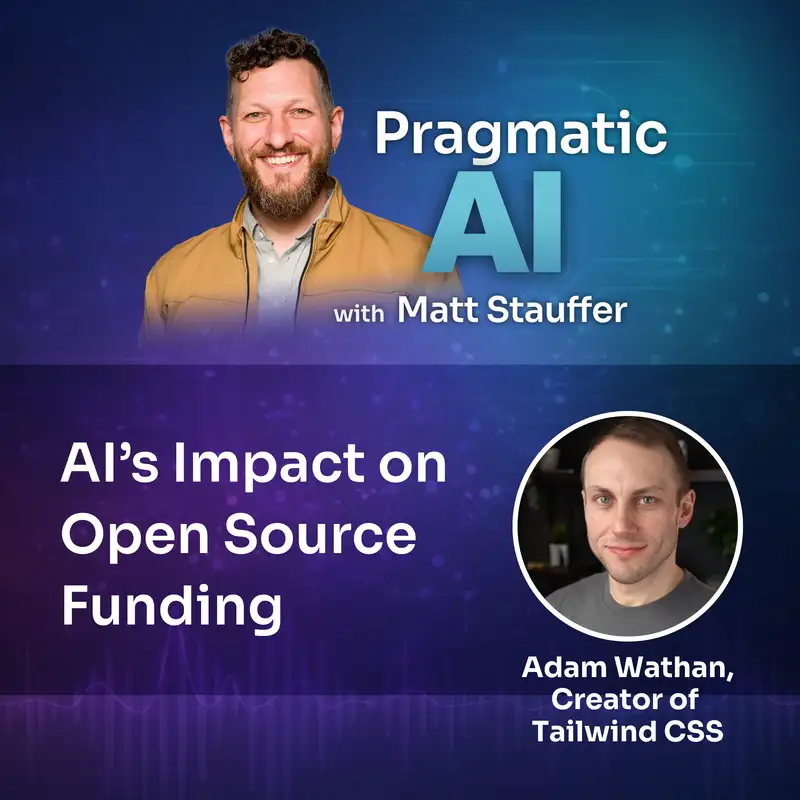
AI’s Impact on Open Source Funding
Matt Stauffer
All right, welcome back to Pragmatic AI, where we talk about using AI in the real world, what works, how to use it well, and when it causes more harm than good. Practical tools, real trade-offs for builders and business leaders. And my guest today is a builder and business leader, Adam Wathan We actually used to work together, but most recently he's been the creator of Tailwind, CSS, and I mean, a bunch of other products that have come out there. I'm actually just going to let you tell the story because I don't even know how you introduce yourself these days. So Adam, could you tell us about Tailwind and your role there?
Adam Wathan:
Yeah, I think I usually just say I'm the creator of Tailwind CSS. That's what people are most likely to understand. But yeah, I run a small business kind of built on Tailwind with the goal of sort of making Tailwind a sustainable project and being able to work on it full time. So I guess ⁓ on paper I'm like CEO or something, but that's always felt a little larpy because we're like.
five people or something like that, ya know, so doesn't, I don't know, I've never really loved the title, but I would say I'm sort of the leader at the company. yeah, I spend most of my time kind of just trying to figure out what to do next here, really, and what we should be working on and then
Matt Stauffer:
Yeah.
Adam Wathan:
getting into the actual work as much as possible, whether that's making improvements to Tailwind itself or working on our commercial template products that are part of the Tailwind Plus commercial side of things or trying to kick off something new. yeah.
Matt Stauffer:
Yeah. And so
for those who don't know, Tailwind is a ⁓ programming framework helping you do CSS, which is like the front end, the design. And it's basically taken over the internet. Very seldom will you see anybody say, you know what, I'm doing modern HTML, modern front end web development, and I'm going to use anything for my styling other than Tailwind. So this is one of the most, not prolific, one of the most everywhere kind of like pieces of code that ever exists.
Adam Wathan:
Yeah.
Matt Stauffer:
but you're giving it out for free, right? And so the question is how do you basically make a role for yourself, for your co-founders and for your employees where you're actually kind of like making money out of this foundationally free kind of product. So you guys have educational tools, you have like prepackaged sets of components and designs and stuff. That's mainly, those are mainly the two things that's come from plus sponsorships, right? Those main three kind of revenue streams.
Adam Wathan:
Yep.
Yeah. Yeah.
Yeah, more recently,
corporate partnerships and stuff too that we've been exploring. But yeah, that's right.
Matt Stauffer:
Yeah. Okay. So
recently, I mean, we have a lot to talk about, like what AI means in your day-to-day life and your world, but recently you guys had to kind of pretty big kind of public moment on Twitter as you talked about how AI has impacted you and how it's impacted Tailwind. For anybody who kind of didn't follow along, can you kind of give us the recap of that?
Adam Wathan:
Yeah, basically, if you go back and look at our sort of like revenue graph for the last few years, since early 2023, it's basically been on like a steady decline and early 2023 is right when like Chat GPT came out. And basically, you know, I think...
Matt Stauffer:
Yeah.
Adam Wathan:
what has happened to us is like historically we've sold pre-designed website templates and components and stuff like that. And as people have sort of incorporated AI into their workflow more and more, people are just like going to those tools to create the little elements that they need or designs that they need. And that means that like less people are buying our stuff, which.
I totally, I don't really resent it. I kind of just, you know, I see like that's kind of progress in our field in terms of how people are working and stuff and we need to figure out how to adapt to it. But we've been trying to figure out how to adapt to it for a long time and it's just been hard to really find our place in it. And then the other element I guess is like more and more people just rely on AI to answer their questions. So,
everyone has probably, or a lot of people have probably saw that chart that came out not too long ago that was like Stack Overflows traffic and how like today Stack Overflows traffic is like the same as it was like on the day that it launched because no one goes to Stack Overflow anymore to get answers to their programming questions, they just ask AI. So even though Tailwind has been getting like more and more and more popular, like the actual installation chart just as like up and to the right, our documentation traffic is actually decreasing. ⁓
Matt Stauffer:
Yeah.
Hmm.
Adam Wathan:
because fewer and fewer people are going to the docs and the documentation is like the only place where we can sort of surface the commercial products and stuff like that and that's historically been our distribution. So in addition to people just like using AI to create UI stuff instead of paying for commercial stuff, fewer people are just even finding out about it in the first place because they're not going to the docs.
So it's sort of like a double edged sword and well, I don't know if that's the right term, but there's two problems that kind of like stack on top of each other. ⁓ And then over the Christmas break, I finally sat down to do like some real financial forecasting because the thing about revenue going down, especially really slowly is like, you just kind of every month.
Matt Stauffer:
in which both sides are cutting you negatively. Yes.
Yeah.
Adam Wathan:
is lower than the month before, but it doesn't really feel like lower because it's so slow. You're just sort of used to things kind of being down a little bit. You're still able to pay everyone, still able to pay all your bills. So if you're not really making it a priority to be a CFO, which that's not what I do all day every day.
Matt Stauffer:
Yeah.
Yeah, yeah.
Adam Wathan:
It's easy to just sort of think like, okay, well yeah, things are not as good as they used to be, but they're fine, even if they're slower. But I did like some real forecasting and just went and looked and like, okay, how much are we down every month? And became clear that, man, like I keep thinking that like we're just kind of like at a comfortable floor here and that things aren't continuing to go down, but actually they are. And I'm just like, it's happening so slowly that I'm.
It's like a boiling the frog sort of situation where I just don't even really recognize that it's going down. And I basically realized that we only had about like six months of time left before our expenses would exceed our revenue, which is not, ⁓ you know, we're like a bootstrapped small company. know, we're not, we don't have.
Matt Stauffer:
Yeah.
Yeah, runway, yeah.
Adam Wathan:
cash in the bank that we raised from venture
capitalists that we're trying to burn us on our way to product market fit or something like that, you know, so that's not like a situation that our type of company is designed to even handle. It's not like we're gonna go take out loans or do anything crazy like that. You know, the only thing we could really do was basically make some big changes and we had to lay off three of the four engineers on the team to be able to get things into a spot where it felt like
Okay, well as long as some of the things that we're working on start to turn things around a little bit, then we should be in a good place. ⁓ Yeah, but that kind of caught me off guard. And then at the same time, someone had this PR open on the Tailwind repo where they, ⁓ a common request was everyone wanted either
markdown versions of the documentation so they could quickly copy it into their LLMs or like an LLMs.txt endpoint so their agent could go and like fetch that for them instead of like going and visiting the actual docs website. And this PR had been like open for like six months and I just ignored it really because... ⁓
Matt Stauffer:
Yeah.
Adam Wathan:
I was already stressed about traffic going down to the site and making it easier for people to not go to the site is like in conflict with our business model. Even if I think it's like a good thing for users, which is the most frustrating spot because it's like, okay, like I need this business to work so that we can pay people and keep the project sustainable. But we're in this spot where like the things that...
Matt Stauffer:
Yeah.
Yeah.
Yeah.
Adam Wathan:
would be good for users are bad for business. And that's just like a really frustrating spot to be because now it's like you against your customers, which is just like such a dynamic. It's like not how you want it to be, you know? But I basically just like let this PR sit for that reason because I'm just like trying to figure out how to sort of stop being in conflict with what's happening in
Matt Stauffer:
That's tough.
Yeah. Yeah.
Yeah.
Stop the bleeding. Yeah.
Adam Wathan:
our industry and figure out how we can like swim downstream instead of upstream, you know? And just like the day after we had laid everyone off, was someone had just like commented on the PR like, what's going on with this? It's been this many months. Like this is ridiculous. When is someone gonna merge this? You know, like your classic sort of open source thing, which whatever, I'm used to seeing that from people who just like assume that.
Matt Stauffer:
Yeah.
Adam Wathan:
Anytime that you're not paying attention to their contribution is like some personal attack on them and not just because I'm just doing other things with that time, you know, I'm not like ignoring you maliciously but it's just like this ⁓ Sort of perfect storm with the timing where I just eventually responded. I was just like listen like I We just laid people off for this reason. Like I'm not going I can't justify like spending a bunch of time
Matt Stauffer:
Yeah.
Adam Wathan:
trying to review this and add it to the site when the expected outcome in my mind is that it will reduce traffic to our site even more and put our business in an even worse place. And that's kind of like when, that kind of blew up unexpectedly, that little comment, and it got linked on Hacker News. And at the same time, I recorded a podcast where I sort of was talking about this problem, because I've been doing this podcast since the fall, where I just go for a walk
Matt Stauffer:
Yes.
Adam Wathan:
⁓ with my dog with a little microphone clipped to my jacket and I just sort of talk by myself about like whatever problems I'm trying to solve or whatever just a very sort of candid ⁓ you know like just me thinking out loud talking through stuff and historically the audience for it has been like fairly small and just like the people who are like really interested in like what I'm doing and I think they've sort of enjoyed that.
Matt Stauffer:
Yeah.
Adam Wathan:
that format because it's so transparent. But this one like blew up because yeah, I mean it just sort of like changed people's perspective I think on what position we were in as a business. think People See Tailwind is like a huge successful project so the company must be huge and successful and yeah like a couple years ago things were we were doing really well but
Matt Stauffer:
Yeah.
Adam Wathan:
Yeah, it kind of like put a spotlight on the fact that things weren't going well for us. yeah, so I think like the main thing that came out of it is all of a sudden a lot of companies sort of like showed up to join our like sponsorship program, which was awesome. Even companies that we had like reached out to in the past that are just like not come back to us or whatever, you know, and. ⁓
Matt Stauffer:
Yeah.
Adam Wathan:
So like we added a lot of partner program revenue, which was really awesome and honestly that's like the best type of revenue for us to have and in a lot of ways because it's just like companies that depend on the project that have budget to support these types of things and their only expectation is that we maintain the thing and make it better, you ⁓ But it's ⁓ I'm I've always been a little
Kind of leery of depending on like charity as a business. It just doesn't feel It feels like the first Line item for someone to cut from the budget if things get tough for them if it's always just felt more stable to me to be solving like a real problem and charging money for it directly, you know. So I don't think we're totally prepared to pivot completely into that
Matt Stauffer:
Yeah.
Adam Wathan:
model and I'm still like just genuinely really curious to see what happens long term with the partners that we've that we've added to the program, you know, it's like I don't know how to say this without sounding like a negative in some way, but as much as I appreciate all the support from these companies ⁓ at the same time, it was like a really good PR opportunity for a lot of companies to sort of jump out and say, you know, there's this there's this
Matt Stauffer:
We're gonna come in and rescue.
Adam Wathan:
There's this news cycle happening about AI. Here's a real situation where people lost their jobs because of AI. That's what it was spun as, which I don't know that it's quite as black and white as that either. ⁓ But it gave a lot of companies an opportunity to come out and be part of that and be the good guys. It's just hard to know how long all these companies are going to be able to justify sticking around supporting the
project and I hope they do and even if they don't I appreciate any amount of support for any period of time but again it's just like I can't just like bet the business on that working I think we still need to try and find some real problem that we can solve for people where people are happy to pay for it because the solution is worth more than they're spending on the solution you know so anyways that's that's sort of a recap anyways and and where we are now
Matt Stauffer:
Yes.
Yeah.
Yeah, thank you. And I mean, it's definitely very interesting to come face to face to what we've all been hearing for so long, which is AI is going to take your jobs, right? And the people's understanding of what AI taking your jobs in this scenario has been pretty mixed. Ya know, some people get it and a lot of people don't. But in the end, you did have what I think, you know, from knowing you for quite a while was one of the hardest moments you've ever had in your business career.
And AI was the primary driver for that. And I could definitely imagine walking away from that feeling really resentful. And one of the things you mentioned was you don't want to be in odds with your customers. And I feel like the thing that put you in odds is their move from the traditional consumption of educational materials, the traditional consumption of templates, towards doing everything through AI. And so I could really easily imagine walking away from that feeling just really negative and really resentful about it.
Adam Wathan:
Mm-hmm.
Matt Stauffer:
Is that something you're having to battle? Are you having to like make sure that, you know, or are you there? you? Yeah, like screw AI. I don't want to be a part of it. Or like, how does, how does this leave you personally and as a business owner?
Adam Wathan:
Yeah, any resentment I have, and I try not to really have it, but any resentment I have is more towards the fact that like, fuck this project, Tailwind is taking over the world, it's used by everyone, and somehow we can't
support eight people working on it full-time. Like it's used by like millions of people. ⁓ It gets like millions of downloads a day, I think at this point. You know, it's used by every new site that looks awesome that comes out is almost invariably built with Tailwind. It's just like how do you build something that has such an impact and is so huge and not figure out a way to like...
Matt Stauffer:
It's always downwind, yeah. Yeah.
Adam Wathan:
capture any of that value, you know what I mean? ⁓
Matt Stauffer:
Yeah, yeah.
Adam Wathan:
And we have captured a lot of value out of it along the way, you know what I mean? So it's not even fair to say that. But just like going forward, it's getting more popular. All the AI tools spit out code that uses Tailwind, you know? And it's just like, damn, like where, what am I not seeing here? Where is like the opportunity for us? Because surely there feels like there has to be one. But I don't have any resentment towards like AI as a technology. I'm like, I am hugely excited about it.
Matt Stauffer:
Yes, 100%.
Adam Wathan:
I love using it, I love finding new ways to use it. It's like the most transformative thing I've used for building things, ⁓ like in my whole programming career, I would say. So it's like really exciting time and...
Matt Stauffer:
Yeah. Yeah.
Adam Wathan:
Yeah, I'm not like an anti-AI person. I think there's a lot of people who are. I'm really excited about it. Just ⁓ almost more frustrated with myself that I'm struggling to find where we fit into it in a way that helps us continue to develop ⁓ the tools.
Matt Stauffer:
Yeah.
Yeah.
I mean before you made Tailwind, you were primarily a Laravel developer. And one thing that helped you gain prominence at that point was you were constantly out outside of the world that was around you, learning what other people were doing and then adapting it, teaching it, building patterns, building applications that were using kind of ways of thinking that were new for the people that you're around. ⁓ So I have been watching you kind of as a friend, ⁓ kind of process a lot of these things and
Adam Wathan:
Mm-hmm.
Matt Stauffer:
It reminds me a lot of that, you know, like I don't know about you I'm 41, I think. And I have found that it was a lot easier to adapt and try new things. And when I was younger and now that I'm kind of a little bit more established, I'm sort of like, sometimes I just want the thing to work. I'm like, I've worked really hard to get here and I just want it to freaking work and I want my business to be successful. And sometimes it feels hard to be knocked down to square one, ya know, like Titan had a hard time in 2022 and we were knocked down to the bottom peg and
Adam Wathan:
Mm-hmm.
Matt Stauffer:
had to fight back up to where we are today. Is there an element where it's any harder to get back there after success, if that makes sense?
Adam Wathan:
Yeah, I think so. I think there's a bunch of factors to it, honestly. When I was young and didn't have kids and really hungry to make something successful, it was a lot more intrinsic sort of motivation, for sure. Now I kind of feel like, I...
Matt Stauffer:
Yeah.
Adam Wathan:
I have three kids, I've got a fourth kid on the way, they're all young kids, like eight and under, so it's a busy life. And there is no energy to stay up late and hack on things or learn new stuff or whatever. I think, especially with the pace that the AI stuff moves at, it is really challenging to...
have the energy to sort of keep up there. yeah, at the same time, you know, ⁓ like Tailwind has been like a huge success for me personally over the years, even if the business isn't in the best spot ⁓ now compared to where it was. But I sort of like the whole time sort of ⁓ acted
as if it wasn't gonna be successful forever. I tried to save as much money as possible along the way and really just try to set myself up so that if Tailwind was only big for five years and that was the only time to do anything with it, that that was enough to give me what I needed to feel like I made it in life. That doesn't mean that like, I don't know.
Matt Stauffer:
Yeah, yeah.
Yeah. Yeah. Yeah.
Adam Wathan:
Yeah, ⁓ anyways, I guess what I'm saying is, ⁓ yeah, I don't need a big success the way that I wanted one when I was younger and hadn't had it yet. I feel like we've released some products that have done really well and we took a lot of money off the table along the way to make the most of that. ⁓ now, ⁓ yeah, so now it is a little bit harder to f***
find like where is the where does the sort of like motivation come from or like what are you trying to
Matt Stauffer:
Yeah.
Adam Wathan:
to chase, you know? ⁓ But in some ways I think that's like almost an inevitable, it's almost like healthier to be in that spot, because it forces you to like try and do things for, ⁓ I don't know what the right way to describe it is, almost like, I wouldn't say the right reasons, because it's important to try and earn money and provide, you know what I mean? Like you need to do that.
Matt Stauffer:
Yeah, yeah, yeah, 100%.
Adam Wathan:
But to do things like for your own sort of fulfillment and what's gonna like make you happy, I guess, you know? ⁓ But I am finding like a lot of the same fascination with working with AI that I had in those like early Laravel days where I was trying to crack test-driven development, you know, like, or trying to crack CSS with Tailwind. And right now I'm trying to crack like building
Matt Stauffer:
Yeah.
Yeah, yeah.
Adam Wathan:
UIs with AI because I don't, haven't seen a workflow for that that feels right yet, you know? But it also just feels like walking around in a pitch black cave, like with your eyes closed, spinning in circles. And it doesn't help with AI that everything is like non-deterministic and that every two weeks a new model comes out that behaves differently than the previous model and... ⁓
Matt Stauffer:
Yeah.
Adam Wathan:
Yeah, I don't know, it's chaos, you know, but it's very mentally stimulating for sure. I feel like honestly it's been a long time since I've been this just curious about something. I think that's probably the best part. For a long time I've just been working on things that felt like this is something I know how to do. I'm just doing more of the thing that I'm good at, that I know how to do. And that...
does get old, think. definitely personally thrive in situations where I'm learning. That's what I really think I enjoy the most. ⁓ But it's also like, ⁓ yes, it's harder to push through the wall when you kinda don't necessarily need to, to your point about, okay, if you've already had a success,
Matt Stauffer:
Yeah.
Adam Wathan:
I joke about this with Taylor Otwell from from Laravel. You tell me if this like resonates with you, but like we've had this conversation where we both sort of have this same sort of like recurring dream almost like nightmare. And I don't know if other adults have this where like you find yourself like back in high school or something, but you're you at your current age with like your current level of success or whatever. And the teachers like giving you a hard time and you have to get this thing done and
whatever, and it just like occurs to you at some point in the dream, like what the hell am I here for? Like I have a successful business and there's no reason for me to be here, you know? And it's like a similar feeling in some ways when you've run into like a really hard problem. It's like why am I trying to push through this when I could just go and pick up my guitar or you know, go tobogganing with my kids or whatever, you know? But.
Matt Stauffer:
Yep. Yep, 100%.
Yeah, 100%.
Adam Wathan:
you know, if you let yourself sort of give up like that, then life is even less fulfilling and more boring. You know, I think like the struggle is is sort of the whole point, you know? So, yeah.
Matt Stauffer:
Yeah.
Well, it's, you know, one of the things that a lot of people keep asking is like, is AI finally going to be the thing that takes all the work off of our plates so that we can just live our ideal lives? And I personally think, you know, we live in capitalism, the answer is no. Like somebody's going to have to, we're going to have to be doing some work that someone pays for at some point. But it is interesting to me how this has kind of like given a moment for you personally to, I mean, like Adam Wathan has a job for life, right? I'm not saying you want to be somebody else's employee. And I think that's a thing here.
But we can get to a point where like there's no moment here where the guy who wrote, know, who's the primary author of the framework that every single AI language tool framework, everything like that uses is not gainfully employed for all of time. So the question here, you know, for you, thankfully is not, can I pay my bills? It is in a different market where the thing that was working before is not
bringing the ability to kind of sustain the business shape that I had before, what's the new shape? And then some of that is a business question, right? Like, you and I talked a bit where I had to do some layoffs as well a couple of years ago, and it was really hard. And one of the things that someone told me basically was like, he's like, if you are losing money every month, this is not some moral failure of yours. This is not some, you know, existential issue. It is the market and your cost to operate are not in sync with each other and you need to get them in sync.
Adam Wathan:
Mm-hmm.
Matt Stauffer:
And so he's just like,
Adam Wathan:
Yeah.
Matt Stauffer:
you got to get him in sync. And if that means an individual can't work for you anymore, I know that's a really sad moment. Hopefully you give them great severance, which I know you did. But like in the end, like your business shape is not working. You got to get your business shape working so that you can be profitable again. If it's not a profitable business, it's not helping anybody because they're going to lose their jobs. Right. So part of it for you is definitely just like a business shape thing. But there's this also like this technological educational shape as well. And so that can, there's a lot of
Adam Wathan:
Yeah.
Matt Stauffer:
things on your plate that you have to shift. I think you probably handled the business shape pretty well with, you know, like changing the size of the team, getting more sponsorships and stuff like that. But now you have this big technical shape of like, what offering can you give that people will pay money for that makes sense in the world of AI? And that's a brand new innovation. Nobody else, like you're not, you're not building an established idea, like another entry in an established category here, right? And so,
Adam Wathan:
Yeah.
Matt Stauffer:
I don't know if I'm saying anything there that you can actually respond to, but it is interesting to me that ⁓ you just kind of get this moment to say, ⁓ like, I'm good, ⁓ but there is an interesting challenge that's never been done before. ⁓ And that on its own is fascinating for me. I've heard a lot of people talk about how AI is allowing them to either create things that they've never created before, it wasn't time or worth it, or it's putting challenges in front of them that they've never had before. And I feel like there's some of that going on for you.
Do you feel any of that? Like I can make something I wouldn't have either wouldn't have been able to or wouldn't have been a time to make before or is it purely just in the challenge perspective of trying to find Tailwinds kind of spot there?
Adam Wathan:
I think I'm more focused on the opportunities than the challenges, honestly.
Matt Stauffer:
Mm-hmm.
Adam Wathan:
Like, I posted a tweet a year and a half ago.
when during sort of like the co-pilot tab completion era of AI, which is crazy that that's what we were doing only a year and half ago. But the tweet was something like, know, is there anything out there that lets me use like AI to sort of automate repetitive tasks yet? Like I need to upgrade from this version of this library to this new version of this library. Here's a commit where I've updated a couple files in the project so you can kind of see what I'm doing. Can you just go do this everywhere else?
Matt Stauffer:
Mm-hmm.
do the same thing. Yeah.
Adam Wathan:
And nothing existed at the time and all the replies were like, yeah, that would be cool, wouldn't it? And it's so laughable now because like that's agents, know, like that's what we're doing with everything now. So those are the sorts of opportunities that are like really exciting to me, like even with Tailwind CSS itself, ⁓ it's such an established project at this point that changes to it are mostly very ⁓ just sort of like
Matt Stauffer:
Yeah. Yeah.
Adam Wathan:
introducing a new set of utility classes that follows the same pattern as something else. And I can just like using the Claude code app on my phone, start up a new conversation and just say, hey, can you add utilities for this, this and this, make sure you add tests that look like the other ones. And then like 10 minutes later, a PR magically appears that like looks.
Matt Stauffer:
Yeah, yeah.
Adam Wathan:
exactly like I would have written it because all it's doing is following the same existing conventions in the code base, not even adding any new features. It's literally just, ya know, so stuff like that is like, man, ⁓ this is really tedious work that was always at the bottom of my priority list that's really easy to do now. And we've always struggled with maintaining
Matt Stauffer:
Yeah.
Adam Wathan:
triage and GitHub issues and stuff like that. I haven't done this yet, but I know it would be trivial to write.
like a bot on GitHub that's LLM backed that can determine, was there like a reproduction provided for this bug or not? Just like using some analysis of the message, does this sound more like it belongs in discussions or is it like an actual bug? Like I feel like you could automate so much of that stuff. I feel like you could even automate like fixing the bugs without any person being involved, you know? It's just fascinating what you can do with that stuff. And then I think like the other thing that...
Matt Stauffer:
Yeah, yeah.
Adam Wathan:
I'm doing with it a lot is creating almost like throwaway tools for things that would have taken way too long to build given how you're only gonna use it like once or twice. But now you can build them so fast. And I think like a lot of us agree that like if you just try to one shot something with AI, the quality is not.
Matt Stauffer:
Yep, 100%.
Adam Wathan:
always there for it to be production ready. Like I would release this as a product. ⁓ Maybe the performance is kind of bad or maybe there's some weird bugs or maybe the code is structured in a way where six months from now it's gonna be a total disaster. But if I know I'm just building this tool to help me achieve this outcome today and then I can delete the tool, then it doesn't really matter. So a good example is we're working on a template and Steve had designed this sort of feature section that had
Matt Stauffer:
Yeah.
Yeah, once. Yeah.
Adam Wathan:
sort of like a graph SVG and it's just like an up and to the right sort of like nicely stylized sort of graphical element you know it's not meant to be like real SVG chart or anything it's just supposed to look like an illustration and trying to export it from Figma in a way where it was like scaling the way I expected it to and stuff in the browser was really difficult it was just not giving me the SVG sort of like written the way that you might write it
directly in code if you wanted it to work this way. So I just pasted like a screenshot of it into V0 and was like, can you build me a tool that lets me adjust like how tall the start point is and how tall the end point is and how many like dividing lines there are and what the opacity is of different things. And it just like one shots you this tool with all these like range sliders and stuff. And you can just copy the SVG from it at the end. And because the SVG is like programmatically generated.
Matt Stauffer:
Nice.
Adam Wathan:
is much cleaner than it's just like the sort of borderline rasterized looking SVG as it comes out of Figma. And I'm never gonna use that tool ever again. And I never would have built it because it would have taken me way longer to build it than it would have to just like write the SVG by hand in the first place. So I'm doing stuff like that all the time now, just creating these one-off tools because the cost to create them is so low. ⁓ And then also just like even
Matt Stauffer:
Yeah, I think my, yeah.
Adam Wathan:
I don't know, like I'm always trying to just like pay attention to every single task that I do and see is there a way that AI could help me do this. And I find like surprising new things every day. Like just yesterday, we were migrating the Refactoring UI website, which is just like a basic landing page where we can buy this ebook that we released years ago. Migrating it from Paddle to Stripe, because we're trying out Stripe's new managed payments stuff. ⁓ we're just sort of like trying to get our heads around how
you sort of model products versus prices versus whatever in Stripes backend because I don't know, it takes a little bit of trial and error to figure out what's the right fit for your situation. So initially for like our team pricing, we just had one product with different prices and each price meant you'd get a different number of seats or whatever.
Matt Stauffer:
Number of seats,
yeah.
Adam Wathan:
but the checkout doesn't show the description from the price. So on the checkout, you had no way of knowing that I was buying this for five people or eight people. You just sort of had to remember that you clicked that link. We're like, crap, this sucks. We already had this all set up. And it seems like we need to move each one of these to a separate product.
Matt Stauffer:
Okay
Adam Wathan:
So that's gonna mean sitting in the Stripe UI, click, click, click, type, type, type, back, save, click, click. There's like nine of these things. It's gonna take like 20 minutes of just like boring, tedious work. And I was on a call with Jonathan Renning, I worked with while we were doing this. And he was like right about to like get into that. And I was like, wait a minute, we have a Stripe API key in this project. Ask Claude to just do this with the API. And 30 seconds later it was done because it just goes, it pulls down the product, sees the prices that are there.
Matt Stauffer:
All right.
Adam Wathan:
keeps track of that and its little memory that makes a bunch more API calls to just like create all the products for us. And it just does it flawlessly, you know? It's just like, is there, just like noticing, is there like an interface that exists where this coding agent could talk to the thing where I'm trying to do this work? And more often than not, like it does exist and you can automate that work. ⁓ So yeah, I don't know. I'm having a lot of fun just like,
Matt Stauffer:
Yeah.
Mm-hmm.
Adam Wathan:
trying to.
Find figure out how to delegate a lot of this this stuff to AI and and honestly like
It's kind of like scary to even talk about this, but on the point of like AI taking people's jobs, it's, I really feel like ⁓ it really can replace certain types of roles, even at software companies. And it's like, you know, that sucks, but I think pretending that's not true is just like putting your head in the sand because
ya know, we have, ⁓ historically, sometimes I'd run into something at the company where it's like, ⁓ fuck, there's this little annoying thing, someone needs to take care of this, I'm in the middle of something. I might just go into our team Discord and just drop a message, hey, when someone gets five minutes, can they just go and do this thing? And now I can take that exact message and just put it into the Claude desktop app and it can literally take care of the task, you know? So, I mean.
The positive side of that is like, okay, it kind of frees up everyone to sort of work on more interesting, like creative work. ⁓ But you might have a certain team size at your company because you needed capacity to take care of those sorts of things. I think with everyone setting up their Claude bots, there's a lot of VA work that's disappearing to stuff like that. ⁓
Matt Stauffer:
Yeah. Yeah.
Adam Wathan:
And I think even at software companies, like a lot of companies have ⁓ technical people that are really doing like assistant type of roles in a lot of ways. I mean, that's something that I sort of learned running a company over time was, ⁓ there's this book called Buy Back Your Time by Dan Martel that just like talks about a lot about like how to think about like delegation and what sort of tasks to delegate. ⁓
I had sort of found I had fallen into a trap running a company where I was delegating away all of the interesting work. ⁓ And I was just doing the boring stuff and it was becoming sort of really depressing for me. But my job and life got a lot better when I started spreading out more of the stuff that I didn't want to do and finding people that actually really like were totally fulfilled, like trying to dig into some deep bug and f-
Matt Stauffer:
Yeah.
Adam Wathan:
solve that problem and whatever, you because I think that's the other thing that's hard for people to sort of like get a lot of the time is that just because you don't like doing something doesn't mean that it's not someone else's like favorite thing to do, you know. But yeah, like these agents can just do a lot of that type of work for you now. And. Yeah, I don't know what that means, you know, but it's just reality.
So, yeah.
Matt Stauffer:
Yeah. Well, you got to it before
I even asked. I was going to ask questions about how you feel like the impact is on kind of the human aspect of our jobs. So I really appreciate you going there. ⁓ One of the things that in other industries we've seen a lot of complaints about is like the real thing that someone is passionate about that they've devoted their lives to, like artistry and writing are the things that they're unable to do. And I know that, you know, saying there's less space for education means your role as an educator is being kind of infringed on.
⁓ saying there's less space for building UI patterned ⁓ Tailwind templates, means there's less space for that in your job. Do you feel ⁓ an encringement on your core identity as being like the things that Adam Wathan loves doing with his life that fulfill his passion, there's less space for those? Or are you feeling like there's space for that, but what specifically looks like is just shifting?
Adam Wathan:
A bit of both, honestly. I think I've spent a long time honing this craft of API design, for example, and just designing really delightful to use APIs. I think if you look at Laravel, that's a craft that Taylor's honed for a long time, too. Just naming things in this way that makes people sort of smile or whatever. It's hard not to lament the fact a little bit that
that work is almost like counterproductive now in an AI dominated world because a method like chaperone and Laravel is not intuitive, what that even means to like an AI. So it's better to name it some boring descriptive thing that is self-documenting for AIs. And in some ways like, yeah, it was like more self-documenting for humans too, but it just had no personality, know?
Matt Stauffer:
Hmm.
between AI, yeah.
Yeah, huh.
Yeah,
Adam Wathan:
and it just wasn't as fun. But if
Matt Stauffer:
didn't have the art. Yeah.
Adam Wathan:
you're not really interacting directly with the code as much anymore, no one's benefiting from it. But it also just means it's like.
Matt Stauffer:
Yeah.
Adam Wathan:
you just don't really get to do much of that work anymore. Or there's just like not a lot of value in it. And I was listening to Caleb Porzio's podcast the other day and he was talking about, you know, if he was to do like a conference talk at Laracon this year and he was going to show a bunch of new APIs added to LiveWire or something like could, would people even get excited? You know? And I totally understand like where he's coming from. like,
I'm not typing code anymore as much, know, like still a little bit here and there, but for the most part, I'm trying to not. ⁓ You almost wanna optimize for like reviewability of code, you know, to make sure that when the LLMs write something that you think it's good. So yeah, it does kind of feel like there's some things that are just not important skills. ⁓
Matt Stauffer:
You actually, it's good, yeah.
Adam Wathan:
And I'm sure there's millions of analogies to other areas of progress in the world, but in a lot of other places like CNC, sort of like machine churned out furniture, it obviously replaced handcrafted furniture, but there's still a market for handcrafted furniture, because if you have that nice piece of furniture in your house that you know someone made by hand, it just sort of means something different.
I'm not sure people are gonna ever be sentimental about code that same way, you know?
Matt Stauffer:
Yeah. I mean, I can say that as a consultancy,
we've got a lot of people who come to us who say, I tried to do it the full AI way. And I realized that whether or not you are handwriting the code, you're bringing a level of understanding. We just talked about with Aaron about this, about architecture and planning and the ability to review to make it good. So there's definitely like a need for the human element. But there's a difference between a need for the human element and the need for the human artistry of actually like hands to keyboard, right?
Adam Wathan:
Yeah.
Yeah, yeah,
yeah, and I don't know where we're at. Like right now we're in this sort of position where there's still a lot of people who know how to do this stuff the old-fashioned way, and that makes them very good at doing it with AI. But it feels like we're sort of burning a bridge behind us, and I don't know, I don't know, like, well, I'm sure this has been a problem in the past too. So it's just, it might just not matter. What might matter is just like there's gonna be new ways of learning how to build.
Matt Stauffer:
Yeah, how do people learn, right?
Yeah.
Adam Wathan:
things and you're just gonna have people who understand things differently but can still get like the same results and wield the tools differently and whatever and it's sort of hard to maybe like just predict exactly what that's gonna look like but I could totally see how that's the case. I sort of have to believe that's the case because it seems, it doesn't seem right that we're just not gonna know how to do this stuff in 20 years or whatever. ⁓
But on the education side, I think the appetite for learning how to do a lot of the programming stuff is definitely disappearing. I know Jeffrey at LaraCast is struggling to get people excited about learning how this new feature in Laravel works in some video, because again, people are just not typing the code by hand as much as they were in the past. But.
I think there's an insane amount of opportunity in teaching people how to sort of work with these tools. And I think there's a bit of a gold rush around that in some ways, but I think people are sincerely hungry for someone to help them become experts in building things this way too. Like, maybe more than I've ever seen people hungry to learn anything, honestly. ⁓ So.
Yeah, think you can still teach people things. You just have to be teaching them the right things, you
Matt Stauffer:
Yeah. Yeah.
mean, I wish we had more time to talk. I got to start wrapping. But one thing that I think you'll appreciate, because I for those who don't know, we're recording this before Aaron's episode has come out. So he hasn't heard Aaron's episode. But in Aaron's episode, we talked a little bit about how ⁓
the foundations are even more important. Like if you look at boot camps, boot camps people trained people primarily on the code to write ⁓ and computer science degrees, which a lot of people have been looking down on over time taught you the foundations. But now like the things that are getting us through in prompting and reviewing code from AI is more in the foundation side than the pragmatic practical kind of step by step. And so the cool part about that, I think somebody just put out a tweet, Lee Robinson, I think just yesterday saying like, I think there's
Adam Wathan:
Yeah.
Matt Stauffer:
there's going to be a return to understanding what are the foundations because that's what we're bringing uniquely rather than us just being kind of like fingers on keyboards. So the dream, there's not like you said, there's people who going to lose jobs, people who are going to lose opportunities. And the prayer is that we can help shepherd that in a way where there's this minimal negative impact on individuals and their families as possible. But like the hope is that it is what has happened. And when other technological shifts have happened, which is just those people take new roles that didn't exist
Adam Wathan:
Mm-hmm.
Matt Stauffer:
before or they're taking a different step in the stack or you know the dream is that there's just more software being produced and people are taking a different role in the software production but it's not like all of a sudden there's just left jobs or whatever so
Adam Wathan:
Yeah,
I think that's true. think I heard Jordan Gall talking about this too the other day. It's almost like this, you need to learn a skill now of like, almost like the discipline to like work on the things that matter because like the, if you're good with using these tools, just like the bandwidth that you have for building is so high now. Ya know, it's like the developers are waiting on the product managers now rather than the other way around, you know?
Matt Stauffer:
Yeah.
higher. Yeah.
Yeah, yeah,
yeah, totally. ⁓ So if people are fascinated by you, they want to keep learning from you, how do people follow you, Tailwind, your process, and everything else you're doing?
Adam Wathan:
So, yeah.
Yeah, the best place is just on Twitter, X, whatever. Just Adam Wathan over there. That's only place I really hang out online. yeah.
Matt Stauffer:
OK.
So you don't know this because again, this is this none of these have been released but at the end of each These episodes I want to share two tips that people have shared with how they're using AI and the day-to-day So I just went out in Twitter So you the guests just to get to sit here and listen, but it's gonna be real quick So the two people who I have lined up here are ⁓ Andrew Schmelian and Roxy Rodbeck So Andrew said and remember for those who listening I said just ask people ⁓ What are some practical not like I'm using the latest greatest sexiest but just practical day-to-day ways that AI is a part of your life LLM
and stuff. So Andrew said, I found I was deficient in few vitamins. I planned out meals to make them fit my taste. I wanted a markdown based API test runner. This is super nerdy, but with very niche use cases. And it's similar to you, right? Like a very specific niche. He said, just, I had it built it. Uh-huh, personal software. We could have an entire additional episode about personal software.
Adam Wathan:
Just like personal software, you know?
Matt Stauffer:
⁓ And then Roxy said I use chat GPT to help me picks out pick up shoes I have it swap out the shoes in a photo to see how the different colorways look with an outfit before dividing deciding which ones to order Have you ever done anything like that? Because I feel like you in the early days you were doing that with your Yeah
Adam Wathan:
I love using the image generation stuff. I mean, I
was using it a lot more when I was trying to do a bunch of renovations in my house and the models weren't as good then, so was kind of frustrating. I almost wish that I had more stuff to do now, because this Nano Banana Pro 3, whatever the hell it is, it's incredible at this stuff now. yeah.
Matt Stauffer:
was just thinking of.
Yeah. Yeah.
I remember
when you were redesigning your office, would often be like throwing pictures and be like, show me what this office would look like with this flooring. And at that point it was struggling a little, but it was pretty, pretty cool to see that that's actually possible. So.
Adam Wathan:
Yeah, yeah.
Matt Stauffer:
Well, Adam, know you're ⁓ insanely busy and I really appreciate you spending some time to share all this with us and hang out on this untested new podcast. ⁓ I really, really, really wish for the best for you and the company, but I also believe for the best. First of all, you've already shown that you're kind of turning this all around. And second of all, ⁓ like I just said, like Adam Wathan is set, right? Like, and I love that it's not just about being set and providing for your day to day, but also you want to do these creative things. But I'm really excited to see kind of what you figure out out of this as we're going forward. So thank you so
Adam Wathan:
Thank you very much. Yeah, my pleasure. Happy to do it. Cool.
Matt Stauffer:
for hanging out man. Awesome
and for the rest of you thanks for hanging out we'll see you next time.
Creators and Guests