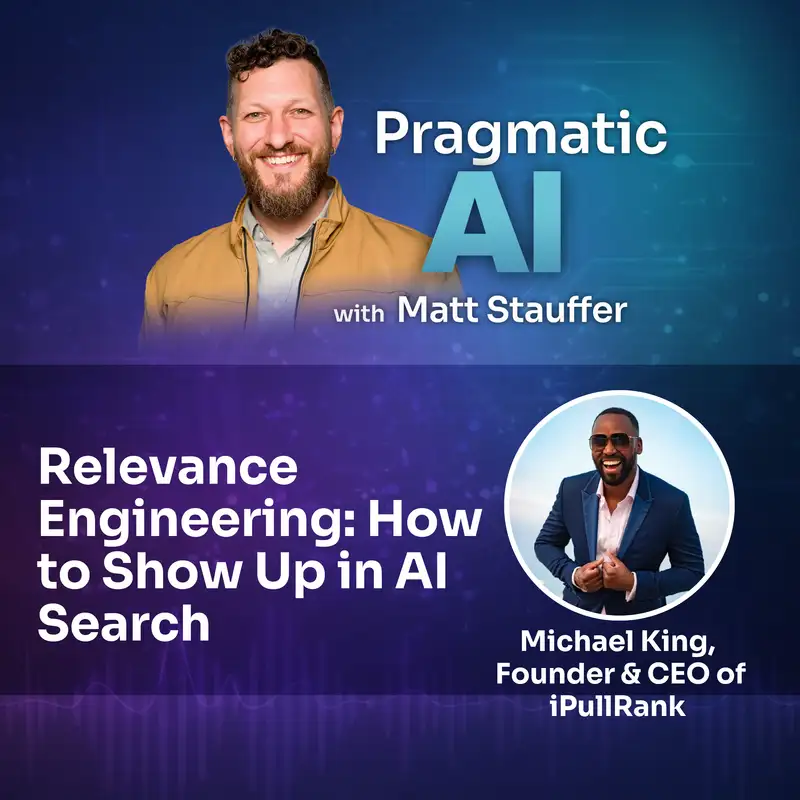
Relevance Engineering: How to Show Up in AI Search
The Pragmatic AI Podcast is sponsored by Tighten.
T-I-G-H-T-E-N.
We will take your AI ideas, prototypes, or even vibe-coded apps,
and we'll take them to production.
Scalable and secure. Check us out at tighten.com.
All right, and welcome back to Pragmatic AI, where we talk about using AI in the real
world, what works, how to use it well, and when it causes more harm than good.
Practical tools, real trade offs for builders and business leaders.
And my guest today is my friend, a builder and a business leader, and also a rapper.
We'll talk about that later.
Mike King, the founder and CEO of iPullRank Mike, thanks so much for hanging out with me.
And could you say hi to the people and tell them who are you and what do you do?
Hey Matt, first of all, thanks for having me.
I am, like you said, Mike King, founder and CEO at iPullRank.
And we are a relevance engineering firm that focuses on machine media.
And if those words sound crazy to you, what we do is help people get visibility in AI
search engines.
Okay.
So uh I mentioned to you that just a couple episodes, I don't think if it's even live yet.
I actually talked to Meg Clark, my friend, who also does search engine optimization.
And usually I'm trying not to put people who do the same thing back to back too much.
But I think you guys are in pretty significantly different worlds, so I don't I don't feel
any discomfort about that.
But I just want to note to folks that like there's a gonna be a little bit of overlap.
But one of the things that I kinda get to got to know Mike from in the first place is Mike
is out at conferences talking about like like people...
There'll be like a new thing that comes out and Google's changing their ranking and like
SEOs are all like, we gotta learn.
This is the dude they talk to to like learn how to parse through the documents and figure
out what it means.
And he's up on stage with graphs and be like, Well, I broke the whole thing down.
I haven't slept in forty-eight hours because all I've been doing is breaking this thing
down.
So this guy does work for clients 100%, but he is a leader in the industry thinking about
how, you know, how these things have worked since
I don't know, twenty years ago, I think.
You've been at it for at least fifteen years, right?
Um
I I started an SEO in in twenty or excuse me two thousand six.
Yeah.
Yeah, so 20 years.
So he's that guy, right?
Um, so you use some language in there that's not, you know, because some people are like,
we're replacing SEO with GEO, which is fine, right?
But you you're there's a lot more that you said there than other than just we replaced the
search with the generative, whatever.
So talk me through how are you seeing the role that you take for your clients and what is
in what ways is it different from what you were doing when it was Google optimization,
basically.
Sure.
So I mean of course it's different because there's different channels that we're talking
about.
ChatGPT functions differently from Google or perplexity and so on and so forth.
So there's more to know as far as nuances of how those channels react to your content.
And the other thing is that there are things that we've tried to do as SEOs that the
market just wasn't really allowing.
But now that it's AI search, it's like a blank slate.
We can say, okay, this is required.
And so, you know, there's a world where if SEO grew the way it was supposed to.
To then it would be what you know people are calling GEO or AEO.
My problem though with those names is they've never made sense.
Like search engine optimization also doesn't make sense.
You are not optimizing a search engine, you are doing feature engineering for a search
engine.
And the same is true of you know GEO and AEO.
And so where I've landed is this concept that we call relevance engineering, which is
really like the confluence of AI, content strategy, user experience, digital PR.
And uh
There's one more thing.
I can't.
information retrieval.
And the reason why I'm saying those things is because you can be a great SEO and not know
how things work.
But right now, things are changing so fast in this AI world that you have to know how they
work in order to find where the opportunities are.
And so it's more of a technical function to some degree, or at least a technical
understanding that you need to have to then apply to those other functions.
And from my perspective, SEO just is not
enough to represent that.
Got it.
So a lot of people, as they've been kind of imagining how do we whether or not someone is
a full time SEO or not, like I own a business and I actively want to make sure that we
were super discoverable before because of the things we had done to build reputation.
I want to make sure that as people are now trying to discover people like me through AI,
that they are also seeing us come up, right?
So I'm I'm I'm in your kind of target market there.
And so people like us, and especially people like you, uh a lot of our first thoughts are,
well, let's just poke at it from the outside and figure out what works.
Mm-hmm.
Mike King, the things I know about Mike King is he's not just gonna poke at it from the
outside and figure out.
He's gonna say, well, what is the underarching technologies and what are they doing and
how are they looking through?
But it's never been super clear, right?
Google's not trying to publish a document that teaches everybody, like, here's what we're
using for our ranking.
And yet somehow you still always were able to dive in.
So I know that you're gotta be doing the same thing with these AIs.
So obviously, we don't wanna hear your trade secrets, you gotta keep that.
But what can you share with us about like what does it look like?
To develop technical skill in understanding not just the outcome, the outer shell of like
what does good, you know, like search ranking and ChatGPT look like, but like
understanding the technologies behind it.
How do you even go about doing that?
Yeah, I mean I think that's ultimately my role in this space is like, you know, I have
like a a a
a s a special set of skills that allow me to do it, you know, because my background is
computer science.
So I can like wade through things like patents and white papers.
Cause the reality is that the engineers that work on Google, that work on open AI and so
on and so forth, they're very forthcoming about what they do.
Like they have their own conferences and they're like, hey, I want to show off how this
works in my white paper.
It's just that people that do SEO read like the public documentation from Google.
You gotta peel a layer back and see what are the engineers talking about, what are the
researchers talking about, what are they publishing in their patents?
And a lot of it is very dry reading.
It's just I have the wherewithal to get through that dry reading and then translate it for
people that actually use it.
And so beyond just reading, I also like to do a lot of proofs of concept.
So when Google announced what they call search generative experience, it's now called AI
overviews.
I was like, I need to know how this works.
And so then I just did a bunch of research.
Research came across what's called retrieval augmented generation, which is really a fancy
way of saying a large language model combined with a search engine.
And then I found the open source equivalents for all that and I built a version of it.
And so that's how I understand how things actually work.
So I can then give that information back to the community.
So we published something that we call the AI search manual, and it's something that we
continue to update and so on.
And we give all of the things that I've learned and like very
beautiful charts and and you know figures and things like that.
It's basically the equivalent of like if I wrote a book for somebody like here on the web
for you guys.
And you know I think that's been really impactful to the space because a lot of people are
just running around saying like hey it's just SEO, but we've peeled the you know layers
back to showcase that it's not and it requires different things or at least more things in
either in order to be impactful there.
Yeah.
So you and I have both been people who historically have chosen that uh rather than
holding everything super close to the chest, we teach everybody else in our industry and
we kind of say that that's gonna work for us.
Have you found that being someone who shares everything you know with everybody around you
has become more or less of a value to you or more or sorry, more or less beneficial to
you, or more or less of a liability as AI kind of has become the place people gain garner
reputation?
Or is it not clear yet?
No, I think I think I'm getting diminishing returns from me specifically because you know
I where I'm at is I feel like I am kinda speaking to an echo chamber and then like
teaching that echo chamber and then I'm watching them like reflect back the ideas that I
know they got from me but try to act like they came up with it.
So it's like, you know, th there's always value in giving back because that's how I
learned.
I learned from people that were doing these things before me.
But I'm thinking in a space where I'm like, uh, maybe my team can focus on that.
I need to figure out how
how to like get to the next level of my career and what I wanna do with my life and things
like that.
Yeah, no, that makes sense.
Um, so as you have been exploring kind of like helping people place, is the general work
you're doing just directly help me find someone who so for us, you know, who's the best
person to go to for Laravel?
Who's the best person to go to for custom web application development, making sure you
land there?
I imagine it's not just that, but it's a lot more nuanced.
Um, as you're thinking through what are people ranking for and how are they getting these
placements, have you found um that you have to develop new
skills and workflows or is it more like applying the same existing skills and workflows of
figuring out what the keywords are and what are the quest what are people searching for
and you're just applying them in a new context?
Yeah, it it's more that you're applying them in a new context, but there's more nuances
that you need to think about as far as like how are you how do you become eligible to be
considered by the language model for a response?
Because like I was saying, it is a large language model with a search engine.
And so what they're doing is they're taking your prompt and they're breaking it down into
a a series of keywords effectively, and then extrapolating on those and then pulling back
a bunch of things that rank for those subsets of the keywords.
And then they're looking at the documents and pulling
out the roast the most relevant passages and then they're sending them down like a whole
agentic pipeline to figure out what should be used.
So for you as someone trying to get into it, a big part of it is creating more surface
area.
And that surface area isn't just pages on your site.
It's across your content ecosystem.
It's like what videos do you have?
What sort of uh conversations in Reddit are talking about you?
Are you active on on LinkedIn posts?
Are you getting coverage in PR outlets?
Things like that, all of that matters.
And these systems are effectively looking for consensus before they determine an answer
that they can provide to the user.
So, you know, ultimately it's about how do we get you in more places ranking for more
things across the web with your messages so that you can appear in those responses.
You mentioned digital PR a couple of times.
Is PR something you've done a lot of or is that something that's more new for you?
I don't know a lot of people who do PR.
So I mean digital PR in the SEO space is kinda like a euphemism for link building.
Um
got it, got it, got it.
But but it it's more evolved in the AI search space because it's not about links at all.
It's about is that fact about you and your brand mentioned in more places?
And so PR is gonna be way better at that than like classic SEO because it's easy for you
to say like, hey, I want a story about this thing in the USA today or whatever.
Well it's not easy, but like it's easier than trying to go after like, you know, exact
match anchor text and things like that.
Yeah.
I think digital PR is definitely a big part of it, but we're also seeing some of the older
tactics come back, like people do micro sites or people do guest posting or you know
what's called like parasitic SEO where you like, you know, you're you're publishing on
other people's like subdomains and things like that.
So ultimately, again, it's all about like more surface area and how you get there, digital
PR is gonna be a more scalable approach.
So when I um and I mentioned this to Meg when she was on, when I was working with SEO,
like early proto SEO ten, fifteen years ago, like I was building sales and marketing type
sites on CMSs.
So I was doing the the SEO for us that we didn't have a paid SEO.
And the the thing that came pretty clear pretty quickly to me is you had black hat and
white hat SEO.
White hat meaning you make good stuff and black hat meaning you're trying to trick the you
know, trick the search engines into coming to you.
Um
And I what I walked away with from that that I've carried with me now is I'm building, you
know, we build the marketing sites for some of our clients and stuff.
And what I mainly just say is like, build high quality, well-structured content and make
sure that people who want it can find it.
And when they find it, they're happy with it.
Right.
I'm just like, that's that's 90% of it.
and that has left me kind of in a place where I feel like that's translated pretty well to
AI world.
But I keep hearing people say, Yeah, but you know what the really the trick is is right
now it's Reddit, or right now it's LinkedIn, or right now it's this or that or the other.
Are those things that feel like flash in a pan where people are like, Yeah, you gotta hype
on it today, but six months from now it's gonna be something different.
So if you've got to be always at the top of your game, really focus on those, but a long
term strategy maybe don't focus on those because they might change six from months from
now, are you like, nah, I kind of think those are the things that are here to stay and
really focus your energy the on them long term?
Or is it hard to say?
I think it's hard to say but, you know, what do we have, like four years now 'cause of
chat GPT or whatever?
It seems like they continue to leverage Reddit pretty heavily because they understand that
that represents like an actual human experience.
So I don't think I don't think Reddit's gonna go away.
I don't think LinkedIn is gonna go away because they understand those as like really
valuable spaces in the same way that you know Google has always leveraged Wikipedia, even
though we all know Wikipedia is gameable to some degree.
But I do wanna go back to what you said about white hat and black hat.
So
You know, those distin distinctions were like developed by Google as a way to get people
to not do things that Google wants.
Like black hat is not like illegal, it's not wrong, it's just what is against Google's
guidelines, right?
And I'm not encouraging anyone to do anything black hat, but what I want to make a
distinction on is that there's no guidelines for Chat GPT.
There's no guidelines for perplexity and things like that.
So there's no black hat.
It's just like people are doing tactics because they
work.
So I think that you know ultimately the the North Star has to be the things you said.
Like make a website with content that people actually want and make it well structured and
promoted effectively.
Like that is the primary thing that you should be doing.
But don't not take advantages based on like a a thought pattern that Google introduced
that doesn't actually apply here.
Yeah, totally.
Today's sponsor is Mailtrap, Enterprise Grade Email Delivery Infrastructure for
Modern Software Teams.
Mailtrap helps teams deliver email reliably at scale with the security,
compliance, and infrastructure control modern organizations require.
Built for enterprise environments and ready for AI era communication workloads,
MailTrap integrates easily into existing infrastructure without slowing teams
down.
See how it works at Mailtrap.io.
Um Okay.
So what was your journey of coming to AI in the work context for sure?
Because obviously you had to think about how your work shifted, but also just like as you
personally interacted with it.
Are you an early adopter type?
Were you coming to this stuff late?
Like I imagine I think of you as being like the earliest of adopters or things, but I
don't want to make that assumption.
So kind of what was your journey of like coming to AI like?
Yeah, so I mean we we've been doing AI things well before generative AI, you know, like we
were always looking for ways that we could scale our approaches.
And then once GPT showed up, we have been playing with GPT too, not just playing, like
building production apps for our clients for scaled content creation or programmatic SEO.
Uh going back to like, you know, whenever it first came out, like 2019, 2020, we have a
case study where we leverage that to drive like
300 million in revenue for a client.
So yeah, pretty early adopter on this stuff.
And then then once like ChatGPT came out, because you know GPT-3 was out for a while,
right?
Like a lot of people were building apps on it.
There was like copy AI and all these sorts of things.
It just wasn't, you know, like easy to use.
It was kind of expensive.
Like it just wasn't great, right?
And then once Chat GPT hit, it was like, game over.
Like this is now easy for anyone to use.
And so
So as far as adoption, like I always play with the new things.
You know, I've got open claw on my machine.
ah I've got a mandate with our team that they all have to get 50% faster by the end of Q2.
And so everyone has a Claude account.
You know, they're all building skills and co-work and things like that.
Because the way I look at it is, you know, our clients are gonna come to us at one point
and be like, hey, why is this so expensive?
I know you guys use AI, so I want to get
ahead of it that when they try to come from my margins we're already like good, you know?
So yeah, I'm I'm a pretty heavy adopter on it.
Um, you know, I don't think I've written manual code in at least a year.
and for you know better or worse.
Um but nevertheless like I'm I'm I'm trying to live in the future.
You know what I'm saying?
And I I wanna I wanna leverage these things in ways that like I I get more time to focus
on the things that I enjoy rather than like doing busy work.
Um, that's a really fascinating part of the conversation.
I want to get to that parts you enjoy, but I want to ask real quick.
So a lot of people who've been mandating that their employees use things or get certain
outputs don't actually know how to get those people capable of doing it.
They're like figure it out or you're fired.
How what has it been looking like for you to because you want your employees to succeed,
right?
You're not trying to to have money in a in a rough shape.
So how do you set them up for success?
Are there training platforms?
Are you like listen to this podcast?
Like think about your most reticent employee.
Mm-hmm.
kind of on their own learning AI.
How do you help that person get set up for success?
So I I didn't want it to be like a top-down thing.
I mean, I I set people up to get started, but then we already had a few folks on our team
that were already deeply into this sort of stuff.
And so what I did was I put together a guide and then I threw it into Notebook LM and I
was like, hey, consume this guide in whatever way you want.
You know, if you want a podcast, you want a a deck, you want to look at the document, you
want to chat with it, whatever.
And now all of you have
Claude co-work accounts, chat, whatever, and basically just play with it.
Like see where you can inject it and how you're working.
And then the bottom-up approach to it was like I said, we've had folks that already have
experience with it, and they've been doing uh weekly just meetings, like, hey, let me show
you how I use this.
And so it's it's just like naturally happening that people are sharing things and so on.
And at the same time, we've been reworking our process.
documentation and looking for the spaces where we can inject Claude into it.
So it's like the ultimate goal is that there will be a training on all that new stuff.
But at the same time the team is already naturally coming up with things and they're
sharing them.
And then there's something that we had already been doing that works really well in this
context.
We call it makers monthly.
And everyone or anyone on the team can bring something that they had built or you know
like some sort of like uh tactic that they've discovered or whatever.
And we all like showcase the things that we we've got and then whoever wins gets a bonus
for that month.
So we've got a series of things that are helping.
Um I think down the line we will look to tie it to things like uh you know compensation
and so on and so forth.
Uh
As far as like getting bonuses and things like that.
Also career advancement and so on.
But I'm not trying to just like be like, use it or you're fired.
I w I just wanna encourage people to leverage these opportunities.
Okay.
So the next thing you said was to work on what you want to work on.
And one of the things that has been really interesting for me in the podcast is a lot of
us are feeling this kind of pressure from the outside of like, well, AI's here, whether
you like it or not, so you might as well respond to it.
And on the one hand, we're all like, Okay, well, I as a person who tries to take the best
of things, as an entrepreneur or whatever, I'm gonna I'm gonna do that.
But also sometimes somebody telling you it's here or not, whether whether it's here
whether you like it or not, doesn't feel great.
And I
Like to look for the places where people say, Well, like it or not, I like it because I'm
able to have it do these things I don't like to do, so I can do these things I do like to
do.
What does that story look like for you personally?
Like it doesn't have to it could be at work or not at work, but like what are the things
you're not doing anymore because you have Claude or whatever other AI tools?
Uh I don't do a lot of spreadsheets by hand anymore.
Um, you know, there there are instances when I really want to write something, but like
for whatever reason I just can't access that part of my brain.
And so I'll have like the general idea of what I want to write, but I just physically
cannot generate the words at that time.
And so having these tools really allows me to like get the idea out no matter what, or
even just have like a a kind of feedback loop where I can be like, hey, I'm thinking about
this.
How does that align with information that's out there?
There, you know?
So it just allows me to work a lot faster on certain things and also work on things that I
don't feel like working on when they need to be worked on.
Yeah, and and it's also, you know, like as far as like creative things, um sometimes it
takes me really long to like draw something.
And I'm not saying like, hey, I'm gonna, you know, give all my drawing to
these AI things, but sometimes you just want to be like to get the idea out and then you
can be like, cool, okay, that's what the idea is.
Let me come back to it and like do it myself later or something.
Um so yeah, it just allows me to have more output.
And that's probably one of my biggest problems in life is that I have so many ideas and
I'm the sort of person that will like be like, Well I have all those skills.
I'll just make the thing.
And then what happens is I have this like graveyard of forty great idea projects.
So, you know, if you look at like my my personal GitHub, you have like plenty of things
that could have been game changers for the SEO space that are just like halfway done.
So now I'm able to like get at least to a proof of concept or even to a production app in
some cases pretty quickly.
Yeah.
so we're talking about work this whole time, but one of the things that you and I kind of
wanted to make sure we got a chance to focus on is your music career.
I think your Twitter profile says something like semi retired rapper, but I don't think
the semi or the retired are actually really legitimate because you're still making music.
So first of all, tell us a little bit about kind of your music career, where it's been,
where it's heading, and then I want to talk about, you know, what AI looks like for a
musician and a writer.
Yeah, so I started um professionally making music in two thousand three.
Uh, you know, I did a lot of touring all over the States, all over Europe, played in
Africa and Australia a couple of times.
And, you know, I I I before all that I was actually like a battle rapper.
So a lot of the if you watch battle rap at all, a lot of the guys that currently do it,
um, you know, really revere me because I'm from the school before them or whatever, before
YouTube was really popping.
And, you know, I I released a lot of independent records.
And then around the same time I got into SEO, I kind of started to transition out of it
because it just it just got really difficult to continue to like do the same, you know, 30
shows over and over and like not really progress, you know, because if you don't have
money and you're doing music unless you get some sort of benefactor, like you're kind of
dead in the water to some degree.
Um and so yeah, I transitioned into SEO and you know was still doing music and
at the time but then I moved to New York and you know it just kind of tapered off for a
while.
And then in 2022 I put out my first record in like nine years.
And at that point, you know, I've got a lot more resources, I got a lot more contacts.
Cause a lot of my clients on the media and publishing side are like the the publications I
would have would I would have wanted to be in or the record labels I would have wanted to
be signed to.
So now it's like I got this great network.
And so I started working with you know people that
That I I really wanted to work with, like Music Soul Child and things like that.
And so more recently, I I decided I want to win a Grammy.
And I was like, well, how do I do that?
And so I started reaching out to big name producers through my network, and I've got a
couple records with Scott Storch.
I'm working on some other records with some other big names and so on.
And yeah, I mean, really at this point, making it in music is digital marketing, and
that's what I do every day, so why not give it a shot?
I mean, digital marketing is for real because I how did you get best rapper ever dot com?
Is there a story behind that?
I just so so actually back in the day I used to rank number one for that term from my old
website.
And
It was the worst traffic because at the time everybody looking for that was looking for
Little Wayne.
And you know, I had locks back then, so like people were just really confused.
Like, this isn't Little Wayne.
But yeah, then when I wanted to make a website, I couldn't come up with a cool brand.
I was like, all well let's just make it best rapper ever dot com.
And the original idea was like, Yes, it would be my website, but then we would also do
this like big data science project to try to quantify what the best rapper is across a
variety of different dimensions and so on.
Um but like I said I have a lot of projects that are unfinished and that's one of them.
of Okay, so you are making music today.
You're working with producers, you're writing, you're you're performing, and you've done
it in the past.
Battle rapper definitely says, I'm capable of figuring stuff out in the spot, I'm capable
of thinking my toes, which means you're not necessarily the person who's sitting at home
with a thesaurus and a dictionary, you know, writing out your raps six months in advance.
Like you've got to be able to do this.
What does AI do to that?
kind of writing process.
Is it anything?
Are you relying on it all?
Are you like, nah, man, I do so much stuff like so quickly in the moment that this is not
out actually relevant.
Like what's what's the interplay there?
I use it as kinda like I said before, like a bit of a feedback loop.
So one I have a instance of Claude where I've like fed a lot of my historical rhymes and
then I'll say like judge what I've written here against my historical rhymes.
And, you know, just like give me feedback on how to make it better or it'll be like, well
this simile isn't good enough or you know,
the the rhyme pattern here could be better in this way or whatever.
Um to be clear, I'm never saying like, hey, Gen AI write for me.
It's more just like, you know, kinda like a a external review of what I'm doing.
Yeah.
Exactly.
more and more people I talk to who are like, I've been doing this since the very beginning
and I think I've settled in a place I like are talking to me about that.
Like one of my friends says, I write grants, and before I actually submit the grant to
somebody who's gonna take three weeks to get back to me to decide if they like it, I'm
gonna say, Hey Claude, you're a grant reviewer.
Tell me what I'm missing, and it'll get the first sixty percent or something.
Or, you another of my friends was like, you know, I I just recently had my friend Greg on
and Greg was
People think of AI as like a slot machine where you just say, Give me this and kinda pe
he's like, but if it's a conversational partner, then you can say, you know, act as if
this and kinda whatever.
And so that's that's such an interesting way of looking at it.
I I I have not asked anybody else because I uh I don't know how much I have space to go
into technical stuff, but we got time.
So I'm gonna ask you.
If you are building uh a chat agent and you want to train it up on a certain, you know,
set of information, I know in the past we would have created like a um
forget what ch open AI called it, like a custom GPT or something like that.
And chat has its own name for it.
But you're a programmer, are you building your own custom RAG and doing that?
Or are you using some kind of like built in Claude system for when you are feeding it all
that kind of stuff?
Because assume it's a long running agent that you've done this training on, not one you
just trained in the moment, right?
Yeah, um I'm I'm not building RAG pipelines for that, but you know, we we do that for
clients, right?
So like we typically use like Lama Index for that or if they want something that they can
edit easily, it's like promptitude.io or something like that.
But in the case of you know, what we're talking about, literally I just dump a bunch of
files in.
So like you can stand up like a project and cowork and it's like, here's a bunch of text
files of of raps that I've written, and then I'm like, Okay, well compare that against
this rap and then like I have a skill for like the expectation of what that review needs
to look like.
So it's not it's not like I didn't build like a specific app for it, I just used Claude
directly.
Yeah.
so are what what are your kind of day to day interfaces with your own personal AI?
So you talked about using cowork.
are there any are you using Claude code or using desktop or using any of the other models,
or is it mainly cloud cowork your day to day?
So co-work is my day-to-day.
Um, I also use anti-gravity when I'm writing code.
and you know, Chat GPT just has so much context on me.
So when I'm just like I have a quick question as about something I've talked to it a long
time ago, I'm I'm gonna drop into that.
But yeah, those are the three things that I use the most.
Uh I'm starting to like explore more of the, you know, like video and image generation
stuff.
Like of course, Gemini have used that a lot for
nano banana and all that but I'm trying to get to something where I'm I have like more
persistent characters and things like that because I want to figure out like how can I
make my own animated music videos with the lip syncing and all that and I like Opus is a
great tool for it but I just haven't landed on a workflow that I'm like consistent with
yet.
Got it.
I wish I could give you advice, but all I know is that it's very difficult to do.
So I wish you the best.
Cause it's not me.
Um, okay, so as you think about like the broad world hearing what Mike King has to say
about AI from a perspective of SEO, from a perspective of music and everything, are there
any things where you're like more people need to understand this, more people need to use
it this way, or stop having this idea.
Like if if everyone were walk away from this episode, like one new piece of information or
one thought changed, where do you want to lead them?
I just want people to remain deeply curious.
You know, I I don't I think a lot of people kinda lock into one tool and they're just
like, okay, this is my one tool, and then I just ride with that.
I that's a mistake.
You know, like every tool gets updated and they get like advantages at certain times and
then new things come out.
And I just I just recommend that people keep their minds open and keep looking for what's
out there.
Cause right now, and everyone says this, but like this is the worst this technology's
gonna be.
And it's gonna progressively and it's really quickly
getting better, faster, and more capable.
And so um, you know, just like I was saying, like I I I want to play with Opus a bit more.
I want to play with, you know, these other things.
Cause there are people that have deep expertise in these tools and are doing amazing
things, right?
Like the way I look at it is it's kind of like with streaming video, right?
Like we've had YouTube for like what 15, 20 years, but we didn't get influencers until,
you know, we got to like Instagram and things like that.
Even though we had, you know
Like Vine, which had the seven-second videos and all that.
My point is that once people kind of grow up with these platforms, they become native to
them, and then it's like part of how they just do things.
You know what I'm saying?
So, like, there's gonna be a generation that grows up with generative AI, and their whole
feed is gonna be the equivalent of MCU films.
So, because they're not like beholden to the idea of I shouldn't use this or I can't use
this, they're just like, no, I've always had this.
oh
gonna use it to the best of my ability.
And so I just encourage everyone to kind of like think like that to figure out where the
opportunities are to improve whatever they're doing in their life.
Not just business, not just creativity.
You know, there's so much that you can get out of these platforms um for whatever your use
case is.
Like even for you know like planning a trip with my kids and things like that.
Like it's so much easier just using these platforms.
Yeah.
Yeah, I literally just right before this call was was planning a trip with my wife and
I've planned a lot of trips in my life and I I wish I was not becoming dependent, but man,
I said she's gonna be she's flying into here, she's taking a train there, she's taking a
train there, she's flying out of there.
Help me make these three decisions, help me understand a baseline, and like I could get
all that information.
I've done it before.
But I have not done it in thirty five minutes before.
And I was like, look, we got forty minutes before I get on with Mike.
So let's see what we can do.
And we did it all.
It was amazing.
So yeah.
The the one caveat I will say about that though, and I'm not saying this about you
specifically, I'm saying about like broadly as people, we used to learn as we searched.
Now these platforms are interpreting for us and we're missing out on opportunities to like
change our own minds as we go.
So I definitely encourage people to remain like critical thinkers so that we don't just
turn all of our thinking over to AI.
Yeah, I mean one as you were talking about, you know, these kids that are that are native,
AI native, you know, I had a a a guest on a while ago, um, who's a elementary school
principal.
She talked a lot about like we want them to learn critical thinking skills and we want
them to learn all these kind of things.
And and I was like, Amy, I'm so relieved to know that there are teachers and professors
out there or and principals out there wanting to make sure that's the case because my fear
is I'm I'm watching
my friends, thirties and forties years old, saying, I I can't even kind of like think in
longer thoughts or the moment you ask me a question, the first thing I want to do is just
go say what does Claude say to do.
And those are the more extreme examples.
But I'm like, if that's how grown people who have had the time to develop critical
thinking skills are going, what does it look like if you hand it to my thirteen year old
son and just say, Here you go?
Like I he and I were looking up specifications on some GoPro competitor.
And I was like, it's gonna take me a while to process all this.
I'm gonna throw it into Chat GPT and be like, look, I don't understand all the the
Whatever, what size uh SD card is he gonna need with this specific spec, this whatever?
And it just popped out for me real quick.
I like, Yeah, you need 64.
And then I I see him like go and like Google Chat GPT afterwards.
I was like, What have I done?
So I I am with you.
I am so cautious, I'm so careful.
And every single time we get excited about, you know, the benefits it offers us or the
future of these AI-enabled kids, we also say, like, what are we what are we losing?
What are we compromising?
How much are we putting our futures in the hands of the labs?
Who have the all this money and it's like, now they control us even more and now we owe
them even more.
So I'm please make that caveat every chance you get.
So geez.
okay.
So we're close to wrapping.
I wanna check in with you.
Is there anything that you wanted us to talk about when it comes to AI, when it comes to
music, when it comes to SEO, or anything else, Mike King, that we haven't got a chance to
cover today?
Um, I I think broadly we've we've covered it.
I love it.
Okay.
Well, you know, at the end of each of these, I pull uh a reference from a community member
who kind of said, Here's how they're using AI in their day-to-day life.
This reference actually is from a Tighten employee, Nico Devs.
He says, I use Claude code to generate choose your own adventure books, but just prompting
or vibing it produces absolutely awful output.
And he actually showed this to us in an internal.
We lunch and learns like you're talking about.
And he's like, if you just say make me a choose your own adventure book, it doesn't go
anywhere, it doesn't make any sense, the story doesn't make any sense.
He said, But
I have a main agent that uses a skill I built for it to generate an outline.
And it can actually generate a reasonable outline for a story.
Then it orchestrates there's another agent using another skill to orchestrate an army of
customer custom writer subagent.
And each sub subagent gets a page, gets the understanding of where in the outline that
page make the pages or makes the page and then saves it.
And then the next one says, here's the outline and here's the page previous to you.
And then the next one says, here's the outline, here's the two pages previous to you.
So each of them is getting these really kind of narrow constraints.
And then only after that he says, All right, here's your page, illustrate it.
And and he's doing a lot more of that stuff that you were talking about with custom
characters.
They're more consistent, whatever.
Um, and he says, I'm actually pretty happy with the results, especially when it comes to
like consistency and the choose your own adventure aspect of it.
And one of the things I loved about this is uh the exact same agent given saying do the
thing produces garbage.
Bit being put in harnesses using skills, using structures, understanding what they're good
at and what they're bad at.
produces good results.
And so it's another one of these like when you learn how the thing works and you learn the
processes and you trial and error, you can really do very different stuff.
Does this bring up anything for you, either in your personal life or in as you guys are
learning how to be useful in AI, you know, in a day-to-day?
Yeah, so we do a lot of that.
And so when I talked about the idea of like these agentic pipelines, like that's how
search is working now.
It's not the naive RAG where it's just like, okay, do the search, pull the things back, uh
send it to the language model.
There's both the orchestrator, there's the critic, there's the generator, and like they go
back and forth until they land on something that they're happy with.
And I definitely encourage a lot of people to build those sorts of pipelines so that they
can get higher quality stuff.
When we build these sort of um RAG pipelines
For content generation for clients, that's what we're doing as well, like multiple stages,
and it'll say, like, hey, this isn't good enough.
Send it back to the writer and you know, with this feedback, and then the writer goes,
Cool, rewrites it, sends it back to the critic, and it if only if it meets a certain
expectation, then it moves forward.
So I'm a big proponent of that sort of like pipelining, and I hope that that catches on
because so many people are still just being like, let me go to Chat GPT and say give me a
thousand-word blog posts.
Yeah, that's gonna be garbage.
And we we all know exactly what they look like and none of us actually read them.
Yep.
All right.
Well, Mike, I so much appreciate you spending some time sharing your hard earned learning,
not just with us today, but being someone who's consistently shared with the community.
I'm looking forward to your new music.
We'll make sure that all your existing stuff, all your social media profiles and
everything like that are followed.
And if somebody does want to keep up with you, what are the best places for them to go?
Yeah, go to ipullrank.com or at ipullrank on all the social channels.
You got it.
for the rest of you, thank you so much for hanging out with us and we will see you all
next time.
Creators and Guests