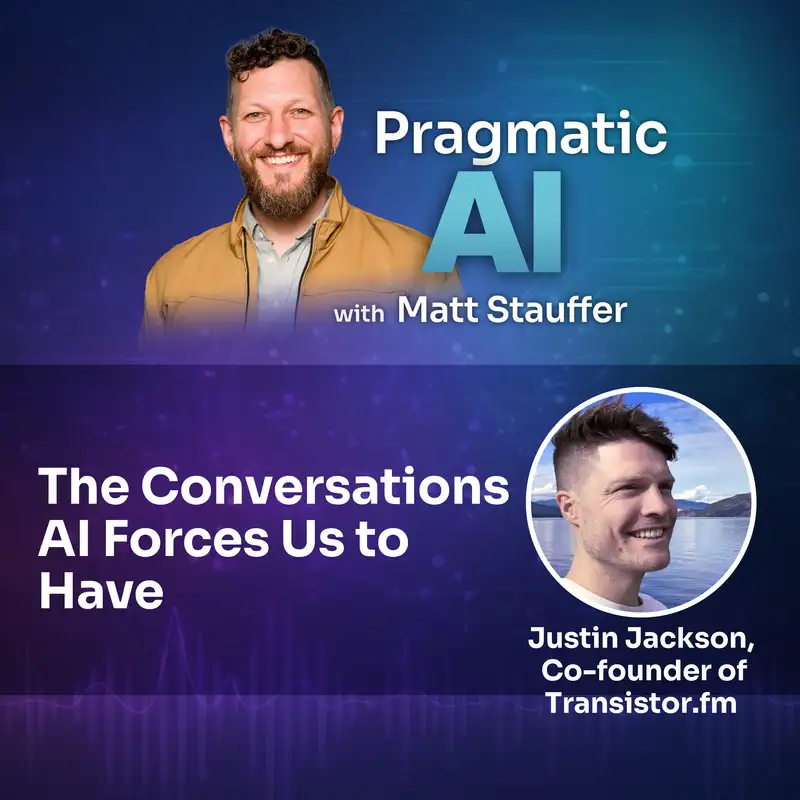
The Conversations AI Forces Us to Have
The Pragmatic AI Podcast is sponsored by Tighten.
T-I-G-H-T-E-N.
We will take your AI ideas, prototypes, or even vibe-coded apps,
and we'll take them to production.
Scalable and secure. Check us out at tighten.com.
Hey, and welcome to Pragmatic AI, where we talk about using AI in the real world, what
works, how to use it well, and when it causes more harm than good.
Practical tools and real trade offs for builders and business leaders.
My guest today is my old friend Justin Jackson.
Y'all missed out on like twenty minutes of us just catching up.
Oh, it was so good.
I'm so sorry we weren't recording, but co founder of Transistor FM Podcast Hosting, which
we use for hosting every single podcast I have, and absolutely huge fan of Justin and the
tool.
Justin, would you mind saying hi to the people and tell who you are and what you do?
Hey everybody, I'm excited to be here.
I've been listening to the show and I've found all the discussion so fascinating.
Um, and not a lot of easy discussion either.
There's some there's some hard stuff being talked about here, so I'm excited to be here.
Uh I have been since 2008, I've been in tech and I started as a customer support person,
worked my way up to product manager, and then eventually made a career in
product management and product marketing.
And here at Transistor I do many things.
Uh overall I feel like I'm responsible for the product and especially the user experience.
I'm obviously collaborating with my co-founder John on that quite a bit and other people
here at the team, but I am a creator.
I care deeply about creators and the creator process.
And so
I want the product to reflect that.
And that means really feeling how does it feel to create something for the first time and
all of the emotions and also just all of the practical things you have to do to get that
out in the world.
And I take all of those feelings and all of that experience and I try to translate that
into shaping the product and then also shaping how we promote the product to folks.
And yeah, been doing a lot with um AI all sorts of places, uh, in terms of product
development and building prototypes and also marketing.
So yeah, I excited to be here.
I'm so happy to have you, man.
So you, I mean, you're in tech, but often when people in tech, they have a certain idea
that someone is going to be primarily working in technology.
And while you are working with the technology, you're working with the people side, I
think, more than the technical side.
And you are technical and you you don't have some programming chops and everything like
that.
But you know, I want to kind of set that foundation.
Uh and the first thing you mentioned was creators.
So let's just talk about creators because I haven't had anybody on yet who's talking about
creators and creators can mean a lot of things.
We're not just talking influencers, right?
We're talking about really just anybody who creates content for people to interact with.
And in your space, it's mainly, you know, audio and video content.
what do you think like if you were to look at the creator ecosystem?
Because I know you you both spend time in Transistor, but you also sp you like go to
conferences for podcasters, right?
And you you are one of sometimes a leading thinker in those directions.
How are creators feeling about AI?
Because I've heard a lot of educators feeling AI is about to take away our jobs.
Uh how are creators as a whole feeling?
Is there more of a level of excitement?
Hey, here's things we can do that we couldn't before.
There's more of a fear, or is it not one universal kind of response?
Yeah, I I think it's it's really depends on a lot of factors.
I would say Gen Z and Gen Alpha creators are mostly against it.
Uh I would say there's more openness amongst millennials and Gen X, and even up to baby
boomers.
I think a lot more of those folks are uh I I think partly because they were more
established and then AI feels a lot more of a tool to them and not as um
scary, not as much of a threat.
So it depends on who you're talking to.
I think it is there's still a lot of unanswered questions.
So for example, one thing in podcasting is there is a there's a new startup called
Inception Point AI.
And their whole point is that they're going to make automated podcasts with AI.
They're publishing, you know, and generating, I think something like hundreds of episodes
per day, and you know, up to and sometimes thousands of new shows.
So shows containing episodes per month.
And um this was a big story in the podcast industry.
People are worried.
I think primarily that the the good stuff, the stuff that they are putting effort into,
whether they're using AI for that or not, but the real tasteful quality
content, they're worried that that's going to get drowned out by AI slop.
I think I'm less worried about that.
uh I think the actual the the real thing that is going to affect creators is if you had an
information business, so you're you're primarily giving information, um that has been
replaced.
so folks who had like I I read the weather every day.
Or I give uh folks a I read out the surf report every week for folks, or I'm teaching
people a different language, or I'm maybe just giving general information, generic
interviews, generic kind of how-to content, um, which honestly had a lot of slop in it
before pre-AI.
Yeah.
Those folks had been able to, you know, get some traction before and and now that's gone.
So I think yeah, I think and every creator has a different opinion on it.
It still seems quite muddled, except the voices from Gen Z and Gen Alpha are very loud.
Uh it's like the yeah you are you are cringe and if you use AI and uh and uh
Any s sort of AI.
So it's like you can't even use it for a little thing.
It's like no, no, anti-AI.
So that's been interesting.
Uh I think it makes sense.
Uh I have I have four kids age six uh age sixteen to twenty-three.
So they're right in that that uh generation and I definitely see that, you know, they
think I'm a total even for using it, they think I'm uh villain, you know.
Uh
So yeah, it's interesting to to watch that kind of backlash.
Uh I saw recently there was something in the news and like the there's a guy who went
missing and he went missing because he was arguing with his mom.
He's 20 or something, because she was using Chat GPT.
And I was just like, that is so emblematic of this experience.
And my my kids uh they're 9 and 13, so they really haven't kind of fully adopted into it
other than that they're just vehemently against Waymo or anything.
They're like, I'm never getting a Waymo, I don't trust the robot.
So like I'm seeing the inner early signs of it.
I'm very curious to see
where that lands.
Uh, cause one of the things we've talked about in the podcast, but I'm also I've got
somebody scheduled soon who really has some really strong thoughts about the the negative
cultural aspects of the way it basically feels like we're being told AI is the future,
like it or not.
And that's something I've heard a guest say and myself say, it's here whether we like it
or not, so let's ABC.
Right.
Like I feel like that keeps coming up.
And so I'm like, you know what?
Whether or not the the the youth are right
Um, that they're gonna be able to sustain the pushback that they're giving.
I like that there is some because a lot of us are just sort of like, I feel the threat, I
feel the fear that I'm gonna get replaced, or if I don't do it, I'm not gonna be keeping
up whatever.
So I have to be a part of it, you know?
Um, and for someone to say no, I'm just like, that's that's actually kind of cool.
That's kind of badass, right?
Like, go kids.
yeah.
I mean, I'm c I'm conflicted about it.
I I think one one big theme I've noticed with AI, and this might be the theme for our
conversation, is that the presence of AI, AI uh being here, actually brings all sorts of
other things to the surface that weren't there before.
And so uh I have lots of examples of this.
I mean personally.
My co-founder and I got into a big fight because I had built a prototype with Claude.
And it in in my mind, it's what I've always done.
I've been building prototypes since I got into product management.
But there was something about it that brought a bunch of other issues to the surface.
And some of these are issues that are because of AI, you know, it's like
In a way, I think he was grieving his craft.
He's grieving the way that the technology industry is going.
All that that was part of that got brought up.
But there's also the big thing that got brought up to the surface is him and I were not
communicating very well.
And um and that there was a lot of other issues that we had not been addressing.
Nothing to do with AI, but AI is it is.
Because it's here, it's like a lot of these other cultural forces.
It's like, well, now we have to talk about it because it is bringing these up to the
surface.
And I think this is also true.
I think this is actually a lot of what kids are experiencing.
now there are certainly some good questions to have around AI, like there's some ethical
things.
There are, you know, there are some issues around.
it's environmental impact.
I think those are certainly things we would need to discuss.
But what's odd about that is that kids didn't bring up, you know, the fact that every
electronic thing we've ever used has a massive uh environmental impact.
Uh, you know, people are complaining about data centers.
Folks, we have had the building of data centers forever.
The the actual data center footprint and impact and energy usage and all that stuff, it
actually hasn't gone up that much.
And there are there are some good discussions to have there.
I think what kids are experiencing is just everything.
This is this is brought up the fact that they were experienced COVID.
And COVID really did a number on them, uh, I think in ways that we're still figuring out.
I think they are worried about the economy.
Real productivity gains in North America and certainly in Europe.
Have basically been flat, US, Canada, Europe.
So some of what they're rebelling against, the underlying feeling underneath it is, do I
have a future?
Things have been so hard for me.
Uh am I going to be able to have a job?
And there that it it I think what complicates it is we can't just have a conversation
about AI because there's we should.
Like I think a real uh impact of AI, for example, that I've noticed with my
kids is a lack of motivation.
So if my son, for example, is really into electronics and electrical engineering and he'd
learn about how uh like logic gates work and then how binary works and he was kind of
moving his way up the chain.
And he's like, I want to try to learn assembly, which is like really one of the hardest
low-level programming languages to learn.
It is, it is incredibly hard.
It is it
Well most programmers these days use these kind of abstracted, easy to use, like kind of
resembles English, but this is like it's it's getting close to zeros and ones.
And his frustration is dad, I wanna do hard things.
So I think a lot of kids feel this.
I wanna do hard things.
I wanna feel the satisfaction of of focusing on something and working really hard at it.
And then doing it myself.
But I know that I could spend years learning this because it would be very difficult.
And then some Chud, as he says, some Chud is just going to be able to type into Chat GPT
and get what took me years to learn in just a few seconds.
So I I think, you know, I want to be addressing all of these things.
I think every technology brings good and bad, but I the
I think a lot of narratives around AI I would push back on in the sense that I think
there's a lot more nuance and depth.
And you can't just take it all as a whole and say, well, all the layoffs are happening
because of AI.
That's not true.
We we absolut the the the layoffs in technology at least are ha mostly happening because
during COVID companies way, way overhired and that drove up salaries.
Which then drives up interest in computer science, which means all the computer science
programs had all these people looking to get into it so they could make money.
It and supply and demand, there's going to be a shake out from that, right?
Now AI might not be helping.
AI might be having an impact.
Maybe it's having an impact on how fast people are hiring.
Um, but a lot of these things, like a lot of the sickness, I would say, in the technology
industry, and a lot of the sickness in our economy
was pre-AI.
um You know, big technology companies have really abdicated their responsibility of hiring
junior programmers, for example, right out of college.
They've abdicated the responsibility doing R&D.
They've been spending massive amounts of money on stock buybacks as opposed to investing
in people and investing in research.
So there was already a sickness there.
And so now it's all exacerbated by
This technology, and now I'm I'm a little bit worried.
not that I'm saying AI is all good or all bad, but I'm a little bit worried that it's now
become the scapegoat for a lot of things uh that were already a problem beforehand.
so yeah, I'm I I'm I'm conflicted about all this, and I I'm especially worried about, I
think.
The once something gets to the level where, you know, kids are booing people at
commencement speeches.
Now, in some ways, yeah, kids have always there's been rebellious things that, you know,
rebellious topics that kids have picked every generation.
You know, my generation, there was a lot of anti-George Bush sentiment and a lot of
anti-Iraq sentiment.
So yes, this all makes sense.
Um I I think actually this will
it will become more I th I think a lot of the the the kind of backlash against it from
these younger generations will subside and I'm hoping as a society we can have a more
calm, collected conversation about okay, what what is this?
What are we going to use it for?
What are the advantages and disadvantages?
But uh the hyperbole
Of even, I mean, we could go into any topic.
It'd be like I had someone, you know, I had used AI to generate uh intro video bumper for
a uh podcast.
And he said, Well, what about the environmental impact, the the electricity usage and et
cetera?
I said, Well, the other way for me to do this would be for me to run my computer with a
GPU with after effects for hours and hours and hours.
So I was able to accomplish this in five seconds.
The energy, if we're gonna talk about comparable energy usage, then we have to actually
address what is it comparing to.
And there's pros and cons.
Like maybe I would have hired somebody to do that, and I'm no longer hiring them to do
that.
That that could be true.
But all of every time you use a computer, there's always there's always been a cost.
Uh and the the the
the systems that run Spotify that allow you to find a song like that have an environmental
impact.
That's always been true.
And so let's we we need we'll need to have more we'll we'll need to compare, you know,
okay, so what is the environment if you're gonna talk about environmental cost, what is
the environmental cost of producing a CGI kind of animated intro?
And what would be the equivalent?
And let's compare those things.
And in a lot of cases, AI is actually better.
So th once you actually do the comparisons, right?
So we need to yeah, I'm hoping that there's gonna be a lot more nuance there.
Uh, nuance definitely seems to be the name of the game for a lot of pieces here.
I mean, we've got you know, one of the things that I've talked about far earlier in the
podcast is when people say AI, they're usually not talking about the same thing, right?
You know, might be talking about LLMs, you might be talking about, you know, any of a
whole suite of things.
But I I often think about that from people talking about it from a hype perspective.
And kind of one of the things you pointed to here is that people who are critical of it
are are critical, maybe a little bit blindly, but also
If you hear a critic of AI, they're usually gonna name, you know, impact on uh other
people, impact on the environment.
they keep getting shoved into my software tools and I don't want it and they're gonna
charge me more money for it.
You know, like there's all these various things that people don't like about AI.
They're gonna take people's jobs that are less about AI itself and more about the culture
surrounding AI, the application of AI, or the behavior of the big tech companies, or the
the
the local governments uh hearing all the people saying they don't want something and doing
it anyway, right?
They are the behavior of people in response or in the context of AI, which to your point,
you're like that that problem was that local politician was being bought off by big
companies long before AI came along.
This is just the context in which we're noticing it more, right?
That's right.
Yeah.
And I mean I like in a in a way I get both hopeful and dismayed when these get brought up.
So right now in Canada, I live in Canada, the we have lots of clean electricity.
We're the leader in hydroelectricity.
And we also have just lots of energy.
So we um and we have a lot of land.
So the idea of of of um
I want say data warehouses, what data centers.
The the idea of building data centers is an important topic.
And so part of me is hopeful because I'm like, well, for our sovereignty, we should have
our own data centers.
For our sovereignty, we should be investing in our own AI research and not just depending
on the United States and certainly not depending on China, right?
So we need to be doing things for our sovereignty.
And
At the same time, we gotta also ask some other questions.
What's the environmental impact?
We gotta talk about that.
And what's the economic impact of this?
Like, is it going to provide a bunch of jobs?
Right?
What and what how for how long?
Like, let's let's really get granular about all of this.
But you know, if I was gonna say there's a big sickness right now, I would rate I would
rank or a threat to our culture, I would rank social media.
And social media discourse far above AI in terms of negative impact.
And by the way, you want to talk about every single frickin' issue, like environmental
impact, every like running Twitter, running Facebook, running Instagram, running these
societal sickness machines takes an enormous amount of energy and uh and pollution and
everything else.
And uh it's not just polluting our environment, it's polluting our culture in a way that I
think is makes discussing any of this stuff much more difficult.
Um, yeah.
And that you say it's it makes it harder to talk about this.
Is it in part because of the polarization of conversation that happens through social
media?
Or like what's what's your
know, I again one of the the benefits of AI so far has been, at least on our team at
Transistor, we've had to increase face-to-face communication.
So let's go back to So let's go back to that that that conflict I'm having with my
co-founder.
Again, the the seeds of that conflict actually have nothing to do with AI.
That has to do with our inability,
To have conflict, our inability to confront hard topics, our inability to communicate.
And part of the problem is we're a remote team, and I primarily communicate to him via
Slack.
So we're both getting more and more upset about different things.
And finally, our wives got together and said, We got to get these guys on a founder
retreat because this is not working.
I love that.
So they they they planned a founder retreat for us in Mexico.
They invited themselves too, so that that was the the perk.
But you know, we get there the first day of work.
And okay, ladies, we're going to work.
We go find a cafe, we sit down, and in 30 minutes of sitting next to each other, we solved
something we had been arguing about for three months.
So
That is a communication problem.
We need more face-to-face conversation right now.
If people can be building things faster with AI, we need more communication.
Like, whoa, whoa, hold on.
What are you doing?
What you're adding this?
Wait, whoa, whoa, whoa, whoa, whoa.
We gotta slow we gotta not maybe not slow it down.
We're working fast, but we definitely gotta commute we gotta increase communication.
And um and so that's been a positive, I think, is that I'm realizing more and more what
Our society really needs is more communication, more face-to-face conversation.
Uh, I get this feeling all the time in in technology, there's a bunch of software that is
open source, meaning people work on it for free and build all this incredible software
that runs tons of things uh in the world.
operating systems like Linux, you know, that might be running your your buses.
it might be running the bus you're running you're you're on, right?
So, but there's these discussion threads online.
And recently I'm like in these threads, and I'm just like, man, there's so much confusion
and so many hot takes, and you don't know who why this person is saying this or why
they're invested in this.
There's getting nuance and just figuring stuff out is so complicated.
And I increasingly I'm like, we need more face to face time in our culture.
And
You know, a Zoom call is an okay.
That's a that's a level up above like talking to ourselves.
We're talking to each other in Facebook comment boxes and Twitter replies and LinkedIn
DMs.
Like this is ridiculous that we're trying to accomplish anything of value here because
it's just not it has some advantages, you know?
Like you're you're having the conversation in public, I guess.
But all I've seen is it just increases
polarization.
And so, yeah, and now we've got these important topics to talk about, like AI.
I mean, and even if we just segment it a little bit, let's just talk about LLMs and let's
just talk about it.
And then let's talk about it.
What does it mean in education?
Well, are we gonna have are we gonna continue to just have this conversation as a society
in Twitter threads where the the tech bros say, well, you guys are all a bunch of dummies,
this is the future.
And then the Luddites say, no, no, no, the, you know, we've got to fight against the
machine.
And these guys are all it the the truth is probably somewhere in the middle.
And yeah, I I'm I the encouraging it has been encouraging to me that I think because AI is
so disruptive, it just it at least on our team, it's caused, it's meant we gotta up.
The communication.
We gotta get in, we gotta be in person more.
We gotta do more calls.
so now after John and I got back from our founder retreat, we have a Monday.
What do I call it?
It is because the name was important.
John and Justin's call, partnership, strategy, vision, planning, and friendship.
that's that's it, you know, and and um
You know, I have more meetings now, more standing meetings than I ever have before, just
because I think the need to communicate is higher.
And is this part of this because a lot of the actual implementation work has moved from
individuals to AI and so now the individuals have to do more thinking and planning?
Or what aspect of the introduction of AI has required more meetings?
certainly I think because now I mean a building with AI, so building especially software
with AI is like a superpower for someone like me.
So it was a really weird situation to have my business partner really grieving the loss of
his craft in a lot of ways, while at the same time I was feeling
more empowered and energized and excited than I'd ever been.
Because I've always considered myself to be a product person, but that meant to
communicate the things in my head and the feelings, the essence of what it means to use a
product and use a product in the way that makes sense, in our case for creators, I had to
I it was just difficult to translate that.
Like I could
Build HTML mockups, which I did.
I could build Photoshop mockups, which I did.
I could build interactive mockups, which I did.
I could make videos.
But to be able to actually express what the vision is in my head tangibly was like, you
know, it it brought me back to like building things in HyperCard on a Mac, which was this.
Thing this visual builder that allowed you to visually build what you had in your head.
And that's just, yeah, and interactive.
Right.
So for me, I was just experiencing this like incr this is so empowering.
And uh at the same time, he was having this also very real experience.
And again, here here's a it it it forced me to.
It it's so funny that so much of this disruption, like for me, I think the antidote is
just human connection.
And so we're having this this thing that is ostensibly because of AI, but it's actually
about some deeper things.
And then I I reached out to Jason Cohen, who's the founder of WP Engine, and he had this
great line, um, which I think will probably be applicable to all the AI debates we're
gonna have in as a society, which is um because there's always two sides, right?
And he said, in a partnership, a good partnership is where one partner says, Here's what I
want.
And the other partner says, Here's what I want.
And then you both look at each other and say, Well, I am a hundred percent committed to
helping you get what you want.
And then the other person says, I'm a hundred percent committed to helping you get what
you want.
Now, when we sat down and had our chat, and I said, Listen, I'm excited about AI, man.
Like I'm I'm not gonna stop using it.
I'm gonna get the Claude Max subscription.
I'm gonna be building things.
I'm gonna I I I'm gonna use I'm so excited about it.
And I'm also committed to helping you get what you want.
So let's talk about it.
What you what does that look like for you?
And you know that the conversation goes from there.
Um very helpful.
and
and but I think also just this acknowledgement, I could see on a small we're a small team,
we're six people.
Six people, and we serve, I think, something like forty thousand users.
So we have a lot of users.
We're already a lean team.
And I've already seen this.
It's like, for some people this is exciting and empowering.
Some people don't really care.
Either way.
uh some people it's threatening.
And some people it like it's it's uh you know everyone's having a a spectrum of reactions
to it.
And I think just acknowledging all of that is healthy.
And then all you can do is communicate about it.
And uh I think the the worst thing we could have done is I could have said, well, some
people on the team don't like it.
It's threatening to some people, so we're not gonna do it.
We're not going to do anything with it.
I think that's the wrong approach.
I think the right approach is so let's take a another contentious topic.
We have actually the majority of our team right now, because we hired a summer intern, is
100% focused on customer service.
So they will answer live chats, they will jump on Zoom calls, all those things.
I think one of our
Best features is our customer service.
And I don't want that to preclude us from considering maybe using AI in our customer
service.
And it can't be binary.
It can't just be like, well, we're never going to do that.
Well, let's let's think about that.
Because my fresh my friend Jesse Hanley at another software company called Bento, he's
using it 100%.
And he's had really good results with it.
And so we we can't we can't ignore something that might have a benefit, right?
And but we can also recognize like, well, I can see that where that would be threatening.
Like we we need to talk through that.
And we need to talk through like, you know, how what are the possibilities?
What how does this how might this impact how we're doing things?
Um so yeah, I found this whole
Basically since December 2025, when a bunch of engineers went home for the holidays and
started playing with Claude Code, ever since then, it has been just like, wow, this is
having an impact um on us.
And yeah, it's just been way, way more communication.
And the I think part of the reason I'm I'm I'm kind of enjoying this is it's like
These are the hard things I've been forced and our team has been forced into confronting
some hard things that we just needed to talk about anyway.
And so now it's just it's here.
And it i the catalyst was AI, but that I'm I'm I'm really leaning into it's here.
It is forcing a conversation and it's forcing us to reckon with some things.
Let's reckon.
Let's it.
I love it.
All right.
So we're gonna pause for a second to thank our sponsor and we'll be right back.
Today's sponsor is Mailtrap Enterprise Grade Email Delivery
Infrastructure for Modern Software Teams.
Mailtrap helps teams deliver email reliably at scale
with the security, compliance, and infrastructure control
modern organizations require, built for enterprise environments
and ready for AI-era communication workloads.
Mailtrap integrates easily into existing infrastructures
without slowing teams down.
So see how it works at mailtrap.io.
Okay, so before we did the sponsor read, one of the things you had been talking about
across a couple different contexts was when uh somebody's feeling that experience of fear.
Fear that my craft is gonna change, feel that my job's not gonna be here.
And then you also talked about another experience of maybe freedom and opportunity and
being uh empowered and enabled to do something.
Um, and I I found that there's often uh a little bit of an overlap between the two.
For example, you know, you and John.
John is feeling
Like the the work that he put into becoming an amazing developer is being devalued.
And you're feeling like as a non-developer who has not put in the same amount of work that
John is, you now have the ability to be a developer.
Or, you know, your your son is saying, I want to put all this work in and learn assembly,
but somebody else is going to be able to write assembly.
And so it's this weird that it's like pulling down on some things and pulling up on
others.
Often when I look at these, the thing that's made it feel comfortable for me is uh the
people who are being pulled up are never gonna be at the same levels that people are being
pulled down and
We all have this kind of dark night of the soul when it comes to, my God, I'm gonna lose
my job.
Like that December 2025 hit and a lot of people, you know, spent, but then a lot of people
came out of that saying, wow, is my career gone?
Wow, you know, it can do all this and it's so exciting.
And then the the valley after that is, and wow, people don't need me anymore.
So I'm I have found a lot of comfort in saying you come out of that value when you realize
that like you're not actually gonna get replaced.
You mentioned, you know, people who have informational podcasts where all it does is just
say out loud some text that they might be in t trouble.
Similarly, programmers who don't do anything other than the very rudimentary base stuff
that, you know, is in the manual, they, you know, they might be replaced.
But somebody like John Buddha is not going to be replaced because he has decades of
software expertise and excellence that no AI can replace.
And I can imagine a workflow in which Justin Jackson uses Claude.
To build an MVP of 20 things.
And everybody knows that that's not gonna go to production without John Buddha making it s
stable and secure and you know, all these kinds of things.
And so there's still space, but we're we're moving and it takes what really felt solid and
uh solidified.
I know where I am, I've made it to this place in my career, and the the platform of that
solidity was taken out from underneath us.
But I do feel like there's a way to kind of like there's a new platform somewhere else.
That makes space for Justin to still see the empowerment while John also says, there's a
new spot for me.
Have you found that that is something that is there kind of universally?
Um, or are is, you know, have you come to that same conclusion that I just did where it's
like, there's there's always a space for the people.
And and I guess maybe part of that question is, are you finding any threatening?
You know, we've talked about other people being threatened and feeling like they're has
has your job as a product person ever had a moment where you're like, my gosh, everybody's
gonna?
kinda replace me because they all have Claude now.
Mm-hmm.
Yeah, I mean, I think one difference is that traditionally anybody on the softer side of
software development, of s of building software, has always had faced more threats than
the hard side.
So uh meaning softer side would be things like product management and marketing and
management and et cetera.
Yeah.
hard side was the programmers.
Like that's the the the hard side.
And uh, you know, since I guess basically since uh after the dot com bust.
Since then the demand for programming has just increased, increased, increased, and there
was a lot of demand.
Uh with uh there was a lot of demand, more demand than there was supply.
And so um, you know, if a software developer lost a job, they could get another one right
away.
Um if a you know, if a software developer wanted a raise, they could just quit their job
and get hired by somebody else almost right away.
I think
What's changed is that it's just leveled software development with what the rest of the
industry was already having to face.
So so on my side, I feel like, you know, the the the mark you know who gets fired in a in
a downturn?
Well, it was always the soft skilled people first, right?
We're gonna we're gonna fire customer support and we're gonna fire product management,
we're gonna fire the marketers, we're gonna fire the and
Uh now I think it's a little bit more balanced.
It's just, yeah, you know what?
You guys had a bull market for a long time and uh that was great.
I'm not saying it was easy, but it th the the the bull market I think is gone.
Uh and so uh and it we can grieve that too.
I I mean I have friends, I I run a coworking place here and you know, all these layoffs
that have happened, it took them really by surprise.
Like
Before it would have taken them a week to find a new job.
They would have had, you know, 20 recruiters in their LinkedIn DMs saying, come on.
And this time it took them a year and applying at hundreds of places to find another job.
So I don't think a lot of software developers realize how tilted the supply-demand curve
was in their favor.
Um, you know, at the peak, you could go to a one-year boot camp and graduate and
be making hundreds of thousands of dollars.
Um so uh and of course there's gonna be some folks that have always found it hard to find
work and that that's always gonna be true.
But uh generally if you look at the supply demand curve, I think that is correct.
So yeah, that's that's gonna be tricky and there is that that it's gonna be more balanced.
So, I mean, for myself, I think I've always felt that threat.
This isn't this isn't new.
Um, this has always been a a a threat on the on the on the non-programmer side.
And um I think it's difficult to know where this is gonna end up.
you know, I've got these kids that are just on the verge of like
Entering, I'm hoping fingers crossed their employment years, but there's a lot of
unanswered questions.
And I am I'm trying to recognize the reality, which is it there's a lot of things against
them.
It it's just like I said.
Generally, in a c the state of an economy is determined by how your productivity gains
increase.
That's how economists say, is this is this economy healthy or not healthy?
And so you can imagine, you know, there's when we moved from uh you know, an agricultural
society to an industrial-based society, there was this massive increase in productivity.
And um
It wasn't easy being in those early factories, but the the move to factory work actually
lifted most of the world's population out of poverty.
So it was that increase in productivity and this increase in basically economics.
There's way more money flowing.
Uh that's why productivity and the economy are so linked.
So yeah, there's we got some.
We got some headwinds against our young people.
And uh I think they are right to feel threatened for sure.
I think everyone has the right to feel threatened.
Like, like yeah, this is yeah, this is scary.
Like uh and there's l other careers that I think will f you know, my son, my son uh really
got interested in animation, and he he went to college for a year to do art fundamentals.
So the art fundamentals course, let's say, has like 800 people in it or something.
But all the art fundamentals people are there because they want to get into the animation
program, which is a four-year animation program.
Well, 1,500 people applied to get into the full-time animation program.
Only 150 or something like that got accepted.
And you make it through that gauntlet, you make it through that ring of fire.
The truth is, is that
Animators aren't getting hired.
It's like it's like uh increasingly a difficult, long hours job where you don't get paid
that much.
And so that's a headwind.
Like that's what do we do with that as parents?
What do we do with that as team leaders?
I I I I can tell you a few ideas I have, but if you want to know my anxiety.
Partly due to AI, but I think more to do with just these decades of bad fundamentals we've
had in the economy.
I yeah, I'm worried.
I don't know where it's gonna end up.
and my st my my gap like in the what I'm doing in the meantime is I'm telling, okay, kids.
You've got to explore.
You just got so.
Should you go to art fundamentals, even though it might not lead to any?
Yes.
Go to art fundamentals.
Take a painting class that I know you're gonna hate.
Do it anyway.
Meet some people.
And I'm adding to that.
I just got back from a week in Toronto with my second oldest, my son.
I'm adding to that as much in there, like 16 to
19, they don't really want to talk to you, at least in my case.
so you know the teenagers they don't want to talk to you, but I have found they're more
open to it once they get to be 21, 22, 23.
And so in those times, I am encouraging them to increase their luck surface area any way
they can.
So luck surface area is just this concept of yeah, a lot of life depends on luck, but one
But you can do things every day, every week that increase the chances that luck will hit
you.
And one big thing, if any young people are listening, including my kids, one big thing,
you've got to get out of the house.
You've got to get out of the house.
You've got to meet people.
You've got to, I've even said, like, go to a bar.
You don't have to become an alcoholic.
Go to a bar, have a beer, and talk to a stranger.
And we practiced this while I was in Toronto.
I said, Marty, we're gonna go to a bar and we're gonna sit at the bar and we're gonna talk
to a stranger.
Well, why would they want to talk to us?
Because if that they're at the bar alone, that's it just an open invitation, generally.
And I said, here's a principle that you need to know.
Almost everybody on earth is lonely and hungry for connection.
Like that's just the truth.
And when you
Bridge that gap for them, you are going to form a connection.
And the other great thing about bars that I think we're we're we're losing is that now
we're in these polarized online societies.
Listen, when you're at the pub, and I I was also just in London, UK, and it's very visible
there.
You're at the pub.
It's all generations there.
It is all political beliefs there.
It is people you might not normally hang out with, and you're all rubbing up against each
other.
You're all
Bumping into each other.
You're at the bar, you look over, and there's some guy, and you're talking.
And this is all healthy, especially in the age of AI.
And so th these are the some of the things I'm trying to instruct not just my kids, but
you know, we have comp sci graduates that are looking for work.
They're saying, What do we do?
I say, I don't know.
It is scary.
Like,
I I feel bad for you.
Uh, I think the big mega corporations have really abdicated the responsibility of hiring
young talent and training them up.
I don't know who's gonna do that now.
I think I'm starting to realize, and this is actually something I I learned from you,
because you have always been good at hiring young talent and bringing them up.
Transistor's not done that.
Our average age of an employee is probably forty or forty-two.
We're way too old.
And so this year I forced myself.
We're gonna hire a summer intern.
We're just gonna do it.
We're gonna do it.
And I think so.
I think independent smaller companies are gonna have to take up some of this slack.
And then if you were are a college, if you're in college right now, you you're just gonna,
unfortunately, you are gonna have to bootstrap a lot more of this than you would have had
to in the past on your own.
And
there's all sorts of things you can do to increase your lux surface area.
One is getting out of the house, meeting people, go to meetups, go to events, go to like I
said, go to clubs, join uh the uh Toastmasters, learn how to public speak.
Uh go and start writing a blog, start building stuff, making stuff, doing stuff, and
telling people about it.
The the
The the it's not easy, but the simplest way to increase your luck surface area is to do
stuff and to tell people about it.
And you are gonna dramatically increase your chances of getting noticed.
Because if you get really this is what I told my son about assembly.
I said, listen, he's like, This is not fair.
It's not fair.
You know, some idiot's gonna be able to just prompt whatever and all my work's gonna be
for you know uh
In vain.
I said, no, it's not.
I said, if you get really excited about assembly as a 16-year-old and you tell people
about it, and you are saying, here's what I'm learning, here's what I'm trying, here's my
blog about it, here's my YouTube video about it, however you want to do it, here's my
podcast about it, you are gonna get the attention of people because you're gonna be
proving to them all sorts of things.
That you are willing to go after hard things, even in the age of AI.
You're gonna be able to show them proofs of work.
Listen, here's a problem I faced.
Like right now, he's using some sort of assembly to into embedded firmware that lights up
things.
I don't even understand it.
See, but this would, I'm like, that would make a great demo.
That's a great video.
That's something you can talk about.
And I said, I guarantee you.
If you dedicate yourself to this for five years, learning things on your own the hard way
and use AI as you want.
If you don't want to use it very much, like you want, I want to do it the hard way, go for
it.
Go get a book from the library.
I'm I would like him to use more AI, but if you don't want to, that's okay.
Dedicate yourself to it.
Tell people about it.
I guarantee you, in five years, there are going to be all sorts of systems built with
assembly where they can't use AI.
Yeah.
Not allowed to?
Yep.
military, there's banking.
So there's gonna be an opportunity there.
Cause what sixteen year old is going to commit themselves to do that?
And so all those people are aging out right now, right?
And they're freaking out about how are we going to get people to maintain this.
And yeah, even if they can use AI, the likelihood that they're going to say, Hey, this
entire credit card system can be continued to be maintained purely by AI, they still are
going to need the experts.
And those experts are 70 right now.
So by the time you're done, they're going to be out, you know.
Here here's the real truth about just how um how economic rewards work.
Because I think a lot of the fear right now is people worried about losing their jobs,
people worried they're not gonna be able to get a job, people worried about their careers,
all this stuff.
Now there's a whole uh another piece with that called purpose, which I think is important,
but we're gonna sideline that.
But just talking about economic rewards.
Generally, the way economic rewards are dispersed.
Not always, but generally, is that the harder it is to do something, the more the economic
reward.
Why?
Well, it's free and easy to start a YouTube channel.
Anybody can do that.
But most people make no money at YouTube.
Now, what's a lot harder is to dedicate yourself to doing YouTube so well that you
understand every single bit of it, which is what Mr.
Beast did, and then he gets obviously rewarded very well for it.
So
There there's examples of this all over.
And I think one of the things that happens in a shakeout like we're experiencing in tech
is there's some folks that were doing relatively low level simple work and may maybe we're
getting paid a little bit too much for it.
Because the harder it is to do something, the more you're generally, not always.
I know, you know
Listen, I'm Canadian, I'm half socialist, but if you're socialist, you can you can you can
write me some letters.
But generally that's how it works.
And I mean, even I'm I am a huge critic of the billionaire and tr trillionaire class, like
Bezos and Musk and all them.
I I I will critique them with you all day.
But as someone who's built a company, I could tell you that what they have done is very
difficult.
There's a reason that they've been rewarded that way.
Maybe rewarded too much.
Maybe they maybe they need to be taxed and other things, but it there's a reason that I
didn't build Amazon.
It is very, very, very difficult.
And so Bezos has experienced some rewards for that because he did a very hard thing.
If this is true, this just means as a society, if AI takes uh my friend Jeremy Ens says
this, he's like, AI is so good at the simple stuff, all that's left is hard stuff.
Yeah.
And there could be part of us that are like, oh man, but guys, this is what humans are
great at.
We're yeah, you know what?
You know what so many kids need right now is they need a hard challenge.
They we need a hard challenge.
The reason that most people are bored at work or even experience um, there's two types of
burnout.
You know, there's the burnout where you're just working too much and stressed, but then
there's the burnout of like,
You just don't feel like you're making any progress.
Like you're there's no purpose at work or whatever.
This is our opportunity.
And I think I the the approach I'm trying to take and the advice I'm trying to give my
kids and the advice I'm trying to give comp sci graduates is like, listen, sorry.
It if it ever was true that all it took to get a great job was a degree, that was a blip.
Like the truth is, is it's generally not been the case.
You don't get a degree and you don't magically get a job.
What's left is the hard stuff.
But we don't have to be scared of the hard stuff.
We can lean into it.
We can say, What is hard that I would like to dedicate myself to that will likely be in
demand and be economically rewarded in five, ten, fifteen years when I'm at the peak of my
expertise.
Yeah.
I just went into my uh my mail search history to search the name Justin Jackson 'cause he
recently sent me a newsletter that says, In all caps, do the hardest thing.
Yes.
Yes.
Because and this is the funny thing from the the business building standpoint, because
everyone's like, AI is gonna make it so much easier to build a business.
No, no, no, no.
You don't understand.
uh the the the numerator in business, like in terms of like the numerator is how many
businesses succeed.
It's actually fairly static.
It the every year there's
A X number of businesses that succeed and use any any measure you want.
Like yeah, businesses that made $200,000 a year.
That numerator is fairly static.
The denominator has always been massive because the entry there's no entry cost to being
an entrepreneur.
You just say, I'm an entrepreneur and now I'm doing entrepreneur stuff.
But th what what differentiates somebody who's trying to be an entrepreneur and somebody
who is an entrepreneur.
With someone who's done it, someone who gets into the numerator position, which is very
hard.
And if business is already hard and life is already hard and careers ever is all already
hard, this is all just applies everywhere.
And now certain things have gotten easier with AI.
If that's all true, then you you should focus on doing the hardest thing that accomplishes
the thing that you
Are going after.
Now, when I write, I often write about economic compensation.
And this probably comes from me being a 22-year-old dad and just being like, How am I
gonna feed this kid?
And then how am I gonna feed these kids and feeling the economic pressure basically my
whole adult life?
So for me, my one of my primary measures is when I'm determining what do I want to invest.
In in terms of my career is what are the what's the economic return?
But for you, it might be something else.
I don't know.
If it's world peace or calm or whatever.
I think this this principle still applies.
Um if if doing anything is if doing anything worthwhile is already hard, then you might as
well do the hardest thing, meaning the thing that most people won't do.
Most people won't learn assembly for five years because the chances of being rewarded for
that just go up.
And so the example I used is in 2003, I'm 23 years old, so my daughter was two.
I decided to start a retail shop, which is which I the way I've described it in the
pieces, that's one of those easy ideas that everybody has.
You know, it's like it's an easy to have idea.
And it's it's a low-hanging fruit kind of idea.
Uh so I started the skateboard snowboard shop, and it was actually fairly easy to get
started, but a ton of work.
Another company that got started the same year, with the same number of people, by the
way, was Skype, which was the first way to make a call over the internet.
Now, what's interesting about that is
I had been doing calls over the internet since before the web.
Like I had been using voice over IP little experiments that people were working on before
the web even existed.
I had felt what it was like to call up my friend on a dial-up modem and play Duke Nukem.
And for the first time we were able to talk to each other at the same time.
Now, I so if I could have
certainly seen that there was a desire to make calls over the internet.
The other thing that was happening at the time is that uh long distance calls were really
expensive.
And so I had experienced that too.
I'd been calling some friends.
My parents got a $200 phone bill.
They were upset with me.
So the idea of cheap phone calls over the internet, that was already in the zeitgeist.
That was swirling around.
Why did I not go after that in 2003?
Well there's probably a a number of reasons.
But one thing is that that just seems so, such a difficult idea to go after.
But the difference is that, and I I realize this is cherry picking a little bit, but I
think the principle is still true.
I chose an easy idea, a low-hanging fruit kind of idea.
And three years later, I was $80,000 in debt.
The Skype founder said, we're gonna do something that's quite hard that not very many
people are doing, which is figuring out how to make phone calls over the internet.
And three years later they sold to eBay and each pocketed about 350 million.
And they deserve it in that sense because they built something that was very hard to do at
the time.
And the lesson I've taken from this, it took me a while to learn this, but the lesson I
learned is I've gotta commit myself to doing hard things.
And this is something, you know, with my kids, kids and people naturally, most people just
don't want to don't want to do hard things.
You know, my kids are like, basically my kids are like always, what's the easiest thing I
can do to make some money now?
And, you know, it takes some maturity and some life to eventually realize there's a lot of
competition in being lazy.
A lot of competition in low effort money, right?
There's a lot of competition for that.
Um, there's less competition and more rewards the more you go up in terms of the hardness
scale.
And I think AI has just made that distinction explicit.
Now we've got to do the hard things.
Yeah.
I love this idea of the Chud because I now have a vision of of the person who is trying to
do the easiest thing, the laziest thing.
I just wrote a note to um my VA said as soon as this Justin episode is rest ready, I need
to send it to my kids because I'm like, This is the less message I want them to be
hearing, right?
Like, yeah, there's there's a ton of competition to be the laziest, to do the easiest, to
do the minimum.
Um
God, I wish we had more time to talk.
This is so freaking good.
We haven't even gotten to talking about how you use AI in your day-to-day and marketing
and everything like that.
Uh no, don't be sorry.
It's great.
It's wonderful.
It just means I would have you back on to talk about the actual day-to-day things.
Um
let let's if anyone's listening and they had thoughts, I would love for there to be
feedback on this, like send it to Matt, comment or whatever.
And even if I mi even if I upset you, I think that that's fine.
uh, 'cause then we can collect all of that and that we can use that as a jumping off point
next time we chat.
I love that, which has to be sooner than later because there's so much to do.
but I w you know that the end of each of these, I I read a piece of community feedback
where somebody says, Here's a way that I've been using AI in my day-to-day life.
so Wendell Adriel, who is interesting, I just had him on the Laravel podcast like two
weeks ago, but he said this months ago, uh when I first put out this call, he said, I use
AI to plan weekly or monthly meals for me and my fiance, taking into consideration things
we like to eat, things we need in terms of vitamins and minerals, and that fit our
lifestyle.
So
Are you using AI as a part of either meal planning or daily household management at all?
yeah.
A ton.
A ton.
Um yeah, I'm using it all the time.
Especially for meals.
I don't enjoy making meals and most of my meals are pretty simple.
So when it's dad's turn to cook, there's usually like I've purchased chicken or something,
but then I just say, Here's what I have.
I've got chicken, I've got these sauces, I've got these veggies.
Make me tell me what to do.
And then it does uh
And you know, I basically just make whatever uh I chat GPT I I think this is a trend I've
seen elsewhere too.
Chat GPT is my at home personal AI, that's the one we use for family stuff, and then
Claude is my business one.
So yeah.
gotten a recipe from chat where you're like, no, that that was not legitimate.
You totally screwed the pooch on that one.
I mean, the nice thing about recipes is it's like an area where the non the
non-deterministic side of AI actually I think works because there's just so much to draw
on.
Like it's generally it especially with simple things, like I'm I'm not telling it to make
something complex.
I'm just like, this is what I have.
Like I want to make a stir fry.
What do you recommend?
You know, like that's that's it.
I can imagine baking where it's like all these like very scientific, you know, chemical
things that might be a problem, but with with this it's like you're gonna put the things
in the stove or in the pot and then you're gonna make them warm and then you're gonna the
onions are gonna go in first and the sauces later, you know, like that's pretty standard
consistent fare.
Okay.
and in a lot of ways it's like just helpful at like when I'm I'm terrible at planning
trips and also at packing.
And so to be able to just speak, I use uh whisper flow quite a bit.
So I'll just speak into it.
I'll be like, All right, hey Claude, I'm uh gonna be going on this trip to London.
It's for a week.
I'm gonna need some like outfits for each day.
I'm gonna be speaking one day.
I've heard of this thing called the three by three.
uh packing method.
Can you just like tell me based on what you know about me?
and I uploaded a bunch of photos of like me in different outfits and I said, just tell me
what kind of what I should pack.
And that gave us a benchmark for like, okay, here's kind of what you should pack.
And uh I actually that was my best packed trip ever.
Now I should tell I should say my wife helped a lot.
So
I heard you say we so
So so so it was it was it was a combination of AI and uh my wife helping, but yeah, I
found that so nice because I don't wanna overpack and I don't wanna forget anything.
You know, it reminded me, you need to get your your UK declaration, you need to get your
charger.
That was a big one, yeah.
Get your charger.
Um so yeah, I I I I don't think there's a I think I'm using it every single day.
To to the consternation sometimes of my family, 'cause I'll be watching hockey or
something and I'll be like, How tall is this guy?
Well that's me and Google.
My kids are like the the number of times I'm just gonna say, Hey, S I R I, you know, in
the middle of something and so funny 'cause the kids actually get pretty actively
frustrated when S I R I cannot answer something they want.
So I have not moved to that point because I'm trying not to be that guy, especially when
the kids are like nine and thirteen.
I actually just did a uh chat GPT look up in front of my son for the first time just last
week.
I think I said told I last guest this.
And I'm like, no, what have I done?
So but he
got one more.
Can I tell this one this story?
I think you'll love this.
Okay.
And please, I mean you can write about this, but just don't judge me.
Tell you for the whole thing.
Okay.
So before I feel like Elon went terrible, we bought a model three.
We love the model three.
It's actually our favorite vehicle.
Um we have teenagers.
one of our vehicles got written off because of teenagers.
We need to replace that vehicle.
So we already have the model three.
It's fine.
We're looking to replace the the vehicle.
And our favorite vehicle is the Model 3.
And I'm like, ugh.
And so we go out and test drive a bunch of cars.
We test drive Mustang Mach E, we test drove a Honda CRV, which is what we ended buying.
But at at some point,
We're like, we should go test drive a new Model Y.
So we're test driving the Model Y, and I'm just like, ugh.
And in the Model Y is the Grok button.
So I push it.
And I'm like, hey, Grok.
And he's like, Grok's like, hey, how's it going?
I said, man, we're test driving this Model 3, but I'm just conflicted because on one hand,
it's the best vehicle I've driven today.
But on the other hand, I don't respect Elon Musk.
And I also feel like a lot of the people around me would think poorly of me for owning
this.
And I I'm just conflicted and I don't want to be supporting him and I I what do I do?
And uh Grok is like, Yeah, you know what?
I totally get you.
Elon's been a real trouble lately.
Not think I thought it was gonna say, Well, he is our supreme leader because he's you he's
tweaked it sometimes.
That's so funny.
behavior has been really concerning.
And then then he l it listed a bunch of his public behavior.
I was like, yes, exactly.
What should I do?
And then and then Grok's like, well, here's a bunch of other vehicles I think you should
consider.
Then it just went through them all.
I was like, wow, this is crazy.
Grok talked me out of buying a Tesla.
So the
Love it.
That's fantastic.
Wow.
Love to hear that.
Justin, you are such a pleasure.
You're such a delight.
It's so good to hang out with you.
Thank you for being who you are as a person and also on the internet, man.
I really appreciate you being here today.
Likewise, likewise, you're you're definitely like one of my favorite people on the
internet.
I guess I should ask if people want to follow you, if they wanna pay you money, or where
is Justin on the internet?
yeah, Transistor, I think it people have told me, is some of the best podcast hosting
software.
Uh so if you want to distribute your podcast to YouTube, Spotify, Apple Podcasts as audio
or video, go to transistor.fm.
And I write a blog.
I still write a blog, justinjackson.ca.
Uh I'm on social media, but I'm trying to blog a lot more.
And so uh you can check that out.
I also do a podcast with Brian Casel and Jordan Gall.
And that is called the panel, so you can check that out as well.
Brian Casel former guest of this podcast, and we'll make sure all of these things are
linked in the show notes.
So once again, Justin, thank you for hanging out, man.
Rest of you, we will see you next time.
Creators and Guests