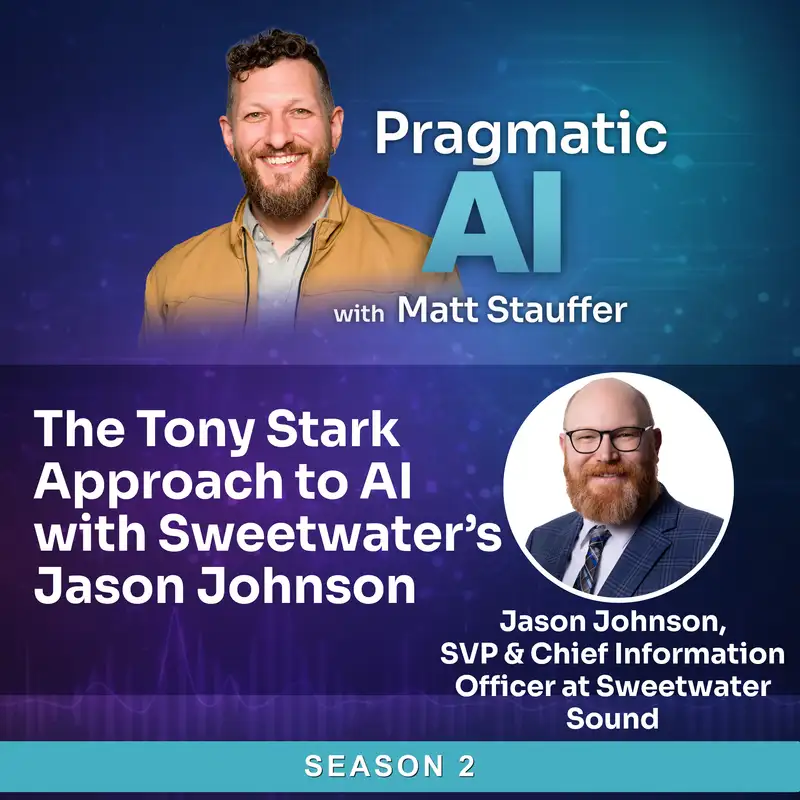
The Tony Stark Approach to AI with Sweetwater’s Jason Johnson
Matt Stauffer:
Hey, and welcome back to Pragmatic AI, where we're working to bring a clear-eyed look at how AI interacts with the real world. My guest today is my good friend Jason Johnson, SVP and Chief Information Officer at Sweetwater Sound. Yes.
That sweetwater sound, the one that if you have any interaction with any kind of audio stuff, you're like, my god, I order for them all the time. They're the ones who send us the candy. Like the number of people who freak out when they know that I get to interact sweetwater sound, it's crazy. Jason, thank you for hanging out. You want to say hi and tell us kind of who you are and what you do?
Jason Johnson:
Yeah. Yeah.
Yeah, I'm uh I'm Jason Johnson. Thanks for having me. I'm the chief information officer for Sweetwater Sound, not the beer company. we get confused with that a lot, but the music company,
Matt Stauffer:
funny.
Jason Johnson:
that that's probably hits home close for you and it with Atlanta ties. So, you know, um
Yeah, we what a lot of people don't know about Sweetwater is like we're a tech company in disguise. We have about uh two hundred and forty people in our technology organization for a two billion dollar company that's still relatively large. And we build all of our own tech. So every piece of the Sweetwater experience from the candy bags, and I can tell you all about um how we automate candy packing and all the technology we have around
Matt Stauffer:
Yes.
Jason Johnson:
making sure the candy gets in the bag and all that type of stuff. Uh we're we're just a big tech shop.
Matt Stauffer:
Yeah. And I love telling people because people are like, you know, okay, you guys who work with Sweetwater, what are they like? Mm mostly because people have such a personal experience with Sweetwater. Cause for those who don't know, when you buy something from Sweetwater, you're assigned a specific rep and that person gets to know you by name. You're like, yeah, you know, I was talking to Bob and Bob's my guy, and Bob and I are talking about drums because and I've ordered from Sweetwater for years, right? Long before I got to work with you guys.
And they're like, and we get the candy. And my family knows, oh, you know, when mom orders something from Sweetwater, we're all gonna get some candy. So there's this very kind of like small, intimate personal connection. And they're like, Is Sweetwater this kind of like megacorp? Because obviously it's a very big and profitable group. I'm like, I mean, I guess yes, but basically, no, like you go there and I'm I'm freaking going down a slide and taking pictures of
Jason Johnson:
Yeah.
Matt Stauffer:
selves on the slide. Like it is one of the most i c family connected, intimate, you know,
Jason Johnson:
Yeah.
Matt Stauffer:
just kind of like human.
large companies I've ever been to in my entire life. And I know it's super intentional for you guys, but it's still such a cool environment.
Jason Johnson:
I always love to say like the process of making music is highly collaborative and the process of working with musicians is highly collaborative. I mean, it is one one big family here. I one of my favorite stories was like I was in Florida. My grandmother had passed away several years ago, and I'm down in Florida kind of packing up the house with my dad and helping my mom out. And um I go to a local FedEx store because we want to ship a bunch of stuff back to Fort Wayne. And, you know, I can use we have a we're a big FedEx customer, so I can use our FedEx account. And I I go in there and I'm wearing a sweetwater t shirt. I'm just, you know, I'm just
It's a Thursday at 10
Matt Stauffer:
Yeah. Yeah.
Jason Johnson:
a.m. And this guy walks up to me and he slaps me on the chest, literally. And he looks at me and goes, Who's your guy? And I'm like, excuse me, sir, you just assaulted me.
Matt Stauffer:
What? What are you talking about?
Jason Johnson:
Like and I look at it, and it takes me a minute to click. And he's like, he's like pointing at my shirt. He's like, Who's your guy?
Matt Stauffer:
Uh-huh.
Jason Johnson:
He's like, My guy's Jerry. And I'm like, I'm like, you know, I work there. No way. And I mean, this guy just, he's just like,
Tells me all about his sales engineer and all about his experiences there and everything else. And fun story, I challenged that guy who was talking about a buying a guitar. And I said, if you buy a guitar, I'll make sure a free t shirt gets put in your next order. And
Matt Stauffer:
Oh cool.
Jason Johnson:
and I came in Monday and the dude had bought like a four thousand dollar guitar that he had been he had been cruising on the website for several months. So we I personally got a t shirt packed in that box. So uh
Matt Stauffer:
That's amazing.
Jason Johnson:
yeah, people people love us.
Matt Stauffer:
Yeah, and that absolutely true. Um, so that is the context for all of our conversations today. Um, as you know, the main thing I'm really trying to dive into is how normal people and normal businesses, normal day-to-day jobs figure out how AI, which we're tolding telling is going to transform our lives, it's going to take our jobs, it's we have to know it immediately, even though what we have to know, as we were saying, is gonna change every day. And so I wanna know like you are a not only a technologist, but you are a lead technologist in a business context who's defining not only how you interact with AI.
But also how hundreds to thousands of people interact with AI. So, first of all, before we even get into your kind of work context, as somebody who's responsible for leading technology in places, do you feel the pressure to be earlier adopter or more ahead of everybody else? And regardless of how you feel generally, what has this kind of the approach of AI been like for you personally? Like, do you feel like you gotta jump on all of it early? Have you been more of a later adopter? Are you a little more skeptical? Like what's your relationship with adopting
Jason Johnson:
Yeah.
Matt Stauffer:
AI been like?
Jason Johnson:
I I think I think we were early adopters um in things, not like crazy early adopters. I don't have any stories from twenty twenty two or twenty twenty one from, you know, OpenAI one point Um,
Matt Stauffer:
Yeah.
Jason Johnson:
but but really twenty two, twenty three, we really started picking up steam and saying like, Hey, l let's let's go into this. And actually, like, you know, if you rewind that in many ways, like
You know, five years ago, autocomplete in IDEs and just generally autocomplete got really good. And I don't think people think about the fact that like traditional machine learning, you know, Siri
Matt Stauffer:
Yeah.
Jason Johnson:
invented 2011. Like, you know, these things have been sneaking up on us in maybe just ways that were less tangible or in our face. Um, and when you really zoom back and say, Okay, have I believed in the technology at that level? Like the answer is absolutely. Um, you know, I have a a relatively decent sized data science team that that
has been training models for years and years and years to do everything from product recommendations to fraud prevention to you you name it. Um,
Matt Stauffer:
Yeah. Yeah.
Jason Johnson:
this just wrapped a different flavor to it and a and a slightly different interface than what most people had been used to. So ear early adopters for sure. Like I believe in that I think one of the questions that I ask myself is like, um, you know, do I think this is happening with or without me? And I think the answer to that question is clearly yes. And so, you know, whether it's your whether it's a nemesis for you or
Or whether it's something you embrace, like I think, you know, all things are better when we have a knowledge-based, accurate conversation about them from a position of understanding. And so
Matt Stauffer:
Yeah.
Jason Johnson:
that's kind of the heart that I that I led into it. You know, do I think it's gonna take over the world and and and do that? Who knows? I would have never thought, you know, half the things we're doing today are even possible, AI or not. Um, but you know.
AI is not aspirational, human beings are. And I think, you know, we've always been the problem. We will always be the problem.
Matt Stauffer:
Mm.
Jason Johnson:
Um, and it's how we choose to use these tools in front of us that I think is really gonna define, you know, the next the the next generation um of tech leaders, you know, coming up behind us in big, big ways and and where we are here now.
Matt Stauffer:
Yeah. And I I really appreciate your acknowledgement that like you, in terms of what you're doing, all of us who are programmers and plenty of listeners aren't programmers, but many of us are, have been interacting with people. There are people who use Siri. We have been interacting with things that at the time were the leading consumer facing forefront of AI. And this big kind of like shift in AI has really been LLMs, right? Like LLMs, the the advent of LMs and chat interfaces, LLMs have been the big shift, but it's not as if there was nothing prior. Um
And it does feel a lot less terrifying and extreme when you say, well, yes, it LLMs have really made a transformational shift in our interactions with it and the inevitability of it, but it's not as if that was the very beginning. Um a lot of
Jason Johnson:
Yeah. Yeah.
Matt Stauffer:
people when they're talking, they also mention that it's sort of like you know, copilot, which was like basically the introduction of autocomplete going from dumber autocomplete to LLM-based autocomplete, they often often talk about that being their introduction. And so that's even a smoother and more natural introduction, right? Because you're like smart IDE.
into LLM powered IDE into, you know, Claude code. That's that's a much that's a smoother introduction, right?
Jason Johnson:
It is, yeah. And I mean, I think that like, you know, people, technology it just we haven't had something really big like this hit the technology space as deep as we did. Uh I'll I'll blame this on myself, but I I've used this with others. But like, you know, when Uber came out, I was like running around showing all my friends like, look at this great app and I can just like call up a car and it's really
Matt Stauffer:
Yes.
Jason Johnson:
great and it comes to me and I don't have to worry about anything and it's so easy to use and I love it, right? And that's
Matt Stauffer:
Yeah,
same. Yeah.
Jason Johnson:
An endorsement for Uber, but like
it's great. Um, I wasn't like, man, what about the taxi cab drivers and how is this changing the industry? And yet now all of a sudden technologists are having their Uber moment,
Matt Stauffer:
Yeah.
Jason Johnson:
which I would actually argue is kind of our own fault. It's a story of latent demand and supply supply constraint,
Matt Stauffer:
Yeah. Yeah.
Jason Johnson:
right? Um, and now we're kind of like all freaking out, like, hey, that doesn't feel very good. Like, you know, it's just it's uh and yet.
We've had revolutions like this before. The cloud was the same thing too. My infrastructure team is bigger now than it's ever been. They do different
Matt Stauffer:
Yeah.
Jason Johnson:
things. You know, can it's I think it's like Javon or Jabox's paradigm is is one of the things people refer to a lot with the um with shipping containers and how that changed the industry. Yeah,
Matt Stauffer:
Okay. I'm not familiar, yeah.
Jason Johnson:
it's it's it's uh I digress, but it's a it's a it's a nice little rabbit hole to get down. But
You know, you you think kind of through that and you just go like this is just change. And, you know, did the cloud deliver on everything that it said it was going to from the late 2010s? A little bit. But also without the cloud, you wouldn't have AI. And
Matt Stauffer:
Yeah. Hmm.
Jason Johnson:
so I'm I'm not as
excited about what I think AI is gonna do in the next year or two. And I'm much more excited about what it's gonna do, I think, in the next 10 years and the and the path to get there. And then frankly, how we adapt as human beings, uh, is there's clearly governance issues. There's clearly um infrastructure issues. There's there's all sorts of things around um a lot of this stuff. But even inside of that, you know, um one of the most fascinating things I've gotten into many conversations with folks about is like, you know, uh I I don't
the water and the cooling and kind of the environmental aspects of it, which are very real issues that we need to we need to sort through. Um, all of a sudden, hey, I'm not gonna use a chat bot because I'm concerned about those, but I'm gonna go home and play video games for six hours at night. Go look at where the energy costs are going amongst those things. Go look at, you know, what it takes to get a package of avocados delivered to Indiana in the middle of February so you can have your favorite salad from a and I'm not I'm not saying
know there are right and wrongs in those conversations. It's just fascinating to zoom back and look at our ecosystem as an as a whole and go, where is my carbon footprint? What are the things that I'm doing? Where are, you know, the technologies being baked into my life that I wouldn't thought of, that I that I wouldn't think of, you know, um having a having an impact. And I think AI sparked a lot of those really core conversations in in a rapid way that I think are really healthy. They're good.
Matt Stauffer:
Yeah, and
I you've said so many good things to respond to, but I'm gonna start at the end. Uh at the eat at the be very beginning of this podcast, which I don't know how many months ago is, but I think it was less than a year, the water conversation came up on every single episode. And we're all like, I'm not really sure how to respond to it. I don't know what the ethical way to do is. And more and more things have been coming out that are actually kind of like showing practically what the water usage is compared to other things that we all accept and understand as a pr and it it's just become like
less and less of a part of the conversation. We're like, yeah, it does use water, but look at these other things we rely on that use 10 times as much water. If you look at almonds, like, my God, you know, like and
Jason Johnson:
Yeah.
Matt Stauffer:
you know, Dan Sheetz, my business partner, has been telling me for years, he's like, if you if you look at how much water alm a single almond takes to make, you'll never eat almonds, drink almond milk. Yeah. But like
Jason Johnson:
Pistachios. Yeah.
Matt Stauffer:
there's not a massive worldwide revolution to stop using them. And so there
Jason Johnson:
Yeah.
Matt Stauffer:
are other concerns with AI, right? Like data centers and privacy and governance, all these other things.
But it is interesting that that one has sort of just kind of like petered down, like, that was a that was a moment of fear. And now we're like, let's now let's make sure it just doesn't destroy the world. Um so
Jason Johnson:
Yeah, and I
think and look, and all these things are context sensitive and they're all a person uh it's all a personal aspect. I mean, in Fort Wayne, Indiana right now, Google is building a massive four hundred acre data center complex that we think is gonna
Matt Stauffer:
Wow.
Jason Johnson:
largely be AI. I'm not sure, but like that's in our backyard. It's backed up to a to a a protective marsh that we're all here. Like at a high level, like these things can be um not as bad as video games, or they can have a different balance. And at a low level, you literally can have something coming into your backyard in your town.
causing energy crisis for your people. Um, and those like there can be four truths in all this. It's it's not a I think one you know, the biggest thing for concern that I have generally speaking around any new technology, AI or not, but clearly AI is the big the big nut here is like, is is, you know, are we having the right conversation? Um and are we are we not just being black and white at it? It is really is much more nuanced than that. Um
I think we gotta give it the complexity we gotta give it the thought complexity that it deserves, you know.
Matt Stauffer:
Wow, nuance and complexity. Who are you? You're on the internet and you're not making everything black and white.
Jason Johnson:
Yeah. Yeah.
Matt Stauffer:
so you are a lot of times when I'm talking to people about this decisions about how we move forward in our response to AI, it's people who are living in the the Twitter world of everybody needs to change and everything needs to change. And I got rid of all my engineers and I've replaced them all with Claude. And you know, we're even seeing a lot of bigger companies do that. And a lot of them are starting to kind of roll it back and be like, we gotta rehire all those people we fired.
And you are both someone working at really large scale who has to be considered considering their efficiencies, and also someone who I think of as being uh as a person and as a company extremely well established and moderate in terms of you don't just change everything at the on on a whim. So what has your policy been in terms of how you guys decide to or not to adopt AI in your development practices, but also as a part of your
Your workflows and your customer service, like how do you evaluate what you do and don't want to integrate into Sweetwater?
Jason Johnson:
That's a great question. Um, you know, we think about it in a very pragmatic way. It I believe that AI is a tool. Um, and it's a tool in our toolbox. So we started off early by casting a lot of vision and documenting that vision as a governance document for ourselves. And I believe that we're gonna win with Iron Man suits. I believe that that that Iron Man suits are the way that that we we do this. It's human in the loop or human on the loop, depending on the scenario. And and
I think that we the sweetwater version of AI, the version that I put my head on my pillow at night and feel really good about is one that's incredibly human centric. Um, I say, you know, I've told my team, like when Tony Stark lands in the Iron Man suit and he steps out, he's a rock star and it's all about Tony. Everybody knows, everybody knows
Matt Stauffer:
Yeah. Huh.
Jason Johnson:
that he could have only flown in it with the suit. You don't have to stand
Matt Stauffer:
Right.
Jason Johnson:
and go, you know, you know, you couldn't have done that without the suit. Of course.
You know, just like a drill on a construction site, right? It's it's making us faster, it's changing the way we work, um, and and the motions that we do it in. Um, but I think we're actually putting humans um more in the forefront. Um, you know, the the folks that I see really, really adopting AI in a well-rounded way. We have folks that are doing, you know, 60, 70 days, man days worth of work in a two-week sprint, um, from an estimation standpoint.
you know, those folks are getting deeper in the business. They're understanding more context. They're realizing that the value they add is in a higher level of thinking and reasoning and maybe not necessarily actually writing every line of code on their own together. And a lot of those are freeing. Um
Matt Stauffer:
Mm-hmm.
Jason Johnson:
and I think I think we find uh people that um you know that are that are also struggling to understand that like, hey, my craft isn't these codes on the screen anymore. Um it's in
Matt Stauffer:
Mm, mm-hmm.
Jason Johnson:
designing systems and planning systems and getting, you know, business outcomes, not just writing code. Um, and so that's a journey for everybody. And, you know, we've committed to every single person that we're gonna wrap our arms around you and we're gonna we're gonna try to train you, get you there. And when something's not working or something's silly, like we're just not gonna do it. And that's, you know, we're gonna put the humans first, always. So that's that that's who we are. Yeah. Yeah. Yeah.
Matt Stauffer:
Okay. I love that. I love that very much. But yeah. And then I'm unsurprised, but I still love to hear it. Um, but
you did mention in there one of the things that is kind of obviously the the the little less nuanced, which is the six to seven X for some people. you know, you said, you know, sixty, sixty to seventy developer days in in two ten business days. Uh how what does quality control look like? How do you ensure that this is not just, yeah, we're moving faster and shipping sloppier?
Jason Johnson:
Yeah. I so what I what I have found is AI is a great accelerator.
Matt Stauffer:
Mm-hmm.
Jason Johnson:
And if you're mediocre and you're not very good at your job, you're
Matt Stauffer:
Yeah.
Jason Johnson:
gonna accelerate to an area that's probably not ideal. And if you're pretty good at your job and you understand your craft and you understand how these technologies work, you're gonna accelerate and hold high level standards. One of
Matt Stauffer:
Mm-hmm.
Jason Johnson:
the biggest things we've done is create like a skills repository where team members can share skills.
We have this mentorship program we call token exchange, where we're taking human beings and pairing them with other human beings. Um, you know, is still a craft. You don't if I put a drill if I put a drill in or a pneumatic nailer in your hand and told you to go build a house, like you can do it the right way faster,
Matt Stauffer:
Yeah.
Jason Johnson:
or you can choose to do it really sloppy. I think that those are choices we're making. Um, including um, you know, uh this concept I say like the answer to AI is always more AI.
It's I have a I have a good friend of mine who's a doctor, and one night, you know, him and I were pondering and he said, Have you ever noticed that the answer to drugs or too many drugs is more drugs? Like if you have high blood pressure and I give you too many, too much low blood pressure medicine, I will just give you some high blood pressure medicine. Right. Um
Matt Stauffer:
Yeah. Yeah.
Jason Johnson:
and I think, you know, I think AI, uh the answer to AI is oftentimes more AI. So it's okay, how do I create a standards bot? How do I instead of how do I uh build a linter? You know, I think, I think actually.
Using non-deterministic things to build deterministic things is something that I don't think people forget. But you, you know, that is the massive unlock here in many, many
Matt Stauffer:
Yeah, yeah.
Jason Johnson:
ways. and then having deterministic parts of or non-deterministic parts of your code additionally, too. but I think that, you know, how do we review, how do we refine, how do we understand, how do we do it? Um, I built earlier this year, um, for like a side project for a nonprofit, I built a my very first 100% agentic project.
that was a Laravel project. It was relatively, you know, I would say it's medium size, but it was running a little business and helping them with some process flows. And um, I did it in about a week. Um, and for the first time I had this really uncomfortable moment where I was about ready to go to production. And I said, you know, I don't know, I haven't code reviewed every line of this. I don't know how this thing 100% works. It's totally usable. It it's the client loves it, but I don't know. And I stopped.
And I said, you know what? I'm gonna use AI to have this explained to me. And I'm gonna go through method by method and I'm gonna totally understand it because that's my choice. My choice as a software engineer is to push it to production and say it's good enough or to say, wait a minute, I'm responsible for this thing. I wanna understand how it works. It's great that I built it in a week. It would have taken me six weeks before. I'm gonna take an extra two days and choose to deeply understand my application.
And you know what the cool part is? I got AI to document it all the way along. And I hate writing documentation. And so now I have apps that have better documentation than I've ever had before. You know? Uh
Matt Stauffer:
Yes. Yeah.
Jason Johnson:
I think those are ch choices. I don't, you know, we have agency in every step of the way. And you know, that would be one of my encouragements to everybody is don't just feel like, you know, you're at the whims of these bots. make them work for you and put them to work. You know.
Matt Stauffer:
That's good. I'm trying
to remember the phrase, but there was some phrase Addie Osmanni had a a blog post a while back that I referenced in one of my conference talks, and he's talking about cognitive overload and cognitive debt where the the amount of work that we um and maybe cognitive surrender is the phrase I'm looking for. We basically you get to a point where there's so much that it is created, whether it's code or something else like that, that you're like, it is beyond the point for me to be able to understand the thing or comprehend it. And so you just give up. And you might not give up at the front of mind, but at some point you just say,
You know what? I always intended to kind of learn what this thing was generating for me, but at this point it's beyond my ability to understand. And you give up and then you keep prompting and you keep building. And at that point, now it's just like it's a downhill trend towards if I didn't understand it back then, I'm certainly never gonna understand it going forwards. And that I think is a really dangerous moment of the moment you say, I'm responsible for this and yet I'm not willing to take responsibility for it, versus the moment you hit where you said, I'm responsible for this and I don't understand it, so I'm gonna pause.
And those two days could have been productive days, or you could have added two days more features, and you're like, No, I'm gonna spend two days to understand this thing, because in the end, the buck does stop with me. And I think that's a valuable moment if it's the Iron Man suit and AI is the thing around the person, then Tony Stark doesn't get to say, Well, my, you know, my sh my suit just ran away with me. And I I let it make the decisions and I let it decide
Jason Johnson:
Right.
Matt Stauffer:
whether or not we're shooting that missile. Like, no, the Tony Stark is the brain, he's the decision. He needs to understand what it's doing. It's just amplifying his brain, his
vision, his his purpose, which means he still is responsible for anything it does in the end. And and that's something I think a lot of people are forgetting about, you know, when they they they they go full agentic, you know.
Jason Johnson:
Yeah, and I think there's a I think that there's a spectrum. let me ask you this question. Did you ever have and I know I personally did, so I'll I'll answer it first, but like, did you ever ever have a part in your early programming journey, your early developer days, where you wrote a piece of code that you, you know, you copied and pasted over Stack Overflow and maybe you even wrote a comment that was like, I have no idea. I have code
Matt Stauffer:
Yes.
Jason Johnson:
I have code I could go point you to that says,
Matt Stauffer:
Yeah.
Jason Johnson:
if you're ever reading for this, I literally have no idea how it works, but this is where I pasted it from and it's working.
Matt Stauffer:
Yeah. It's
usually a regular expression for me, but yes, it's definitely something I've done. Yeah. Yep.
Jason Johnson:
Yeah, right. Okay. Yeah. Perfect example, right? Yeah.
Okay. Why were you comfortable with that at the time, but now uncomfortable
Matt Stauffer:
Yeah.
Jason Johnson:
that AI is doing something you don't know?
Matt Stauffer:
For me, the main thing is because it's really narrowly scoped. Uh,
Jason Johnson:
Yeah.
Matt Stauffer:
I understand ninety-nine point eight percent of this application and there's one little line, and
Jason Johnson:
Yeah.
Matt Stauffer:
I will know if that one little line doesn't do what it's supposed to, and I will be able to say, All right, maybe I need to pay somebody who knows what they're doing to come fix this thing, right? 'Cause it's this
Jason Johnson:
Yeah.
Matt Stauffer:
tiny little bit versus ninety-nine point nine percent I don't understand, right? That's that's the concern for me.
Jason Johnson:
I think what I'm seeing is that developers that are on the early part of their journey not knowing something, they're more comfortable with it because they because they they don't know what they they they haven't hit a maturity level yet where they where
Matt Stauffer:
Uh
Jason Johnson:
they believe they're an eck a true expert. And I think that what I'm seeing on the top end of the curve, what I experience myself, what I experience with leaders around me, is that oftentimes when you
Get into a much bigger organization and you grow in your leadership and you have lots of people. Like there's I got really comfortable years ago with the idea that I don't understand how everything works and that can
Matt Stauffer:
Mm-hmm.
Jason Johnson:
be okay because really the skill that I've honed in myself is figuring out how to understand things that I don't understand. And I think there's a middle gap in there where people have in even at some psychological level really tied their core identity to understanding something.
And and in that category, I think AI comes in and is is seen as a challenger, not as a not as an enabler. Um, because that's the value I bring to the table is I understand this thing. And the truth is, I think if we got really humble about it, we stood back, we would realize that like, you know, we we don't have to or don't necessarily know as much as we do. And AI on the surface appears like it knows a lot more than us all the time.
And that that becomes, I think, this this this push and pull in there. Um it's just I think it's fascinating. Um but yet we
Matt Stauffer:
Yeah. So how
Jason Johnson:
all go, Hey, the first time I met Matt, the guy who wrote the book on Laravelle, I just like succumbed to him and was like, he just knows way more than me and I'm totally fine with that. Right? Like that
Matt Stauffer:
Yeah. Um
Jason Johnson:
it's fascinating.
Matt Stauffer:
yeah, it is. And so I'm trying to, you know, because my I have an immediate response that I've baked and I'm like, I gotta be open to to a different way of thinking.
Jason Johnson:
Okay.
Matt Stauffer:
My immediate response, and I want you to push back on me and tell me where I'm missing here, is if no human understands the systems that we're responsible for maintaining, then we are entirely dependent on AI's ability to solve the problems that we're running into.
And at times that's fine. A lot of people said, Hey, it doesn't matter if I understand it because AI wrote it and AI will fix it. Except as A, there's some, you know, that puts a lot of control in the hands of the people who make the AI, which means the labs are now com our masters, right? Like if if if the labs say that you're everything's gonna be 10x cost, you're like, Well, I gotta pay it because otherwise I don't understand the system. But B, I've also often hit moments where I do a fully agentic project and I say, Can you solve this problem?
And it's been spinning and giving me wrong answers for three hours. And eventually I'm like, why am I even interacting with this thing? And and for me, it's usually because I'm I'm sending it prompts while it you know, my one minute in between meetings. So I'm like, yeah, okay,
Jason Johnson:
Yeah.
Matt Stauffer:
screw it. I'm gonna spend 15 minutes and fix the thing. But if I were truly in a point where I didn't understand it and I was relying on the AI to handle it and it just hit one of those months where I can't get it, like what do we do in that moment if nobody really understands it? Tell me where I'm am I still overemphasizing
Jason Johnson:
Yeah. No.
Matt Stauffer:
my need to understand?
Jason Johnson:
No, I think I think the need to understand and and you I believe the most important skill that any human being can have is curiosity. And I think you know you you have to understand
Matt Stauffer:
Mm-hmm. Yes.
Jason Johnson:
and you have to do that. And I think AI becomes a tool in understanding. But
Matt Stauffer:
Mm-hmm.
Jason Johnson:
I could argue the same thing about like what if you know documentation went offline for your favorite framework, or what if you know, how do you actually learn these things? How do we get in there? And think that has to be
A personal drive that says I'm going to choose to understand the world around me and the tools that I'm using at a deep level. Um, just clearly, you know, if if AI goes down, you know, I'm gonna be going slower than I normally would, right? That like that, or or my job's gonna shift in a different way. So I think that the entropy is out there, I think that's always existed. Um, but to some extent, you know, like that that human beings are kind of innately built to make
make our own lives easier. Um, and so I think that's the path that we don't we don't go down. You know, my my house is a smart house. And so my kids grew up not necessarily worrying about turning light switches off. And it really frustrates my parents. Really, really frustrates my parents a lot.
Matt Stauffer:
Interesting.
Jason Johnson:
They're like, you know, are your kids come and spend the night our house and they just leave all the lights on. What are they gonna do when they have their own house, right? And I go, you know, when they have when
Matt Stauffer:
Yeah, like it's gonna be smart, yeah.
Jason Johnson:
they have their own house, they probably won't have to worry about lights either. You know, it like, um that it's a
It's a I can't tell you how every piece of Symphony works or every piece of of Laravel works underneath. I have not dug down into every submethod and every modifier and every class and everything else. Um but I'm confident in my ability to be able to do that. Um I just have chosen not to. And and I don't know what makes um I think that the responsibility layer you hit on is probably the thing that makes makes that uncomfortable because you know if you're doing a side project, if you're doing something like that, but
Man, if I'm paying you to build something, if I'm producing a product, then it's this imposter syndrome, right? I'm asserting myself as an expert, but I'm not really an expert. And and I
Matt Stauffer:
Yes, that's a great point.
Jason Johnson:
and I think that I think that's the part that we just we gotta we gotta choose to to to to get around and over. And there's probably parts of it that um, you know, I think you and I chatted at one point, and I'm like, yeah, how many people are coming to you and going, yeah, but I'm just really concerned that I don't know how this PHP uh goes down to an assembly.
Matt Stauffer:
Yeah, yeah. Nobody cares. Yeah. Somebody
Jason Johnson:
No, everyone's like, Yeah, I don't need to know assembly. I don't care. Right.
Matt Stauffer:
needs to know it, but it's not me, right? Yeah. And part of it is like, is that somebody a human? There's there is an element
Jason Johnson:
Yeah.
Matt Stauffer:
that like somebody at Symphony understands that Symphony thing. Somebody at Laravel understands that Laravel thing. And for our clients, s yeah. I mean, as as somebody who interacts with those frameworks, I know there is actually somebody. And
Jason Johnson:
You assume all that you assume all that.
Matt Stauffer:
if there weren't somebody, I would be nervous, right? I would be nervous.
If if I was working with a package where the person who created this package doesn't understand it and they fearfully wrote it with or I I'm a I'm a package author and I maintain packages for Laravel itself and I get pull requests that are purely AI generated. The person who gave me the pull request doesn't understand anything. They just pointed Claude at the valet repository and said, Hey, go spin up fifteen, you know, and I have to spend significantly extra time because I do have to understand it. Right.
Jason Johnson:
Yeah. Yeah.
Matt Stauffer:
And so I there's yeah, it's nuanced, like
Jason Johnson:
Yeah. No
Matt Stauffer:
you say.
Jason Johnson:
it i it is. No, I I hear you there and I think that, you know, I think that we do have to be good to each other as human beings. I had a conversation with um some folks uh that I interact with regularly outside of Sweetwater and you know, a lot of the PRs and stuff like that were just
uh they were just it was the bot. It was the bot. And in some of those cases, like the bot was like like in our world and part of our governance policy is like is like I want you to know that you are responsible for that. When you write something with an agent on your breath, you're responsible for that. And so yeah, I expect you
Matt Stauffer:
Yeah, I love that.
Jason Johnson:
to be able to speak to it. I expect you to be able to understand it. Um that that again I believe is a choice. Um and I do think that we have to um we have to figure out identity management across all this stuff. I I frankly soapbox for a second, like I think that
You know, I think if we can figure out um the watermarking, the identity management, we will actually find out that that human curated art, that human curated music, that human um things become way more valuable. because another thing is I don't think many people realize how much uh generative content has been on the internet and in your world for a very, very long time, way before all this type of stuff. So, you know, I think they said this year was the first year there's more generated content on the internet than there was human.
human curated content. Um, and so um, you know, the TikTok ads you've been watching for years have been completely generative um and and responsive to that type of stuff. It's just been machine learning and a little less context sensitive. So um it it's fa it's it's all super, super fascinating to me.
Matt Stauffer:
Yeah. Um, I want to go down that route longer, but we're coming up on the time where we have to give the speed round. Before we get there, I want to check in with you outside of technology, because we've talked a whole bunch around you as the leader of the programming infrastructure. And that is certainly a place we talk about this a lot. But you're also a business leader, you're also an SVP, you're also a CIO. Like there's there a a lot of aspects of your jobs that aren't about writing code.
How have you found your interactions with AI to be when you're doing business things, when you're interacting with calendars and emails and structures and hiring and all that kind of stuff and writing? Uh, are you more or less pro AI in those moments? Are you v using a different type of AI there than you are elsewhere? Do you have to think about governance differently when it's not code? Like what's the difference there?
Jason Johnson:
Yeah, personally it's been writing a lot of automations and things like that
Matt Stauffer:
Okay.
Jason Johnson:
to, you know, I think it's so much easier to write software these days that like just, you know, getting things out of my way so that I can focus on the
Matt Stauffer:
Mm-hmm.
Jason Johnson:
the highest priority task has been a huge enabler for me. Um, you know, I think that
Matt Stauffer:
What kind of context are you doing that in? Sorry to interrupt.
Jason Johnson:
No, uh say that differently, sorry. What was the question?
Matt Stauffer:
yeah,
I are you uh Claude Cowork? Are you doing things in Gemini? Like where are you actually writing automations?
Jason Johnson:
uh
yeah, everything. So claude co-work, big one, the desktop app. Um, you know, I'm actually a lot of times I'm writing non-deterministic or sorry, writing non-deterministic code to do automations. Um,
Matt Stauffer:
Uh-huh. Yeah.
Jason Johnson:
with maybe a little deterministic injection there. So for instance, like we're a enterprise every day, you know, at eight PM and at three PM I get a spam um email. You know, I've I have a little piece of code that basically searches my calendar and builds a context around my calendar that um
will look at that and email and decide whether to release spam on my behalf or not. I no longer sort through that and decide if any messages got caught in the spam filter or whatever.
Matt Stauffer:
Yeah. Yeah, okay.
Jason Johnson:
But it's that's a cloud cloud run job running every,
Matt Stauffer:
Okay.
Jason Johnson:
you know, at specific times is a very traditional piece of code. Um I that's I've never would have gone down to that level of automation in the past without
Matt Stauffer:
Yes.
Jason Johnson:
AI. AI made it easy to achieve those things.
Matt Stauffer:
Okay. Nerding
for another minute. Is this a Cloudflare worker? Like are you hosting your own things? Like Okay.
Jason Johnson:
this this is a GCP cloud
cloud cloud run job.
Matt Stauffer:
Yeah, okay.
Jason Johnson:
Uh so um, you know, things like that. I I think it when dealing with humans, you know, that's that's always authentically me. So a lot of it isn't on the administrative side for me. Uh I just sat with another executive just before this and we were dumping in PLs into a Claude project and ri and ripping over that and doing analysis on, you know, pack package costs per minute and and things like
Matt Stauffer:
Yeah.
Jason Johnson:
that. Um, that just allow you to uh
Be smarter and and ask questions. I do a lot of summarization and stuff like that.
Matt Stauffer:
Mm-hmm.
Jason Johnson:
so it's been it's been all over the board. I have a little open claw bot that's working on my behalf pretty much all the time in in in some
Matt Stauffer:
Really.
Jason Johnson:
fun ways. Um, so you know, like pinging me and saying, you know, five minutes before your next meeting, you should leave now. uh Stuff like that.
Matt Stauffer:
Yeah, yeah, yeah, that's cool.
Jason Johnson:
Um, but but nothing super crazy. Yeah.
Matt Stauffer:
Okay.
I I appreciate the idea. So we haven't actually talked a ton in the podcast about determinism versus non-determinism. And my simplest way of I've explained it, but I want you to tell me if you're because you're really good at simplifying complicated concepts to people. Uh
Jason Johnson:
Thanks.
Matt Stauffer:
I tend to t tell people that like if the answer is gonna be the same every single time it runs, that's determinism. And if it the answer could be different or it depends, or you it's not predictably consistent, that's non-determinism.
That's like the simplest one, but do you have when you're talking about the difference, do you talk about it any differently? You have a better way of explaining it?
Jason Johnson:
Yeah, so I I oftentimes say like uh a piece of software deterministic, right? Like I want to do something the same way every single time. You can try to make humans deterministic, but oftentimes we're just simply not, right? Like I could I could tell you, Matt, I want you to complete this task every morning at eight AM. I wrote you a a a guide for it that's 10 steps
Matt Stauffer:
huh.
Jason Johnson:
that tells you exactly what to do, right? The deterministic part of that is the guide. It it's not
You know, the word document's just not going to rearrange itself and decide to do it out of order or make it different. The non-deterministic part is you, right? I I promise you, as a human being, if I asked you to do it at 8 a.m., some mornings you're going to do it at 803, some mornings you're going to do it at 758. Sometimes you're going to do step one. And one of those times you're going to think, you know what? It's a lot more efficient to do step five before step four. And I'm just going to do it that way, even though the guide itself says to do it this way. and I think, you know, I think largely like we're going to end up with software that is, it is
That is has a non-deterministic flow in it. So if I can give you a really great example of one of my favorite integrations, um, I'm I I work sometimes with a small e-commerce company. I love them, they're like a little test bed for all my gadgets. And they process like 33 CSVs from vendors every single day and it updates their inventory. And um, you know, sometimes those vendors like the CSV comes out of a structured API, it's very deterministic, never fails, never have problem. Sometimes it's like Suzy in accounting or Susie on the sales team sends an email every week.
And she most of the time sends the same spreadsheet with the same column headers on it. But every once in a while, you get one spread that one spreadsheet that instead of saying quantity, it says QTY. And there you
Matt Stauffer:
Yeah.
Jason Johnson:
go. So I built an entire processing pipeline for these spreadsheets. And it uses like a config map to figure out where these
Matt Stauffer:
Hmm.
Jason Johnson:
columns are. But
If it fails processing for any reason, it kicks it over into a GCP bucket, it hydrates that bucket with the last three successfuls and the config map, and it spins up Gemini and says, Hey, can you solve this problem? And Gemini will come back and go, it looks like the quantity column was renamed to QTY. And it will actually rewrite the CSV file.
Reprocess it on its own. And if that happens more than twice, so two days in a row, it'll submit a PR to me and ping me and say, Hey, I think we need to update the config map. It looks like this file's permanently changed, right?
Matt Stauffer:
Wow.
Jason Johnson:
I just automated a ton of human troubleshooting out of those files
Matt Stauffer:
Yes.
Jason Johnson:
of people calling me and going, Oh, so and so's feeds down again.
Matt Stauffer:
Yeah.
Jason Johnson:
What's
going on? I go, yeah, they changed the column in the CSV and they didn't tell me. Well, what really happened was Susie went on vacation for two days and Matt stepped in and Matt wrote the file differently. And it's
Matt Stauffer:
Yep. Yeah.
Jason Johnson:
such a great way to use a a model to just think through it a little bit more and do and and automate something a that nobody wants to do. Right? Nobody wants to fix CSV files.
Matt Stauffer:
Yes. Yep. And
I and I love this sort of stuff. This is the stuff that people are when they're talking about completely replacing people's jobs and all sorts of I'm like a AI is the best as a tool that makes us better at what we're doing or a tool that takes away the things that nobody wants to do in the first place. Like I I often give the example of like I constantly review submissions to builtwithlaravel.com because people say, Hey, I want you to consider featuring my site in built with laravel.com
And I have very consistent and predictable metric that I use to decide whether or not somebody goes and built with laravel.com And I never want an AI to make the decision for me, but I'm doing the same research every single time. I'm like, wait a minute. Every time a submission comes through, it runs up and it says, please look up these page rank numbers, please do this, please evaluate based on this. Give me a rating and give me the information to justify that rating. And then I still make the decision. So there's still a human there. It's still me deciding it, but there's boring parts that are super repetitive that I don't have to do anymore. So I love this example here. It's like
Nobody wants to do that. Nobody wants to be the the spreadsheet reconciler. That's not a best part of anybody's day, you know? And now they don't have to.
Jason Johnson:
Well
let me give you a slightly different version of that that hits personally for me. Um, I'm a private pilot. I fly a lot recreationally. There's nothing that I go fly for that is absolutely a requirement for me to ever get in that plane and actually complete the mission. And in the pilot community, you create this document that's a contract with yourself that's called your personal minimums. And that personal minimums might be like
Hey, I'll only fly during these hours, or maybe I get this much sleep, or I if a crosswind is a hard limit on this, or if I haven't flown to this airport before in the daytime, then I'm not gonna fly there in the night. And you create you create this document that the idea is to help you process a bias, which is I love airplanes, and when I get the opportunity to fly, I wanna go fly. And so oftentimes I'm looking for reasons why it's okay to break my own rules.
So I do all my traditional flight planning, just the way you know the FA requires me to do it, all by the letter of the law. And then I take that package and I take my personal minimums and I dump it into a bot and I say, hey,
Matt Stauffer:
cool.
Jason Johnson:
double check this. And it'll come back and go, you know, you are over your crosswind minimums, like you will. And it it actually removes bias from the process that I have
Matt Stauffer:
Wow.
Jason Johnson:
in my head and can help um help me make the decision. Um, just like if I had.
You know, another pilot next to me, I might ask them to do the same thing. Um,
Matt Stauffer:
Yeah.
Jason Johnson:
you know, I built a house one time and I was walking through it for the final inspection. And we go through and put blue tape on everything, and I had a good friend with me, and I walk through the house and I'm like, Man, this house is amazing and I love it. I'm so excited to move in. And I don't see and he's like, When do you want me to start telling things that are wrong that are wrong? And I'm any time. And he walks through and he's like, you know, that wire's hanging out of the wall there, there's a nick in this wall, they didn't paint this, your floor is spread apart here, and you're just like, my god, I've got these blinders on.
Matt Stauffer:
Yeah. Hmm.
Jason Johnson:
And so um I think about
it as like actually pitting it against you in ways like that as an enabler is actually like a fascinating, you know, kind of use case. So um I have a briefing skill that I use, and that job of that briefing skill is to keep me alive. Right? Keep me honest. Um and some
Matt Stauffer:
Hm. Yeah. That's very cool.
Jason Johnson:
and sometimes it comes back and says, Jason, there's a thunderstorm and you shouldn't fly today. And I go, that thunderstorm is.
is down in Atlanta and I'm flying up to Michigan and you know sometimes it can be overconscious of that. But um
Matt Stauffer:
Yeah. Mm-hmm.
Jason Johnson:
but it's the it's the conversation that's important that's happening in there.
Matt Stauffer:
That's cool.
And we've talked a lot in the past about um the sick I hate pronouncing this word. Sycophancy? The sycophants. You know, basically where they're sycophantic, where they the AIs have been specifically trained to say yes to everything you ask them to do, to to always give you whatever you want to make you feel good. And so I really appreciate the idea that they can be most valuable when you specifically set them against you. Like please tell me no in these contexts. Cause once you ask it to do that, it'll say, I my the sycophantic answer is to tell you no. Great, I can do that.
Jason Johnson:
Yeah.
Yeah.
Matt Stauffer:
but
we don't often set them against ourselves. We don't often ask them to correct us or to tell us that we're wrong. And there's a lot of worlds that open up when we s consider that.
Jason Johnson:
It's so true. And the reason I'm smiling right now is because um like, you know, these models are trained off of humans and data that humans created. Like you could say that exact same thing about humans. Humans don't like saying no to each other, right? You know,
Matt Stauffer:
Yeah. Yeah, that's true.
Jason Johnson:
hum or people people are like, Yeah, but sometimes the model lies to me and it's super confident about it. And I'm like, You don't think you're w not walking around every day all day long having people lie? I'm not saying they're maliciously lying to you, but
Matt Stauffer:
Sure.
Jason Johnson:
Your whole life is full of lies. Like what, you know,
Matt Stauffer:
Yeah.
Jason Johnson:
and assumptions and context, you know, like like they're just doing uh what what we do to each other all the time. it's fascinating.
Matt Stauffer:
Yeah. That's really funny.
Jason Johnson:
But I do love that you can you can give it a bias to to say no. And and you know what that the beginning of that prompt is um I want you to find reasons not to fly.
Matt Stauffer:
Okay. Alright, and again, so be be a sycophant to me and give me this thing I'm asking for, even if it might mean telling me no. That's really cool. Um,
Jason Johnson:
Exactly. Yeah.
Matt Stauffer:
okay, so we are at the point where we need to do our speed round.
All right. I've got your timer up and let's do the speed round.
All right, so your first question is what is your AI tool of choice?
Jason Johnson:
I would say Claude code, although I have been also uh using some using some open source models.
You created the rule.
Matt Stauffer:
Alright, next question. Have you ever I know and I hate the rules I created. What
have you ever cussed out an AI?
Jason Johnson:
Yes. Yeah.
Matt Stauffer:
Yeah.
Jason Johnson:
Yes. Yes, I have. Yeah. Yeah. I've gotten pretty I've gotten pretty raw with AI before, for sure. It is it's interesting. Yeah. Yeah.
Matt Stauffer:
I you know what? Sc screw the rules. Tell me the tell me the story. We've got fifty seconds left.
Jason Johnson:
Uh you know, I I have gotten I've I have beaten it up, especially my bot
Matt Stauffer:
Yeah.
Jason Johnson:
Jarvis. Like, you I tell him like, hey, this is not good enough. I don't understand what you're doing. Why are you thinking this way? You know, and my wife, you know, believes that that's not a good strategy long term and I'm you know I
Matt Stauffer:
Yeah.
Jason Johnson:
Totally fine with it. So uh yeah, I think you gotta you just gotta be real with it, man. Yeah, exactly. Yeah.
Matt Stauffer:
She's trying to survive the robot revolution later. Yep.
All right. what is one pro usage of AI that more people should be using?
Jason Johnson:
one number one thing, ask questions. Um I created an email persona for myself. How do I help write and speak like myself? What I did was I said, I want you to analyze the last 3,000 sent messages in my mailbox and ask me a hundred questions one by one about how I speak, how I talk, how I write, and how you think you can write better on my behalf. And I think I think getting into an iterative process where you ask it to answer questions over and over again is is really, really a great, um, a great unlock.
Matt Stauffer:
Wow. All right. Um
Jason Johnson:
It might also
it'll also ask you weird things. Like it came back and it was like, hey, 86% of the time you misspell a word or have a grammar error in your email. Do you want me to do the same? And I'm like, eighty-six. I let's shoot for 51. How does 51% sound? You know, you're negotiating with a model on how you should how often
Matt Stauffer:
Oh my god.
Jason Johnson:
you should misspell and and grammar, you know, and have poor grammar.
Matt Stauffer:
That's amazing.
All right. Uh next question. Is AI going to ruin the world?
Jason Johnson:
I don't think it's I think I think we can choose to allow that to happen or not allow it to happen. And I think you can say that about any any other major piece of technology that has ever in the history of humans created it. You know, there's pros and cons. We we are the problem. We always have been the problem. Um, you know, if we can solve that, then we'll we'll do much better. Be better people.
Matt Stauffer:
Amazing. And the last the last question
is what is the most controversial take you have about AI?
Jason Johnson:
Um, maybe that it's not that I don't think it's gonna rule the world, that Skynet is
Matt Stauffer:
Yeah.
Jason Johnson:
not not impending, uh is probably not is probably the most controversial take. I'd I'd have to think about that one for just a second.
I don't think I have a super controversial take. I think I think I think we're we're um I think we're we're building the road in front of us. Um yeah.
Matt Stauffer:
Yeah, that's great. Well, thank you so much for uh participating in the speed round.
Jason Johnson:
Yeah.
Matt Stauffer:
so before we wrap up for the day, is there anything that you were thinking about when you knew you were coming on this podcast that you really wanted to get a chance to share?
Jason Johnson:
You know, not a ton. I I love talking with you, Matt. Um, you know, I think I I love the name of your podcast, Pragmatic AI. I think that like, you know, a lot of people uh I've talked to CIOs, stuff like that. They're like, hey, I'm just looking for a project aboard. Like AI is a tool, use it as a tool. It's an it's an awesome accelerator. Um, it's an awesome enabler. solve real business problems for your business. Start back, talk about the people, talk about the processes. It's always been people.
Process technology, have those conversations first. Don't just say what can AI make better. Say what can we make better. And I guarantee you with the right mindset that when you stand back, you will find that in today's day, AI is an accelerator to help you get there. um But we are not shifting around and just going, what products can we put AI in? What can we do with AI? How can AI lay off jobs? We're looking at and going, hey,
What teams are really struggling because they're behind on their work. They're struggling to stay caught up with our customer and improve our experience. How can we make customers' lives better? How can we make the employees' lives better around us? How can everybody have an easier day? Um, and and then working our way backwards into, man, look at that. There's parts of this code that we would have never been able to write on our own from an investment standpoint. Um, you know, I I built a web-based version of kind of Excel for a process the other day that I just looked at and was like, man.
With a prompt that was super easy. I would have never been willing to sit there for weeks and weeks and weeks and work on this interface. Um that becomes the real power and the real accelerator. And I and I just, man, more than ever, Matt, like love the people around you and and and um and just you know be a good human being. I think that we all have to remember that that there's another human on the other side of that email box. There's another human on the other side of that Slack or Teams message or whatever tool you use.
Um we are in one of the biggest periods of change, I believe, um, that we will probably ever experience in in our generation. Um it it is lopsided. There are people that are having things, bad things happen to them in their lives. Um listen, learn, be curious, um, and be good to the people around you. And, you know, I think that that we will we will have much better, you know, Netflix recommendations one day because of it. Right. You know, I mean, I think that
You really, really, really start to realize how much of this stuff is baked into our lives already.
Matt Stauffer:
Yeah.
Jason Johnson:
and and I I really, really think that when good people um with good hearts build experiences like we all win. We all are better because of great recommendations, as silly as that is. And you know, we are all better because great frameworks made our lives easier. And if you look at it, I think that's one area um that we probably all
rally around and agree upon, like nobody really wants to work. Nobody everybody wants to go home, be with their family. Everybody wants to have a good life. Everybody wants to be prosperous. And I think if you if you do that with that type of mindset, like we are winning and we will continue to win m in in ways that are that are gonna continue to blow our minds, just like it has since since we were really, you know, born or could had, you know, uh more adult like thinking. So
Matt Stauffer:
Yeah. Um, I deeply appreciate how much humanity has been at the core of every answer you've given here. Um, and I was gonna say that before you just gave that as your final closing statement.
Jason Johnson:
Yeah. uh
Matt Stauffer:
And I it's yeah, it's just um the Iron Man suit is my favorite way anybody's talked about this in any of my conversations because you're you're absolutely right. It's it's Tony Stark. It's the humanity of Tony Stark, and not only in terms of how the outside world is looking at him, but how the the comics and the movies have been told is that like
I mean, spoiler alert for anybody who hasn't seen all the Marvel movies, but there's a there's a whole series of the Spider-Man coming up where Tony specifically takes away his technology because he's like, your cool Spider-Man suit with the little stuff coming out of the back that I built for you in my Tony Stark labs, uh doesn't change who you are. It just amplifies who you are. And so we need to figure out I forget his exact language in the movies, but it's very much this concept of and and he's saying that. He's like Iron Man is not
The suit, Iron Man is this decisions I make. And then he ends up teaching Spider Man the same thing. So I really appreciate that analogy. It's definitely gonna be sticking with me. I'll be thinking about it lot because AI at its best takes rote work away from humans and it expands what humans are capable of doing and increases our quality of life and gives us more time with family versus replacing us and taking away our opportunities for creativity and all that kind of stuff. So that's a really nice metric.
Jason Johnson:
And and I think
and then I think our ability to serve others, you know, one of the things I've told my team since the very beginning of this journey is like, you know, when farmers got the tractors in the twenties, like they didn't just plow their two acre field and start taking a nap at at eight a.m. and go, well, I did no, they went and bought 200 acres. And you
Matt Stauffer:
Mm-hmm.
Jason Johnson:
can think of that as a lot more work, but I really think of that as an opportunity to serve more people. And in our world, that's more musicians, that's more people trying to get into music, that's more creatives, that's more and
Matt Stauffer:
Mm-hmm.
Jason Johnson:
Who am I to judge how they want to serve the people around them? My job is to make sure that they have the best experience and that that that I'm an enabler for them. And I think, you know, if you if you take the Iron Man suit mentality and you think about the opportunity in front of you, whether that's more clients, whether that's more um, you know, whatever that is, your your family, whatever, and you say, Man, I mash these two things together and I can just have a much greater impact at a at a very, very human level. Like,
That becomes the thing that makes me wanna stay up until two o'clock in the morning learning these tools and and really wrap my head around because because we all have so much more work to do.
Matt Stauffer:
Hmm. What a closer. Jason Johnson, if people think you're brilliant and amazing and want to follow you and learn more about everything you're doing, how do they keep it keep in touch?
Jason Johnson:
Yeah, hit me up on LinkedIn. that's probably the best place to find me. Um otherwise, you know, shoot me an email. Uh my email is Jason underscore Johnson at sweetwater dot com. I'm a real person. I'll respond to you. I I
Matt Stauffer:
Amazing.
Jason Johnson:
love the conversation.
Matt Stauffer:
Awesome. Jason, I know you are one of the busiest people I know. Thank you so, so, so much for hanging out with us today.
Jason Johnson:
You're welcome. I love being here.
Matt Stauffer:
Awesome. The rest of you, we will see y'all next time.
Creators and Guests