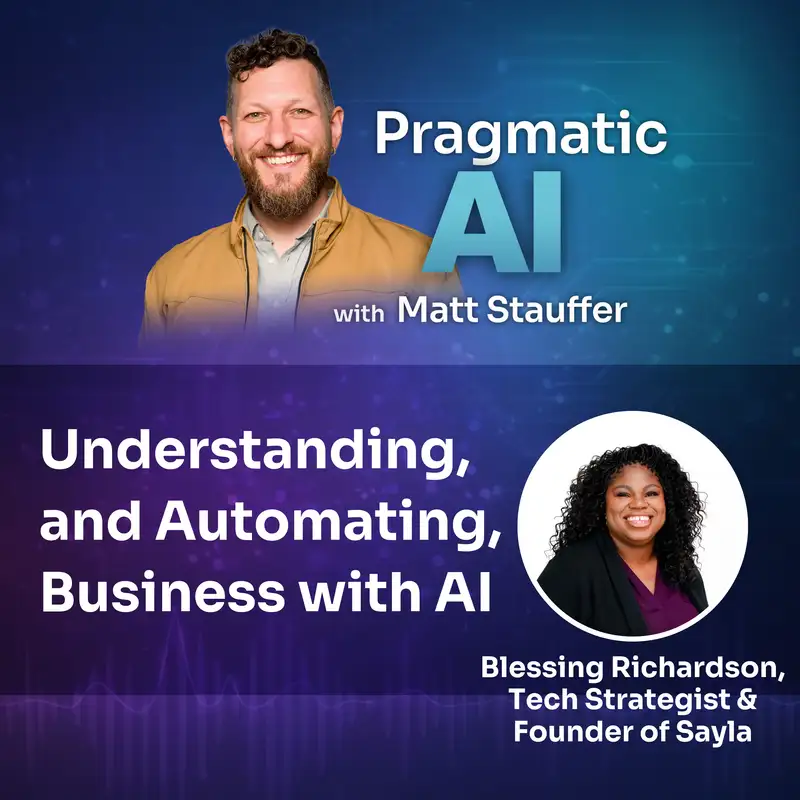
Understanding, and Automating, Business with AI
Matt Stauffer:
Hello and welcome back to Pragmatic AI, where we talk about using AI in the real world. What works, how to use it well, and when it causes more harm than good. Practical tools, real trade-offs for builders and business leaders. My guest today is my friend, Blessing Richardson, who I could give a whole pitch, but I'm gonna read her pitch first. She's an AI and tech strategist. She's a software engineer. She's also the founder of Sela, where she helps business owners turn their expertise into AI teammates and digital products. And we're gonna talk about all that stuff, but in my mind, Blessing is...
When you don't know what your business needs from a technology perspective, she's the person who's going to figure it out for you. That's the simplest, easiest answer for me. And anytime I talk to somebody, they've got a business, small business, medium business startup, whatever. And they're like, we haven't yet figured out, do we need software? Do we need something off the shelf? Is there an existing tool? I'm like, go talk to Blessing. She knows every freaking piece of software out there, every process, every data management solution. If there is a tool or a process or, or if you need custom software, because she's also a software engineer, if,
Blessing Richardson:
You
Matt Stauffer:
If you need to figure out what you need to do, this is the person to talk to. So yes, she does do tech, AI, but before it was AI, was something else, right? Like she's just that girlfriend knowing what thing to go to no matter what. So that's my pitch for Blessing Richardson. So now I have to hand it off to you. Give your pitch. Who are you? What do you do? And what is your relationship with AI?
Blessing Richardson:
I don't think I can top that. I will give a little bit of a fun backstory. I was like, for a while, especially when I graduated college and I was working at a cloud company, ⁓ people would always talk to me and go like, you're just like, there's an app for that. Like there's always, there's an app for that. There's an app for that. But the reason why I knew was because we were working on legacy software.
Matt Stauffer:
You
Mm-hmm. Yep. Yep.
Blessing Richardson:
It was PHP, but it wasn't Laravel. And I've been using Laravel since version, like, three. So at this point, I'm like a diehard fan and I'm dying on the inside. And so every morning, my catharsis was reading Laravel news and finding every bit of, like, new thing and just, like, bookmarking what I'm gonna dig into and then going on, like, hacker news and product hunt and just, getting into it. So I think that's probably why there's, a Rolodex of, like, if not specific apps.
Matt Stauffer:
Yeah. Yeah.
Mm-hmm.
Blessing Richardson:
what people are doing, what is possible with technology. Because I find that in what I do, we're at this weird point where if you were ever a dreamer when it came to technology, this is the time to start dreaming again. And so there's people who never really dreamed and there was like tech isn't my thing and I get that. But I find like there's people who put their dreams on a shelf and we're like,
Matt Stauffer:
Yeah, that's the truth.
Blessing Richardson:
You know, that didn't work out 10 years ago. It's like, it's a whole different game at this point, right? It really is the time to try again. So, but what I do, like you said so well, is that ultimately I work with business leaders who are trying to figure out how to take their expertise and turn it into AI. And that can be really scary if you've heard all the doom and gloom about AI replacing us, often out of the same mouths who are selling AI, which is an interesting conundrum.
Matt Stauffer:
Yeah, try again. Yeah.
Blessing Richardson:
But what I find when you actually get hands on with this is that it's not that smart. It's very capable. I like to think about AI as a capable 13 to like 24 year old. Do what you will with that. Like very capable, we love the youth. Pack up my house and help me move like type of brute strength right? Or like.
Matt Stauffer:
Right. For good and for bad.
Yeah, 100%. If I give very
tight constraints around what you're doing, and check to make sure you did it right afterwards.
Blessing Richardson:
Yes, there is. That's the one thing I miss about being in youth ministry or college ministry at church, because anybody move, like you offered a box of pizza and five guys helped you pack up your whole place in two hours. It was fantastic. So I understand that kind of brute strength. You have the quickness and sharpness of young 20-year-olds who have done nothing but calculus for four years. ⁓ Like, they're just, AI can feel like that.
super, super specialized. But when you start to give it not just real world concepts, but your concepts, because there's like real world general knowledge, you know, I can kind of riff about things, AI will do that. When you start to bring your business context to it, that's not off the shelf, right? And that is very intimate, it is very proprietary, it is.
for a lot of smaller businesses, it's actually just tribal knowledge. It's in your brain and the brain of your team members and often your contractors, right? So AI doesn't have that. ⁓ And so I don't think we have to worry about AI replacing us, but there is the gap where we need to learn how to steer it and kind of lead it, thinking of ourselves as like AI leaders. And when you bridge that gap, then all of the power of AI really becomes real for you.
Matt Stauffer:
Mm-hmm.
Okay, so if I am running a business, let's maybe not do like a mom and pop, maybe somewhere upscale of that. It's maybe in some sort of information technology, but it's not in programming. So maybe a tech-related business, maybe not. But I've got business processes, I've got employees, I've got systems or lack of systems and I need a system. And I come in and I'm just like, Blessing, it's a mess. What does your kind of first prescription process looks like? Do you know?
Blessing Richardson:
Mm-hmm.
Hmm.
Matt Stauffer:
Like you must have at least A, B, and C, and if you don't have these, we're gonna start there, or is it more, it's unique for each person, and you're always just kinda asking questions to figure out where you're going.
Blessing Richardson:
It's
really unique and I started off ⁓ with this go of business with Sela. I started off doing systems work, really operational systems work and consulting. And I had to leave that because it's really not my ministry. I learned that. ⁓ I'm a product person, engineer person. I love building for an end user, not necessarily the business user. And so I realized that it's a different rhythm. However,
Matt Stauffer:
Mm-hmm.
Noted.
Mm-hmm. Yeah.
Blessing Richardson:
The more I said I wanted to work on product and the more I work with smaller businesses, the more I find that I had to sit in this middle of product and IT. And oftentimes that can get conflated. And if you're not inside of technology, you're not going to know. So there's no fault there. But I look at IT as the technology, which is often software, that runs our business, the internals of our business. And if you're going to spin up a product, a software product, let's say you want to make this really cool widget on your website,
where people can go on there and check a bunch of things and it makes a recommendation and you do some lead capture and grab an email. That's a digital product, right? It's facing a customer. However, once we get that email and once they go through and fill out that information, where does that go?
Matt Stauffer:
Mm-hmm.
Blessing Richardson:
Ideally, it would go into a CRM or some sort of ⁓ software that can do lead scoring to tell you how this person fits into your business and what type of customer they are. That is not detached from the operational side. so oftentimes those conversations start with walk me through your workflow, which makes me again, sound like an ops person, but it's.
Matt Stauffer:
Mm-hmm.
Okay. Yeah, it does.
Blessing Richardson:
It really gets really good when I'm like, just show me your screen, because there's a way that we all engage with technology in our day to day that is very different from somebody like me who was mapping through how your team thinks about the tech, how you're actually using it, regardless of what software you're using. Software has a bunch of features and the overlap is insane. So what you choose to use and how you choose to use it is still different from person to person. ⁓ And then realizing, is this a limitation of the tool?
Is this a skill gap between just the team being aware of what the tool can do? Or is it convoluted business process that wouldn't work in any tool? Right? And what's the up-skilling there? Before we even get to, is this a problem AI should even solve? ⁓ And so there's a lot of me just watching and listening and trying to get the story out of people for why they do what they do and more so how they do what they do. And I think the hardest moments is when I find that
Matt Stauffer:
Yeah.
Mm-hmm.
Blessing Richardson:
There's a lot of energy around getting a solution and no one has come up with a functional how, not even a great how, right? It's a functional how because when it comes to automation, you have to automate processes. And if you want to automate a process that doesn't exist, you need that process to have been defined by someone.
Matt Stauffer:
Yeah, and that's I was just going to ask him like imagine because some people are probably hearing this being like, my God, that's me, right? Like I run ops for my company. So I have a software product that runs. And the first thing I had to do in building that software product was ask the question of like, well.
Blessing Richardson:
Mm-hmm.
Matt Stauffer:
What are the workflows? When somebody contacts us on our website, where does it go? And then what are the different branches? Well, if they contact us and they want this, if they contact us, so we had to build our processes. But I there's some people who may not be listening, being like, that's exactly me, because they may not be the ops people who have never even asked those questions before. Do you have a canonical example that you give? you're like, here's the ideal client, and here's a workflow of what it looks like for me to line up these processes for them.
Blessing Richardson:
Mm-hmm.
Matt Stauffer:
Who's your most common example that you'd work with?
Blessing Richardson:
My most common, because I work with so many micro businesses, ⁓ they don't got no processes really, like not at the scale of enterprise, but ironically, they do have like workflows, right? I don't think they would articulate what they're doing as a business process and that language can seem really weird, but I'm really looking for the pattern of saying when you do something, do you do it mostly the same way every time?
Matt Stauffer:
Okay, got it.
Blessing Richardson:
Right?
And if you can tell me that story, regardless of whether it is perfectly digitized or not, we're in business. Because now I can kind of wrap my mind around how you're looking at a problem, why you serve it, why you solve it a certain way. And it might seem weird, but it's like I'm observing the ergonomics of people. Like you have like five different apps, and for some reason, you still use a notebook.
Matt Stauffer:
Yeah.
Yeah.
Blessing Richardson:
Okay, let me not force you out of that, especially when we're dealing with really small teams, because getting people to relearn habits actually makes the adoption process so much longer. So I'm really looking for, depending on the tech literacy and the data literacy of a team, what is the right incremental change to make? Because if we put in whole system and you don't use it, nothing changes and now you're just paying for software and you start doing the whole, I pay so much, I want to optimize my cost, but you never got the operational efficiency of the system anyway to know what
Matt Stauffer:
Yeah, yeah.
Yeah.
Blessing Richardson:
really optimizing.
Matt Stauffer:
Does AI make it more possible to integrate these new processes with people's existing workflows, or is that not one of the places it helps?
Blessing Richardson:
So yes and no. I think that AI, ⁓ the way that AI helps, I still find is a good bit inaccessible if you're really going to use it. Because if you've seen things like Claude Co-Work or
Matt Stauffer:
Okay.
Blessing Richardson:
Claude Code or Codex, and these are all forms of AI that ultimately you can download an app onto your computer. So you're not going to chatgbt.com or claude.com You're just downloading the app to your computer. But because it's on your computer, on device, then it can see the folders on your computer. And it can do more than it ever could, right? And so somebody who says, I have to prepare a pitch deck for meetings. And do a lot of intakes forever to create pitch decks. And then people look at them and change their mind. And there goes like four hours of my life. And dear God.
Matt Stauffer:
Yeah. Yeah.
Blessing Richardson:
like it's annoying. Well, you can then have Claude on your computer and say, hey, here's like the meeting notes from my meeting. Go and like redo this deck.
Matt Stauffer:
Okay, interesting.
Blessing Richardson:
and it will go do it, right? And so the
way I think about those types of tasks is what I like to call AI like day to day, where we're not really building full systems. We're not really automating full business processes. We are automating the things within the scope of what we do, our personal responsibility to actually get the efficiencies ourselves. I think that's the first place everyone should start. Because the moment we take any form of automation or any type of process and we elevate it to business level processes or team level processes, that actually
Matt Stauffer:
Mm-hmm.
Yeah.
Blessing Richardson:
is now business and team level liability. It's only going to live as long as anybody on the team or business can maintain it. so AI is really good at creating personal solutions very, very quickly. But what we know, particularly in our line of work, when it comes particularly to programming, the moment you're looking at a piece of software that is owned by more than one person, that piece of software becomes its own thing.
Matt Stauffer:
Yeah.
Blessing Richardson:
So every new person who gets on the project, you have to look at the existing code base. You have to understand how do we write this, right? It could be as simple as literally reading code is almost like reading a story. So if you've never looked at code, just picture this. I'm reading a story and at the top of the story, call Blessing is referred to as Blessing Three paragraphs down Blessing becomes.
that Nigerian girl who moved to America and like, so we call her Nyjah girl. Okay, well, that's interesting. That's an interesting switch in how we're addressing Blessing How would I know if I just started in chapter three? That's Blessing right? And so if we have more people joining the team and we're taking the shared bit of automation, the shared system, the shared prompt, and we then say, hey, it's for everyone now, that's no longer really owned by one person.
Matt Stauffer:
Uh-huh.
Yep. Yeah.
Yep. Yeah.
Mm-hmm.
Blessing Richardson:
And so
that means that when we go from personal automation, personal workload development, personal use of AI, and we elevate that into being owned by more than one person, that means that everybody is now adopting standards and conventions, whether you think they are or not. Because the moment that thing fails, or the moment we don't think it does what it does, and there's this domino effect, then we all go, well, why didn't we know? Well, what happened? Well, this person needs to essentially be the only person who maintains this piece of software or this tool in the business, which is not scalable.
Right?
Matt Stauffer:
So that's interesting. that to me, that sounds like the idea of personally creating my AI workflow is actually significantly better, easier, et cetera, than making it a system level. I assume there's some costs to that. Like I think first thing probably is how do we get the data to, like if I need data that is organizational system level in order to do my personal stuff, I think that's probably one of them is how to get the data there. But the second one is like.
Blessing Richardson:
Yes. Yes.
Matt Stauffer:
Like you said, the liability, like what does telling every single individually, yeah, you just make your own personal software and then have our systems kind of accessing the data. So there's a pro to personal software, but talk to me about what are the cons and how do you mitigate those cons?
Blessing Richardson:
So the way, especially now when we're moving from micro business, because what micro business especially like solo business, everything serves you, right? It's fine. And if you added two, exactly, if you add two, three more people, but they don't actually touch your systems, it doesn't matter. When you start growing that team size, ⁓
Matt Stauffer:
Yeah, the individual is the business, so it's not a big deal. Yeah.
Blessing Richardson:
and we now have this shared understanding of data, that's actually where I think the language of data becomes mandatory, right? Because if I pull down a spreadsheet and it has, everybody does this in business, expense tracking, right? So we look at our expenses and I have ways of categorizing my expenses. Okay, and that's in a spreadsheet, awesome. But now I have somebody else come in to help me with expense tracking and they don't know how I categorize things. It doesn't matter whether they go into Xero QuickBooks and click the buttons themselves or they tell Claude
Matt Stauffer:
Sure. Yeah.
Blessing Richardson:
or chat GPT to go and update the expense tracking. If they don't know how I categorize, it all gets messed up, right? And so this is where shared knowledge and information I think actually matters more than the tools and the software. Because if we understand the data the same way.
Matt Stauffer:
Mm-hmm, right.
Okay.
Blessing Richardson:
then it's like, kind of like doing math. I don't care how you get to the same answer, as long as we get to the same answer. And that's what personal tools do. They let us get to the answer or the solution the way that we want to. But if we don't have shared understanding about what a qualified solution is and how to read that data the right way, that's actually where I chaos starts to happen.
Matt Stauffer:
Sure.
Hmm, okay.
Okay, so if I were moving from being a smaller business, you know, it's just me and I had my own AI solutions or I'm the only adopter. There's a lot of founders who are like, I'm adopting AI, but I don't know what it looks like for me to get it to the rest of my team. And let's say it's a team of 10, 15, 20 or something like that.
Do you think, if you said personal software is the best, but at some point you gotta move up to the system level, what does that transition look like? Like, yes, your founder and maybe your C-suite are all using Claude individually, and we need to now bring it together to something where we are using AI responsibly and we're avoiding the potential liabilities of each of us downloading the full data set of all of our important stuff on our local computer. Like, what's the first step to get past personal software?
Blessing Richardson:
I think there's two places of responsibility. From the executive level down.
everybody has to gain some form of data literacy. And if you're gonna spend any money on tech projects and programs, whether that's five grand or a million, I don't care how much you're spending, you wanna make sure that you are providing the right data infrastructure for everybody's use of AI. So again, data glossaries, shared understanding, documentation, all that kind of stuff really doesn't need to exist as a foundation. I think that has to come top down. Bottom up is people using AI themselves. And I know, know, a couple months ago, the headline seemed really harsh about tech CEOs making harsh mandates.
Matt Stauffer:
Okay.
Okay.
Blessing Richardson:
like use AI or you're gone, right? ⁓ Which is oddly harsh even in our own industry because we're generally, we do roll forward, right? But even being like working at a product company, what I realized is that when you work on older products, people aren't trying to learn new stuff, right? And they don't really have to because they're working on things that are mature. And so kind of when I reflected on it, I'm like, okay, this seems really, really harsh. And maybe I'm not a fan of how it's happening. But what I know from leaving tech and working
Matt Stauffer:
Yeah. Yep.
Mm-hmm.
Yeah. Yeah. Yeah.
Blessing Richardson:
with teams that are either outside of tech or at the boundary of tech, they are so much slower to move that in reality, you have to put a mandate because it doesn't incentivize anyone to actually take on the extra work of learning something new where the outcome isn't really well defined and the incentives aren't clear. But what you're really asking people to do is upscale.
Matt Stauffer:
Yeah.
Hmm.
Blessing Richardson:
AI is not a superpower that one or two people should have, at least from an understanding perspective, right? It is now gonna be a fundamental skill that people have to know how to understand and process what it even means to interact with AI, whether or not they see themselves as a builder. And so I think it has to come from a mandate. Now, how do you mandate something that might have natural resistance? We don't tell people that it's gonna replace them because even the tech companies that have fired all those developers are rehiring people back.
Matt Stauffer:
Mm-hmm.
Yeah.
Yep. Yeah.
Blessing Richardson:
So that's not the reality
of deploying AI, right? ⁓ I do think the incentivizing narrative though, is that this is an amplification of what I do. It is something that creates capacity. And I think if you have the culture and the psychological safety in your workplace for people to realize, I can automate my way into the job of my dreams. If that is a foundation, you're not gonna have as much resistance, right? I think the other thing is having a culture that is...
Matt Stauffer:
Hmm.
Blessing Richardson:
⁓ Error tolerant. Unlike other forms of software, ⁓ AI is like putty. That's the way I like to describe it. It's not like Lego, right? It's like putty. It will take the shape and the form of the person who is molding it. And so because of that, it really is very difficult to go into anything with AI and say, is the exact ⁓ outcome that we're looking for.
Matt Stauffer:
Yeah.
Yeah.
Blessing Richardson:
right? Because you literally have to experiment. And so if we're going to experiment, there is some form of a quote hypothesis of what we want and what we want to happen out of this. But it is through play and experimentation that we figure out how AI fits into everyone's individual role, let alone figuring out what that means that a team or at an org level. So we have to have the psychological safety to show up and say, I'm going to learn something new. I don't know the outcome. We're going to be given the time to actually go and learn new things, not some random like YouTube video or e-course.
Matt Stauffer:
Hmm.
Blessing Richardson:
like corporate training that you take impassively is like, I'm now accountable for this. And there's, there's no like rhyme or reason to it, right? It becomes a new skill. It changes the way that we show up every day. And it makes sense for a period of time to have a mandate to say, you have to learn this because we are resistant by nature to change.
But then if you hire really good people or smart people, some people will come back and tell you AI is useless for this and we need to be receptive to that feedback. Or we can use this, but this is the risks. We probably could use this, but there's some moral ethical implications, right? So just mandating AI and expecting an outcome that says everyone's gonna use it is insufficient. What smart people need is the ability to execute that judgment when they use AI and know that their job is not contingent on it.
Matt Stauffer:
Yeah. Yeah.
I love that. I one of the things I told my team when I said we all need to know this, as I said, I want you all to be experts at AI so that you know when it should be used and when it shouldn't be used, not experts. Because I think a lot of people think feel like.
Blessing Richardson:
Mm-hmm.
Matt Stauffer:
Expertise means using it every day all the time, becoming a maximalist. And I was like, that's not expert usage, that's blind usage. Just like sticking your head in the sand and choosing not to know it, using it for everything is also actually probably more damaging. So I really like your kind of language there around like giving them, know, error tolerant, you know, giving them the, having smart people and giving them the ability to decide if this makes sense or not and listening to them. ⁓
Blessing Richardson:
Yes.
Matt Stauffer:
For the folks, I think people will, in my experience, people take kind of different responses to that prompt, right? Some people take the response to that prompt and they get excited and they run with it they try new things. And some people get it and they're just sort of like, they stay resistant and they're like, yeah, you're telling me you have to do it and it's gonna replace me. And I love that you were kind of like, let's get them that knowledge here. This is not to replace you. If people need a gentle walking into it, where do you send them?
Blessing Richardson:
Yeah.
Matt Stauffer:
Are there trainings? You're like, well, know what? The best entry level is to use chat GPT versus Claude, or the best entry level is to watch this video, is it just to run into things and start talking? Where do you get a newcomer who you know is smart and you know they're capable, but for whatever reason, they're a little bit nervous about it? How do you gently onboard them into this world?
Blessing Richardson:
Mm-hmm.
The best use case is my husband. I sleep next to him every night. Okay? He's a smart man. I had to bully him into using AI for months. We have been together since high school. And it's like really over the last three years, he's like, I finally understand like most of the words out of your mouth now. It's great. Okay? So proximity doesn't even build, it might build courage, but it doesn't just turn into action, right? ⁓ And since we're so used to like watching on YouTube and things,
Matt Stauffer:
Okay. Uh-huh.
Uh-huh.
Uh-huh.
Yeah.
Blessing Richardson:
But again, those of us, especially who like self-taught coders, we love it because we know like the fallacy of YouTube. Like you'll watch that and go, my gosh, it's so good I know that. And then you have to do it yourself. And you're like, I just spent two hours watching this. I don't know anything. just, I just, I felt really good though. I felt good that you knew something, but like I didn't know something. And so this like knowledge transfer can help to build courage, but you don't actually know something until you put it into practice. And all because AI can spit out an answer. It doesn't make it right.
Matt Stauffer:
And then you try it. I don't know it.
Blessing Richardson:
It doesn't make it good or qualified, nor does that help us when the goal is to actually learn. Because we're short-circuiting all the ways that humans have learned to learn to this point, right? Learning is very tactile, and some of our senses are engaged. We're all different, right? But AI has this weird way of short-circuiting that whole process and giving us the dopamine.
Matt Stauffer:
Yeah.
Blessing Richardson:
of arriving to an outcome. so learning,
Matt Stauffer:
yeah
Blessing Richardson:
I think learning anything, particularly with AI, is not asking it to produce an outcome. I think you go to AI expecting it to be capable but dumb. And you coach it through something that you do fairly well, especially if you're a business professional. Go in your expertise the same way you would, like, think about how you're training and onboarding a new hire. Somebody who's, fresh out of college, great skills, fairly capable, right, knows nothing about what you do in the depth of it.
because that's where you're gonna start to see the weird things around hallucinations and how do I have to communicate to it so it's really tracking and how do I prompt it from one thing to another? It's not giving it a whole like brief, a 30 page brief and say, go do the thing, right? It really is learning how to coach this AI.
Matt Stauffer:
Yeah. Yeah. Yeah.
Blessing Richardson:
into the behavior that you want. And that's effectively prompt engineering. So if you're hearing all the buzz about prompt engineering, I'm like, if you feel like you want to go to somebody's academy, like OpenAI, Claude, Microsoft, Google, like they all have their own online academies. And for those of us who learn really well from an academic perspective, it's a great way to start. It will help you build confidence. But I tell anybody who's looking to get into AI really quickly and figure out where it fits, take something that's within your domain of expertise, start to build like a really small, this onboarding program for it.
Matt Stauffer:
So good.
Blessing Richardson:
and see how it performs. Learn how to adjust what you're asking it to get the outcomes you want, and then you'll know the edges. And so people who use AI, I think within their expertise are the best.
Because for them, AI is an asset. For everyone else, when we use AI outside of our expertise, it is mostly a liability. There's a risk involved. Because we cannot be the judge or the steward of whether or not it's good. I can upload a contract to ChatGPT and go, that sounds better than what I have. have no, I don't know. I'm not an attorney. Dear God, I'm not an attorney. I cannot tell you what liability I've opened myself up to by letting AI just spit out a response. It's helpful if I use an AI that has been created by attorneys. I can give that more trust, right? Because they're the ones who have the
Matt Stauffer:
Yeah, we can't evaluate. ⁓
Hmm.
Blessing Richardson:
expertise to train and instruct that AI. It's the same thing. So whatever we're good at, you should feel very confident about being the coach and the pilot with AI. Whatever you are totally oblivious to, it's cool vibes. And that's OK. Just know, it's OK. It's just vibes. And it's OK.
Matt Stauffer:
Yeah. Yeah.
Well, and vibes is such a great word because vibes has often been defined in opposition to what's real, what's solid, what's expert, what's business, whatever. like, like it's just vibes means it just kind of feels good. And that's fine for personal software within reason. It's fine for something you're having fun with, but it's not fine. You don't vibe something into, you know, a legal liability. You don't vibe something into the corporate enterprise. And so
Blessing Richardson:
It is.
Matt Stauffer:
In the coding world, they're often talking about the difference between Vibe coding and agentic coding. But we're not just talking code here right now. ⁓ What does the difference between building software ⁓ for the enterprise, for these companies you're working with, what's the difference between doing that from more like a Vibe perspective versus a real perspective? Should non-programmers be building software solutions using AI? ⁓
Blessing Richardson:
No.
Matt Stauffer:
at the non-personal level, right? You've said like, it's totally fine, build personal software using AI, but should a non-programmer be building at this point in time, right? In March of 2026.
Blessing Richardson:
Hmm.
I think it's yes, the answer to that is they definitely should because you have to learn somehow, right?
Matt Stauffer:
huh.
Blessing Richardson:
But the barrier to learning is very different. I'm an odd duck. I'm a 90s baby. But I also learned how to code when there was notepad and not notepad++. Right? I got started very, very early. I saw Dreamweaver. I saw all these other things. Right? I understand the evolution of our tech from around that time. What that means is I read a lot of XYZ for dummies books before YouTube was ever useful for me. OK? There's a lot of found fundamentals here that means that I'm going to be a better steward and a better judge with technology. However, should somebody need that?
Matt Stauffer:
Yeah, yeah. Same.
Blessing Richardson:
background before they start to explore something. That's like, it's kind of weird just telling somebody, I think you need to go get like a master's or like a like a bachelor degree in this before you like do something like kind of trivial. That's insane. And most of startup culture is I have an idea, I want to go pilot it.
I want to go prototype it and then see what happens. Should we have better tooling and easier ways to make things more secure and all this other stuff? We should, right? I think we should. There's lots of stuff with security liabilities, making people aware of what kind of laws and things you start dabbling when you make certain stuff. No, don't ask for people's date of birth. Just don't do it. Don't do it. There should be general guides for that, right? But should we make people feel like they are inadequate for trying?
Matt Stauffer:
You don't need it. Yeah, yeah.
Mm-hmm.
Blessing Richardson:
no
to that. And so I think you should definitely go make that thing, go vibe it out, but understand that that is a prototype. Understand that it is always going to be a prototype. I love what y'all do because y'all are special people. Y'all at Tighten you are God's people because you take other people's software and make it better. And even though I learned through reading other people's code, I hate cleaning up other people's messes.
and the order of magnitude in which AI creates messes, is like having a baby that never grows up and just poops all day long. I can't fathom that. But people don't know that, right?
Matt Stauffer:
love it.
Yep. Yeah. Yeah.
Blessing Richardson:
Especially if you do this whole thing one shot prompting, which is where you tell AI all your dreams and you give it what you want. And it actually does a really good job the first time through. I mean, it's amazing. Whether it's like, you know, a hundred words or it's like a couple thousand words. But then the moment you start to iterate on it, AI loses track and it just starts giving you output. But actually thinking like somebody who has to live with this product.
Matt Stauffer:
Yeah. Yeah.
Blessing Richardson:
for the better part of 12 months or a year or five years or 10 years. It just doesn't have the capability to do that. And even if it did, you would still have to have to know how to steer it, right? To that end, because AI can't deduce the needs of your business. It can't deduce the needs of your customers. It can't really look ahead and say, hmm, I see this policy coming down the line in like 18 months. We should make decisions now based on that. AI doesn't know how to do that. So there's always risk, but...
Matt Stauffer:
Yeah. Yeah.
Blessing Richardson:
I don't think it's so severe to where people should stop imagining, should stop playing, should stop exploring, to stop dreaming. As a matter of fact, do more, do more, do more, do more. Because in reality, a lot of these small ideas never needed that big budget to get it done. The barrier was just knowledge to build. And you could iterate so quickly. So take advantage of that.
Matt Stauffer:
Mm-hmm.
Blessing Richardson:
But also the moment you want to turn that into a business versus a little app, like, I have this app, to a business, you now have to start thinking like a business. And you should approach your product like a business.
Matt Stauffer:
Yeah.
Yeah. And that's such a huge difference because I mean, I personally, I'm a software developer. I can build things on my own without any developers helping me that are good enough to go to production with millions of users. But the barrier between I can and I do is still much different today with AI than it was beforehand, because there are so many internal products. again, mainly internal stuff. The barriers exist, but is less for stuff that's going to production. But it's just like
Blessing Richardson:
Mm-hmm.
Matt Stauffer:
It'd be really nice to have a process to automate that thing we do at Tighten all the time, but it's just not worth me spending the next four weeks fully head down in it. But is it worth me like prompting and reviewing the code that the prompt generated just for our internal team when it's going to take me a sum total of like 10, 15 hours over the next few weeks? Yeah, it's totally worth it. So that barrier is changing for everybody. ⁓ And I really appreciate the fact that you are able to balance both the liability that's going on there and also the...
Blessing Richardson:
Nope.
Mm-hmm.
Matt Stauffer:
Not the freedom, but like the creativity that is... Yeah, uh-huh.
Blessing Richardson:
It's the entrepreneurial creative spirit. Like, would
we even be America if we didn't make a space for that in anything? Like, would it make sense for us? It would be so antithetical. no. Like, mean, when I first saw ChatGPT3 I was like, this is dumb. And I started watching more videos, and I'm like, am I concerned? And then I remember sitting there and going,
Matt Stauffer:
Yeah, yeah.
Blessing Richardson:
I'll never have a job again. Like my whole, the time I spent learning, like my summers, my whatever, my job, was like, this is pointless. Then I start to use it and I go, I will have a job for the rest of my life. For the rest, as a matter of fact, I should never. I'm like, I can't imagine the salary that I will begin to negotiate to work for someone again, knowing that they specialize in AI products. You couldn't catch me.
Matt Stauffer:
Yeah.
I feel like we've all had that experience.
huh. huh.
Yeah.
Blessing Richardson:
going to any negotiation the way I used to do five years ago. Because now it's like, ⁓ this has ensured that people like me will never age out. We're hiring back Cobalt programmers.
Matt Stauffer:
That's wild.
huh.
Yeah.
Yeah.
Blessing Richardson:
nothing is actually aging out. If anything, the need to have more reliable systems to mature them and evolve them to modernity and whatever that means is actually requiring more more sophisticated skill sets, right? And so those of us who have that background, it will never age out. People who are learning and getting into AI and coding and producing products, I think you have long careers ahead. Just be willing to learn as you build, because you're going to learn from a different starting point, which I think is a really interesting
that we're going to see bubble, like kind of bubble out and see how it plays out in a way. But don't forget to learn. Don't forget to build comprehension because AI won't do that for you.
Matt Stauffer:
So one of the things that you've done is I think helped a lot of people who have been doing what we're doing feel better about the situation. You're not gonna lose your job, your expertise is gonna be worth it, but you're touching here a little bit about people who are just getting started. If someone is just getting started today and they have the desire to be a builder, to be a technologist, to be a creator, to be an entrepreneur, do you think they should learn to code? Or should their focus primarily be on AI and business systems and projects and process and product?
Blessing Richardson:
If you want to be in the business of selling software solutions, you should learn to code, right? That's gonna be your bread and butter and you wanna either do that, lead that business or lead a team that does it. You should definitely learn in some way, shape or form ⁓ because other people won't and that's gonna be your behind. That's probably the best way I can put it. that's it, remove your own risk and do what you gotta do or find really smart people to do it for you. So acquire the talent or learn it yourself. But when I get kind of remove myself from...
Matt Stauffer:
Mm-hmm. Okay.
Yeah. Yeah, buck stops with you.
Yeah. Yeah.
Blessing Richardson:
the business of creating software and everything else.
I think we need to become good technicians. We need to know how to use it, right? And I can look, I can go into my house and be like, that's off center. And we always have a painting that somehow tilts and it drives my husband mad. And it just does not bother me. And he will just stop and be like, that is off center. Now, both of us can look at that and see it's off center. One of us will go and fix it, right? But neither one of us is looking at that wall asking, how come the wall seems to make everything tilt? They, no, no, that's not it. No one is going to go that far in my household, right?
Matt Stauffer:
huh.
huh, yeah.
Mm-hmm. Yeah.
Blessing Richardson:
You need to be able to sense things and know who to call when things seem off. That's what I think being a good technician is, a good user of a thing. Be a power user, right? ⁓ Power users, I look at them as people who are customizers, who thread the line of builders but are not engineers. So you will learn all the intricacies of different tools, know how to not just use them the way they want you to, but essentially know how to hack them to get them to do what you need them to do. Everyone does not have to be a power user.
But in this day and age, every business probably needs at least one or two. You probably need at least one or two because your competitors, your competitors will have somebody who is going to push AI to the limits to amplify what they are doing. So it doesn't matter if you're coding, you could be using AI for marketing, right? And some people will build a whole business on AI content that we might call slop, right? Low quality content and spit it out and play the high volume, high traffic game online. But yet there are other people who are using AI to amplify their
Matt Stauffer:
Hmm. Yep. Yeah.
Blessing Richardson:
own voice, amplify their expertise. AI is not writing their copy for them. It is helping them synthesize and role play to understand the mind of someone else to help them create better outcomes, right? And create better copy. And so depending on whatever that is for you, it might be for your team that, yeah, we use AI to do this thing in the marketing thing, but like, use a certain way. We might use AI to analyze our analytics and to get us better reports. We might use AI to build a custom dashboard to understand that.
and I do think that's one of the best things about AI. Even if you don't know how to code, the fact that you can use AI to visualize anything in a way that you can understand and comprehend is a really powerful thing because we're really all different. We all learn things at a different pace. We all understand things differently. It's great when we find people who are similar, but the way we internalize information and make it part of our own knowing and our own body of knowledge is still very individual.
Matt Stauffer:
Hmm. Yeah.
Blessing Richardson:
There's so much room for AI in everything that we touch when we start looking across the business. Use it everywhere in any way that makes sense. And you don't have to worry about threading line about being an engineer, so long as you don't try and be an engineer.
Matt Stauffer:
Right, totally. I love
that. You I mentioned at the beginning that I think you're that person who knows every piece of software, every app. And you mentioned your friends kind of said that about it as well. If do you have any like pieces of software, AI related software, whether it's custom stuff that you put together or just existing off the boat, you know, like Claude versus ChatGPT Vs. Whatever else are you like? These are my like superpowers, and I think more people should be using these particular pieces of software.
Blessing Richardson:
Yeah, there are probably a few in my stack that I won't get rid of. ⁓ Coda is one. So Coda is like a notion or an air table, but it's kind of like those things got together and then...
they let you build like mini apps with them and they call them docs. But you can go in and actually add buttons and things and really manipulate your data, but also pull in data from other apps. So Coda is the most fluid in saying, have this HubSpot integration, I have this Xero integration, which actually Xero just took away their integration. So I'll be Vibcoding my replacement. But there's that. But any app that has an API, you can bring it into Coda. They're now adding agents to the platform, right? So you're going be able to bring your agents and
Matt Stauffer:
Yep.
Okay.
Blessing Richardson:
quote MCP servers, which is just APIs for AI. ⁓ And so it is a great way to really flatten your tech stack and bring your data into one place. But then I can build custom solutions. So one of my best ones is my bookkeeping system. ⁓ I built that with Coda and Relay app. ⁓ I don't think I use N8N for that. ⁓ But yeah, I think it's just Coda and Relay. And it's this whole system where I see invoices, receipts, transactions, or whatever. I log it as something that needs to be tracked. It goes into a Coda table.
It gets exported and saved as a PDF into my Google Drive. It will rename it perfectly with the name and like the transaction type and organize it all. And then my agent looks at that and says, is that a receipt and invoice that needs to go to bookkeeping? And it forwards it into Xero for me. And so Coda is like the dashboard for all of that. And the main reason why I made that is because it just pissed me off every time my bookkeeper said, what was this for? I don't know. I don't know. I don't, can't tell you. Like you gave me the most obtuse description of a line item and I see why you ask me now.
Matt Stauffer:
Okay, nice.
huh. huh.
Blessing Richardson:
but I don't know. So I designed
Matt Stauffer:
Yeah.
Blessing Richardson:
CODA in a way where whenever I get asked about some odd transaction, I can click on it and click a button and it will filter all of the different documents I've sent it to help me figure out which one is likely related to. So that's literally why I made that. I made it just to solve that problem. Put everything in one place so when I get asked some weird obtuse question, I don't derail two hours out of my day. It's at most 15 minutes and I click a button, it rolls up and writes the email for me and I send it back to my bookkeepers. So...
Matt Stauffer:
which is relevant. Cool, that's very cool.
Yeah.
And
I know I asked you about software, but I got to pause you this one because I love this because what you just said was there is a real practical pain point that you had in your day to day operation of your business that you said, is there a way for me to solve this using some combination of AI and systems rather than just this like theoretical like what if it's like, no, this is a pain in my butt. Can I put systems together to solve this pain in my butt to make my life better? And that's, think, the personal software magic, right? It's sort of like, is there something that's difficult for me that I can make easier for me by using this?
Blessing Richardson:
Yes. Yes.
That is it.
Matt Stauffer:
vibe coded, configuration of things.
Blessing Richardson:
That is the whole point of it, right? ⁓
Matt Stauffer:
Mm-hmm.
Blessing Richardson:
And I don't have to worry about other people being in it for the most part. So I make it for myself. The way I build for others is so different. It's like a whole formal, like a formality comes in and I'm like, ⁓ this is every idea you have is like five times as long because you have to think about someone else taking this and then asking a question two years from now about what this is. And just a different mindset. But when you build for yourself, it really is just like the focus of I need this problem to disappear. How quickly can I make it go away? And then over time you have the luxury of
Matt Stauffer:
Right. Yeah.
Yeah.
Yes.
Yeah. Yeah.
Blessing Richardson:
tweaking it and expanding it and fixing all the intricacies, which kind of leads me to this other question I keep seeing ⁓ or statements on threads particularly about like how, you know, SaaS is dead and do we need software anymore because we can make things with AI. And I'm just like, that's an interesting question.
because many of us sleep at night using other software because they have people who work 24 seven around the clock. They're monitoring the infrastructure. They're making sure things work even when we don't articulate it. They're responding to customer support. They're doing all the research. They're the ones staying at the top of technology. And we don't have to maintain anything or build or evolve it. We simply consume and use it, right? ⁓
Matt Stauffer:
Yeah.
Yeah. Yeah. Yeah. Yeah.
Blessing Richardson:
And we might take for granted that certain apps have integrations or APIs, but in the reality when it comes to, think, running a software business is that every touch point for a product is a different product. So this app, if we're using software that exists in the browser, it exists on my phone, my iPhone, my Android, what version of Android? God only knows, okay? So any other device, now we have two-ease or terminal GUI apps, know? Any interface, APIs themselves are an interface that people interact with.
Matt Stauffer:
Yeah, how big's the screen? Yeah.
Blessing Richardson:
the product. Those are all technically mini products. People are maintaining that, whether or not they're using AI. And so the idea that ⁓ SaaS is like gonna disappear, that's just weird. It's just weird because it's so weird. It's like, are you going to become a business that has another mini business around solving this one problem for your business? If it is not revenue driving, probably not.
Matt Stauffer:
Weird is a much nicer word than I would use, so yeah.
Yeah, I mean if you look at the amount of SaaS that any of us use to run our business It's just like it absolutely does not make sense for me to vibe code a time tracker to replace harvest and vibe code you know something to replace my Google Docs and vibe code something to manage QuickBooks and but you know just like yeah in theory I could do a prompt that would do a not good enough job for all those to save me ten bucks a month and Then has to be hosted somewhere, and I have to spend time I was just like it just doesn't make sense like and there are probably some software
Blessing Richardson:
No.
Matt Stauffer:
that will be easily replaced by vibe coding, but not the majority of it, right? Like I can't think of any software I use right now that I could easily vibe code replacement. I'm sure there's some out there, but.
Blessing Richardson:
No.
It- I will say it's probably death to-
the really small micro tools and products that solve really niche problems. That's actually the tier that I think has disappeared with AI because I could pay you five or $10 a month or that one time deal to have this really unique tool. But what I find with the proliferation of like mini tools is that these are all little widgets I have to remember to use. I now have to track password management, account reset. Does it truly integrate into my workflow? No, it's usually some, you know, yet another
Matt Stauffer:
Yeah.
Blessing Richardson:
domain
name, yet a detached app that I have to remember that I have. And so we're really taking on the feeling I feel like I have a solution, but the liability of never really having it solved when we play with micro tools that don't actually solve holistic problems. And so what that means is it's much easier for me to just vibe code it, turn it into a skill on my computer, save it in a folder. And then now it'll work across any AI that I use. So the value proposition of solving small problems is gone. I think that is what is truly gone.
Matt Stauffer:
Yeah.
That's a great point. Yeah, and there was a time where build a piece of software on the internet, charge five bucks a month, solve one tiny thing, but you're solving it and it wasn't solved beforehand, was a viable SaaS strategy and it's not now. I just realized.
Blessing Richardson:
It was a good growth
strategy too, and I wonder what will take its place.
Matt Stauffer:
Yeah. I told you this is the beginning that we're going to get to the end and I'm have so many more things to talk about. And I keep interrupting us because I'm like, I got to get to the end. But I did interrupt myself and I want to kind of come back to I asked about what software you use. So you mentioned Coda. ⁓ Do you have a particular, you know, LLM that you turn to the most? Do you have any particular ways of interacting with AIs Do you? You know, I know at one point you were the chatbot queen. Like, are you still doing that? Like, what's?
Blessing Richardson:
⁓
Mm.
Matt Stauffer:
Are there any other things that you do where you're like, I always like chatting with my agents through Telegram or I always like Claude over chat GPT? Are there any other kind of like really strong universal opinions you have? Because a lot of your opinions are nuanced. It depends. But are there any ways you're like, no, this is it.
Blessing Richardson:
I don't know. I don't think any of the LLM, the major ones pay me enough to have an opinion. Cause I, that's just, I paid them. So no, but I use, I use Claude, I use Codex. I was just describing Claude to an audience, I think yesterday or two days ago and explained like Claude is really like three different apps in one. You have Claude Chat, which is like Chat GPT. You have Claude Cowork, which is like for power users who want the power of like.
Matt Stauffer:
Ha
So you use what works.
Blessing Richardson:
the engineers but aren't coding. And so that's great. And then you have Cloud Code, which is for coders and Codex is really chat GPT for coding, right? And so the real barrier is that all of them cost different and they all have limits. So I just rotate. I'm just, it's, know, and sometimes I just take the break and say, got to pause. ⁓ This, you know, you told me five hours is up and I can go take a nap. It's fine. So I don't think I have any real preference right now.
Matt Stauffer:
Yeah, 100%.
You
Yep.
Blessing Richardson:
⁓ Because I just exclusively use AI for work. I don't use it for anything personal. I think if I was somebody who used AI in my personal life, there would be like a preference, but like I don't need my AI to have personalities. Like I'm not gonna spend my evenings worrying about the more dilemma of how I'm talking to an AI. I refuse to introduce that problem to my life, so I'm not gonna have that. So no, there's no personal use. There's no preference for one. ⁓ I did recently upgrade though to ChatGPT Pro.
Matt Stauffer:
Okay.
Yeah. Okay. Okay.
Blessing Richardson:
and I was impressed with the little features that were hidden in there. It's not enough to make me leave Claude. Claude, think, has become my primary suite, but it's just impressive to see where we're going with it. But no, I'm sorry, I'm not a loyalist. Also, when you can vibe code pretty decent solutions like...
Matt Stauffer:
No, it's fine. Yeah.
Blessing Richardson:
Why be loyal? I just need what's functional, right? And what cost me the least. And I review that on 12 month cycle. So that's it. Yeah.
Matt Stauffer:
Yeah. Yeah.
Yeah, now it makes sense. Yeah, 100%. Okay.
Because we're at time, do, you mentioned moral and we haven't talked morals or overall, so I do want to kind of like wrap up with one big question, which is what do you think about the impact of AI in the world? Positive, negative, and has that changed over the last six months to a year?
Blessing Richardson:
I think its impact is becoming common. So we're probably not having the right discussions about it as we should. That's probably more of my bigger concern. ⁓
we seem to be ignoring human nature. Like because AI can do, then we let it do. And that's, I think, the prevailing thought around it. ⁓ But all because we can doesn't always mean we should. So when I see this come up in some circles I'm in, it's like, well, the kids aren't really learning. My father is a professor, so that will come up in one place. But not nearly as often in that category. It's... ⁓
Matt Stauffer:
Say more.
Mm-hmm.
Blessing Richardson:
looking at Gen Xers and Boomers who are really looking at this and seeing some real developmental gaps with their grandkids and people around them and going, I don't know how they're going to take on what the world has for them. Right. And that conversation comes up. And I look at that and go, well, kids are really a mirror about what's most important to us. So we praise expediency, if we praise making money above all else, if we praise all these things and they just found an expedited route to it, it's really weird for us to tell them that they were wrong.
Right? And so I think the moral and ethical issue isn't actually around AI. AI is just yet another thing that should really make us look back at ourselves and say, why do we actually glorify and make certain things reverent in our own culture? Why do we prize expediency above all else? How come art is not experiential? Right? There's some, like some for me, I probably will not be letting AI guide me in like a Bible study. Like I'm good. Like.
Matt Stauffer:
Yeah.
Yeah.
Blessing Richardson:
it's okay because some of the AI spirituality I see out there, I'm like, first of all, that would be different if you were like following a text. Yo, that's just like, that's like ChadGBT Jesus. It is not even Jesus. It's, you gotta give him another name at this point ⁓ because you can't predict it, right? And it will do its own thing. And so it's like, how do we safeguard ourselves knowing our own proclivities and propensities? How do we begin to kind of fight that dopamine hit that we get?
Matt Stauffer:
huh.
Mm-hmm.
Blessing Richardson:
Because there's a lot of things about AI and the way that we're using it that's like a biohack, in my opinion, on how we function as humans. Why are we overly indulgent in that? Why do we make it easy for people to have access to that when we know who we are and how we are? Technology can evolve at a rapid pace, but when we look at the last couple thousand years of history, has humanity really changed all that much?
Matt Stauffer:
supposed to be my last question and I want a whole podcast episode just about the last question. ⁓ Okay, so if people are fascinated by Blessing Richardson, whether they want to hire her, they want to learn from her, they want to bring her in to speak somewhere, where do they keep up with you? Where do they follow you? How do they get in touch?
Blessing Richardson:
you can find me on blessingeffect.com. I would say social media, but you know, LinkedIn's probably the best bet there. So I'm on LinkedIn and then threads. Threads really is my preferred like hub and home online. Instagram is doing a thing and Facebook, not really. So we're gonna say blessingeffect.com. That's like my blog, pseudo podcast kind of thing. ⁓ LinkedIn for sure. And then threads in that order. That's the best way.
Matt Stauffer:
And we'll link it all in the
show notes so y'all can find her there. Blessing. Thank you so much for taking your time. Thank you for compressing the hours and hours hours of conversation we could have had into so many great little snippets. And thanks for leading the way in a lot of ways here. It was really pleasure having you on. right, the rest of you all, we will see you all next time.
Blessing Richardson:
Yes.
this was so fun. Thank you.
See ya. ⁓
Creators and Guests