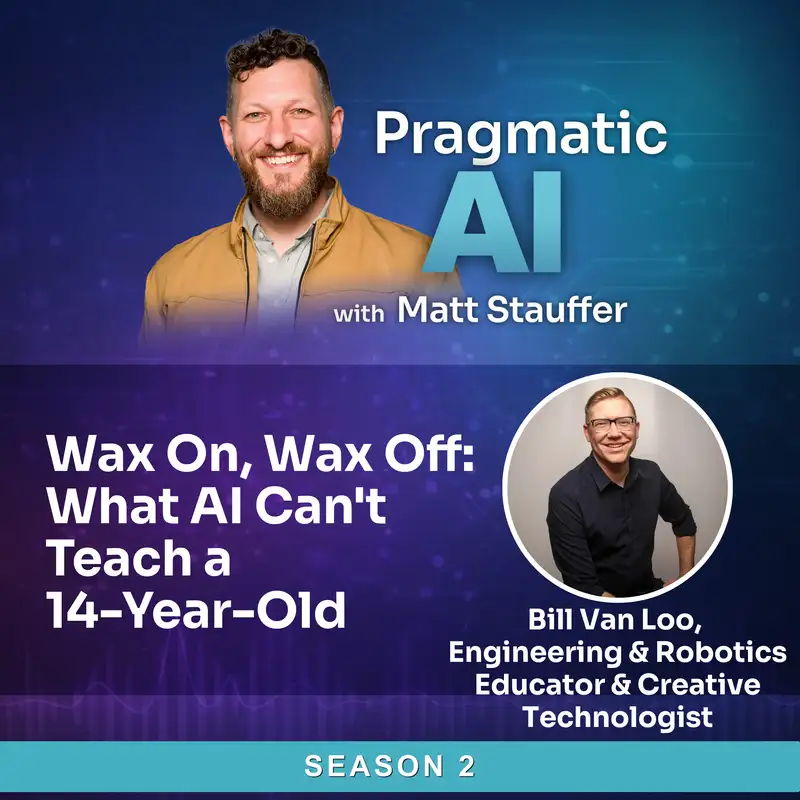
Wax On, Wax Off: What AI Can't Teach a 14-Year-Old
The Pragmatic AI Podcast is sponsored by Tighten.
T-I-G-H-T-E-N.
We will take your AI ideas, prototypes, or even vibe-coded apps,
and we'll take them to production.
Scalable and secure. Check us out at tighten.com.
Hey, and welcome back to Pragmatic AI
season two.
And thank you so much, Bill, for being my
first guest for the second season.
~ for those of you not familiar with what
we're doing,
the second season is pretty similar,
but we're just kind of learning a little
bit about what we,
you know, what worked and did not work in
the first season.
~ and so, as the first season,
we're talking about.
what
it looks like to use AI in the real world.
And this is about having a clear-eyed
perspective ~ to try and find
a middle ground space between the
maximalists who just always want to talk
about
AI is going to transform everything and
the Luddites or the minimalists
who think everything about AI is bad.
We're trying to find a practical
conversation right in the middle for
builders,
business leaders, and also normal people.
My guest today is my friend and I
I need to find a way to talk about my
friends from a long time ago,
'cause not my old friend, because that
makes it sound like you're old.
But anyway, my friend from when I was very
young,
Bill Van Loo
There you
Engineering robotics Educator,
a creative technologist, and an
independent electronic musician.
Bill, would you say hi to the people real
quick and let's get started from there?
Yeah, thanks so much for having me on,
Matt. I really appreciate it and I'm
excited for the conversation.
Yeah,
as am I. ~ so for those who are not
watching on YouTube,
you just need to at least go at some point
and take a look because Bill's setup
has the absolutely perfect setting for you
being a creative technologist
who also possibly moonlights as like a mad
scientist in your basement,
which is kind of what's going on because
you mentioned,
A little bit. Yeah, a little bit.
you know, creative technologist,
independent electronic musician.
Those got some like kind of mad scientist
vibes with all the stuff you're creating.
So can you tell
Yeah, a little bit.
people, walk through each of those
independent roles and just kind of like
What do you do on a daily basis?
Yeah, for sure.
So my day job is that I run the
engineering program at Pioneer High School
in Ann Arbor, Michigan. I've been
full-time at Pioneer specifically since
2022,
and I'm actually starting my 20th year of
teaching right now,
which is a little wild, yeah. It does
Yeah.
not seem like it's been 20 years.
~ part of that is because I'm also a
career switcher.
coming out of college, graduating in in
'97,
~ I came out and did web development for
about eight years in downtown Detroit,
working for a variety of companies.
Companies doing front and back end
development,
but then also a bunch of interaction
design and project management
and software testing. ~ I really loved
that work,
but I felt like there was maybe something
else out there for me.
And so my wife kind of prompted me and
encouraged me to consider teaching,
which is something that I'd been thinking
about anyway.
And so I kind of, you know, accelerated
that timeline and moved into education,
~ where I've been now for, like I said,
almost 20 years.
Yeah. So that was your first one.
So you are a teacher
and you're not just a teacher,
Yep.
but you're
a teacher specifically in technology,
engineering. So there's gonna be some some
things we talk about there.
And what's your age range? Is it just
Yeah, a lot of connections, Christian.
all of high school?
Yeah, so yeah, so my classes, ~ depending
on which one it is,
I might have ninth through twelfth graders
in the same class,
especially for that introductory class,
which is super cool. You know,
a lot of times students who are ~ like
pretty sure they're gonna
be engineers wanna take that class right
away in ninth grade so they can
do as many in the sequence as possible.
But then I also get folks like a senior
who emailed me yesterday and was like,
Hey, could I get in still? Like which
class should I take?
And so I tried to give her some guidance
about the different coursework
and all that. So yeah, ninth through
twelfth grade.
~ I also do
~ work as the lead mentor for my wife's
two middle school robotics team so
I get to keep a foot in the middle school
world which is hilarious.
They're such funny weird people in middle
school.
Yes. I love it. Okay, so that was your
first one,
So yeah. Yep. Yep.
which was an educator, which is the the
day job,
Yep. Yep. That's right.
but you also have creative
technologists. What does that mean to you?
Yeah, so that's a that's a role that I
realized,
you know, it means some specific things to
people.
So a lot of people look at that role as
being folks who might
do things like projection mapping and
building worlds in Unreal
or working with lighting and I love all
those things.
~ that role has taken a little bit more of
a back seat in the last couple years.
For a few years I was really leaning
heavily into that side of things,
~ which is very normal for me.
Like my work and my creative life kinda go
in these big cycles and waves.
And so like it's that's a little bit on a
a lower wave,
you know, lower part of the wave cycle,
I guess, right now. ~ but you know,
basically I've it's it's my kind of
playground for realizing like I
do all these different things that are
using technology in fun and creative ways,
whether it is something like projection
mapping or lighting
or integrating that stuff into music
performances,
which I guess is like the natural segue
into the third part there.
Yeah.
and I want to go to that third part but
for a second also for those not watching.
There is very clearly 3D printers and
other electronics projects type stuff
in the background. So even as you say
projection mapping,
and some of us might go, I don't know what
that is,
we do know ~ that like there are things
that are very tangible and ~
for sure. Yeah. Yeah.
familiar for those of us that are all a
part of it,
you know, and like i i they are three
distinct things we said there,
right? But there is a lot of overlap
between them,
and you've already started giving us some
clues about those.
So
I
wanna dig into those in a bit,
Yeah, for sure.
but tell us about electronic musician
first.
Yeah, I mean so that I got bitten by the
electronic music bug thirty years ago.
You know, growing up outside Detroit,
not in Detroit proper, but outside
Detroit,
you know, folks may or may not know that
Detroit is kind of the birthplace of
Tecno,
Detroit Tecno.
Yeah.
~ you know, it's one of the sort of like
you know, massive sort of cities in terms
of its effect on electronic music culture.
And so I grew up a bit of a remove from
that,
but like realized, you know, kinda early
on in college that that
was ~ something that really spoke to me.
So I started DJing and then almost
immediately after that started producing
music
as well. And so that's again, that's been
a background thing that's been
a steady part of my life. You know,
through kind of ups and downs,
like really over like the last thirty
years.
I have a new record coming up soon,
which is exciting. you
know, I I tend to work where I I make a
lot of partly finished things
and then the grind is like finishing those
things.
I don't know if that sounds familiar to
you or to any of the people listening,
huh. Yeah, it's yeah.
but that definitely is
my is my thing. ~ so I kind of collect
pools of material that feels like they
sort
of sit together and so I've got this new
set of tracks that'll be coming
out within the next week or two actually.
So that's pretty exciting. Yeah,
~ very cool. I love that.
it's been I think two
two years since the last record came out.
So yeah, it feels good. Yeah.
we will make sure that is totally is
linked in the show notes and all your
previous
stuff as well. So
Yeah, right on.
okay, so ~ we are here in the context of ~
an AI podcast.
So before we dive into the way AI overlaps
with your particular jobs and interests,
I do wanna kinda hear like what's your
backstory with AI?
Are you an early adopter? Have you,
you know, been trying it more recently?
Is it involved in all the parts of your
life,
only certain parts? Like, what's your
background?
Yeah, so I would I would really
characterize myself as kind of a a skeptic
and a holdout, which is not typical for me
with technology.
Okay. Yeah.
I I tend to be
a pretty early adopter. ~
I would say like the first couple of
years,
I viewed especially generative AI,
like LLM, you know, based sort of
generative AI,
as a thing to like kinda keep at a bit of
a distance.
~
Yeah.
you know, primarily I think because of the
the sort of ethical
and environmental concerns around it,
al along with things like hallucination
and and that.
You know, so I would use it very
occasionally.
~ you know, the the way I describe it to
people is like,
if I need some words that are good enough
for this scenario,
like I'll let it generate some words and
those are probably fine.
Sure. Yeah. Yeah.
You know, we've all had
that like moment in our off we're like
just write something to like check
the box and move on with your life,
right? So that had kind of been my my
relationship with it.
the big turning point for me really came
back in like February or March.
~
So I'm the one of the faculty mentors for
the high school robotics team
at Pioneer as well. our one of our parent
coaches is a VP for a software company
and you know manages a software team.
And he was talking to me and some of the
other mentors about just
how radically the AI coding tools
specifically were changing that industry.
And I think I had a
Mm-hmm.
sense for it, but he really made the case
that this was a C change,
that there was really something there that
was not there six or 12 months before.
~ and what I realized.
using AI a little bit and having and
leading conversations with students about
it and you know thinking about my
engagement with it or my students'
engagement with
it ~ through one lens so to speak.
but that really made me think I I kind of
owe it to myself and probably
to my students to some degree to take some
time to really engage with these tools,
understand more deeply. And ~ I work best
when I can kind of frame
the things that I'm doing with some,
you know, some kind of put some kind of
framing around it.
And so I thought, okay,
I'm gonna do a summer of AI learning for
myself.
I'm gonna just dig in and really try to
understand the tools,
~ understand what's possible, really just
get myself a a new perspective.
~ and and the the big turning point for me
came actually before the
end of the school year, before the like
summer officially started for me,
~ with a little project that I built.
And that was a that was a game changer.
Yeah. So the I we've talked recently,
so I'm like trying to pretend like I don't
know what you're talking
Yeah.
about. but I think that's really fun
because one of the things we're gonna
be talking about is the practical ways
that ~ we discover what AI does
and does not make sense for, right?
Like that, especially as a skeptic.
I was just talking to one of my friends
yesterday talking about the fact that
~ my goal was to not just jump onto the AI
bandwagon,
but to really like kind of give it a
skeptical,
critical
but open minded shake. And so sometimes
when I found something I was really good
at,
the skeptic in me was like, make sure
you're not just doing it just cause.
And it's like, no, this is actually
legitimately practically helpful.
And I think those voices are really
valuable.
Right. Yeah. Yeah.
So I I I
want to talk in a minute about electronic
music in your students,
but tell us about that experience you had,
that very practical benefit you got from
it.
Yeah, you know, it is it is funny because
there is that intersection already.
My one of my friends Josh, who I've done
music with before and have known
for forever, was making these little tools
to convert synthesizer presets from
one like synth, I think it was like an old
hardware synth to like a
new modern thing or something.
And he was tossing little little tools at
me.
~ and I was like, that's really cool.
And ~ I think that got in the back of my
head.
And what I realized was
Okay, if these tools are good enough to do
that,
I'm sure they could do this other thing.
And the the context in this case was ~ was
for something that I and
my students use all the time, which is our
laser cutter.
So in the engineering lab, we have a laser
cutter,
lets you take a 2D design file and cut it
out,
or you can engrave with it as well.
99% of the time, what we need to do is my
students or I will design something
in CAD as a 3D model. We want to cut that
thing out of a piece
of plywood or cardboard or whatever it
might be.
To turn it into a real thing. And
unfortunately,
the way that like the combination of our
software that we use for
CAD and the software we used to run the
laser cutter,
~ there's just this little gap where you
have to take the the 2D design file,
~ open it up, convert the line weights,
convert the colors, and then save it as a
new PDF so then the laser cutter software
recognizes it, right?
And and what I realized was how many times
have I run this cycle?
Like I have run this cycle personally
hundreds of times probably to
cut examples and cut parts for my own
projects that we're doing in the la
whatever.
And then of course students as well,
right? Anytime they want to run the laser,
they have to do this. So I was like,
I bet I could make Claude do that.
And and so I had already kind of not
settled on Claude,
I think, by that point, but it was like in
speaking with my friend Keith,
~ you know, that was the tool that he had
specifically mentioned.
~ I liked
Of the stances that I had seen them take,
I think that set them apart a little bit
from some of the other AI companies.
so I thought, let's let's give Claude a go
at this.
You know, I was doing this sort of in the
background where students were just
working on a project, and within a pretty
short time I had something that
was really close. I hit my usage limit,
of course, because I was on the free plan,
which I think everybody listening,
if you use those tools, has has had that
experience.
~ I immediately was like, okay,
this is the moment, bought a pro account,
waited for my usage to reset.
And I think it reset at two fifty.
By three o'clock I was laser cutting the
first thing that it had converted.
And it's it was that moment where I went
like,
okay, the ability to build tools like
that,
I mean I
Like I said, I wrote software.
I worked on interaction design.
I did all these kinds of things,
both front and back end. Like could I ~
design a tool and I gave
it some clear specifications about wanting
it to be HTML5?
I just want it to be like super simple,
run anywhere, super duper lightweight.
Like don't make an app. I don't need that.
I just need super something really com
like really,
really easy. So could I have like learned
how to use the PDF library
and JavaScript and done this, that,
and the other thing? Like I could.
have but practically speaking there was no
way I was ever going to write that tool.
And but you know, but being able to do
that with ~ with Claude,
it wasn't even Claude Code at that point,
it was just Claude, ~ really was like,
okay, this feels like a game changer.
~ So that was kind of my like dive down
the rabbit hole,
I guess.
Was there any part of you that originally
leaned towards I will give
the file to Claude every time?
And if so, like what what made you jump to
think the way of having Claude build
a tool instead?
Yeah, I think a lot of that comes back to
that initial conversation with Keith.
So he had specifically mentioned like part
of the power of using the AI stuff
is not just throwing a problem at it,
but getting it to build a tool for you
that solves a problem.
And that that appeals to my nature anyway.
Like I build all kinds of tools and
design,
you know, things, whether it's like a jig
in the shop or whatever it is.
Like that that's very comfortable for me.
And I think having that initial success
was great,
but also the framing around making it
really super lightweight.
~ a thing that can just run in a browser
that you don't need to like give
to one of the platforms in general because
so much of what I do of course deals with
student information. And that's just a
thing where we have extremely strict
boundaries around that for the very best
reasons,
of course. So thinking about what are
tools that I could build that might let
me,
you know, work with student data but are
completely local.
It's just an HTML file that runs in my
browser locally on my computer.
Yeah.
And so, you know, I worked on another
tool.
I have students fill out a getting to know
you form at the beginning of the year.
It, you know, outputs a Google Sheet,
which is fine, but it's not the nicest
thing to look at.
So I wrote a little I my friend Claude and
I wrote this little tool
Ha ha ha ha.
that lets you just chuck a CSV file at it
and it outputs a much nicer looking sort
of student profile sheet where I can kind
of skim
Nice. That's very cool.
through it and it just looks like a nicely
laid out PDF instead of like reading rows
in a spreadsheet. And I you know,
so my hope is to use that at the beginning
of this year.
And hopefully it just makes that process
of
learning students' names and faces and
their background and all that stuff just
a little easier. ~ And so I'll I'll make
that available to my teaching colleagues
as well in case they want to use that.
Yeah. ~
I really appreciate the thoughtfulness of
Knowing how to approach LLMs is one of the
biggest skills that people learn
as they start using it. Knowing what it's
good at and what's not good at,
knowing what prompts to get the sort of
thing you want.
And a lot of people kind of pitch these
ideas as like,
you just need to learn the the top 10
prompts.
And if you pay me for my prompts.
And for me, it's always just been you need
to learn what things it's good
at and what things it's not good at,
because that guides what things you want
to ask it for.
In this particular example,
It's much better at building a tool that
converts ~ this file than it would
be at converting the file itself.
And we can talk about like determinant
versus determinism versus non-determinism.
~ but you kind of came to that thinking
pretty quickly as someone,
it's not that you've been using AI really
heavily for the last four years.
Right. Yeah.
what was it mainly just that one
conversation ~ with your friend Keith that
that
led you to, you know, having a greater
level of understanding?
Or what like got you to the point do you
think?
where you were capable of interacting it
with a way where you
are better discerning like what is this
good at and how do I use it
for the things it's uniquely good at.
Yeah, I mean I think there's two parallel
threads that kind of that kind
of come together for that.
So thank you for the compliment,
first off. I appreciate it.
Worse.
I it was ~ but no, I think there are two
things really.
So one is, you know, in computer science
education,
there's this idea of computational
thinking,
and problem decomposition is a really big
part of that.
And so that's a core
Mm.
skill that we try to teach students.
Like, how do you take this large problem
and break it down into smaller pieces
and think through it logically?
You know, so that that kind of mode of
thinking,
I think, is something that I've been
working with for a long time.
~ but I definitely go back.
Back
to my, you know, my web development days,
~ you know, the last thing I did there was
start our company's software testing
practice. And that's like a little
grandiose.
It was like me and another person.
You know, it's like it was a very small
effort,
~ but it formalized something that we had
never had a formal process before,
where we would go to launch a new version
of this site or web app,
and we actually had formal scripts and
test data and all the kinds
of things that you need. I get very good
at writing up steps to reproduce bugs
and like being able to see.
This is the expect, you know, this is the
input,
this is the expected output, this is what
happened in the middle.
You know, is there a gap? Is that what
happened?
So that kind of like step by step breaking
a problem down thing is pretty natural
to me at this point in my career.
~ and so you're right, there's definitely
a natural sort of I can think
how the machine wants ~ you know,
wants its input. I can I can ~ hopefully
specify pretty well what I want
the output to be. and then I think the
thing that I've really enjoyed that
Interaction design part of having a sense
of what a good high contrast tool looks
like in terms of accessibility and
usability,
Yeah. Uh-huh.
like
understanding where labels should,
you know, be or not be, or why this is
important in the in the interaction flow
or or not. ~ that part I think has has
helped as well.
And it's it's like muscles I haven't
flexed in a while.
So it's pretty fun to be able to get back
into that and go like,
I don't have to do what to me is often
kind of the tedious part,
which is to write the code. I can like
think of the spec and
think of the design ideas and the stuff
that's important,
and then I can evaluate the output and
like do this iterative cycle.
And that's been that's been super
exciting.
That's very cool. So a lot of what I'm
hearing you say is you're you're building
on skills you already had, ~ but applying
them in a new context.
~ in
Yeah, for sure.
and it's very interesting because I I
again the vast majority of people
who I see come to AI have this moment that
we call AI psychosis where you're just
absolutely obsessed and you're not getting
any sleep and you're working
on it all the time and every problem looks
like an AI shaped,
you know, problem or whatever.
And then at some point you come back out
and you've learned enough through that
process that you now kind of have the
discernment of what it's good for
and not good for. So you I I'm not saying
nobody has done this,
but of of the people I've talked to ~ on
and off the podcast,
I think you most quickly move to a point
of having discernment
and having judgment and stuff like that.
So it's it's very interesting thinking
about what things led you there.
~ that's a great transition for me to the
fact that you are a teacher.
And part of what I wanted to ask you about
is you are a
~
a teacher of technology to people
Uh-huh.
who are about to go off to college to
decide what they want to study,
you know, and
Yeah.
they're, you know, my kids are in middle
school in elementary school right now.
So I'm I'm not I'm like, look,
hopefully by the time they're going out of
school,
we'll have a little bit of a better handle
on how much,
you know, these things are impacting their
jobs.
But the kids you're working with are about
to go out there.
Yeah.
What has the process been like of figuring
out how to talk to?
And you mentioned a little bit about like
you want to be able to give them good
advice based on reality. So
Yeah, for sure.
A,
like what has the process been like of
trying to talk to them about their fears
and their concerns about how to make
judgments?
And B, has that changed as you have become
more comfortable using
AI in your personal and professional life?
I'm gonna answer the second part first.
I think the answer is definitely yes.
Yeah. Okay.
It's going to change
like the conversations I think I'm gonna
have this coming school year,
which is right around the corner for me.
I think those conversations with both
students and also with my colleagues,
frankly, are are naturally going to change
because of the experience that I've
had using the the tools really heavily
over the course of this summer.
~ as well as, you know, the the longer
view of of thinking back.
I mean, ChatGPT came out in 2022,
which is not that long in the
Yeah. Yeah.
grand scheme of things, but is a very long
time in the world of technology,
of course. ~ in the in the context of
students' lives,
though, somebody entering ninth grade,
ChatGPT existed their entire middle
school.
school
career and at a time where they probably
didn't have the best judgment
or discernment as you talked about in
terms of how or when to use those tools.
And
Yeah.
so it's gonna be really interesting to see
what those conversations look like this
year. ~
The other thing though is that I,
you know, I have kids as well.
My kids are a little older. And they've
definitely shaped my thinking a lot as
well,
which is that they are all like all of
them effectively like extremely anti-AI,
especially in terms of generative AI.
Like there's a real generational divide
there.
Yeah. Yeah.
And, you know, it we've had some really
good,
really thought-provoking conversations ~
that have kind of checked my thinking,
but also helped me kind of clarify my
thinking in ways that I explain,
you know, ~ why I might choose to use
these tools or when I might choose not to
use those tools or or what things
I might use them for or not use them for.
You know, so the the thing that I think is
has been really important
in the conversations that I've led with
students so far,
a lot of that's been in the context of
this advanced topics
in programming class that I've co-taught
and then also kinda like,
you know, helped with basically.
So one of my colleagues is one of our
computer science teachers.
He's right next door. We actually co
taught that class one or two years,
I think. And then I think the last two
years it's been he's been teaching it,
but we overlap a lot because my
engineering capstone class is at the same
time
That's effectively his capstone class,
the advanced topics class. And so
oftentimes we'll do like Fridays together,
talk about current topics. AI
cool.
is ~ always ~ an option as far as current
topics because it's it's changing
so rapidly. And what we've tried to do is
~
not lead students to any particular,
you know, ~ conclusion, of course,
about AI usage, tools, ethics,
whatever, but just to get them engaged in
the process of thinking about
it instead of just sort of blindly using
things.
You know, hopefully that's the goal of all
educators,
right? Is to is to open students' eyes to
perspectives they hadn't considered
and give them broader context and all that
kind of thing.
~ but yeah, they are definitely on that
cusp of,
you know, either going to college or maybe
even getting an internship
or whatever it might be. ~
So I think we have a an obligation to talk
to them about the way that
the world is shaped right now.
And the way that
Yeah.
the world is shaped with technology and
engineering and software
and robotics is these are almost not an
optional thing anymore
for so many industries and so many
companies.
Yeah.
and that's not a value judgment on my
part.
That's just trying to look objectively at
how I think things are
out there in industry. ~
That's the way it seems. so I think we owe
it to have those kinds
of honest conversations with students
about
what they might expect or not expect about
helping them come to those their
own individual conclusions about when to
use or not use tools.
~ but also to to give them some framing
for their thinking.
That's been a big part of what I've been
working to develop for myself over
the summer. And one of the things,
that kind of framework of trying to help
them,
you know, slot their thinking into stuff
as well.
And so for myself, like
You know, in the in the learning that I've
done,
whether it's formal learning through like
I've taken,
you know, some of the Claude anthropic
training specifically,
~ you know, I've done a a a number of
professional events,
~ like development events and conferences
this summer.
~ you know, thinking about AI as a
thinking partner,
thinking about it as a tool to do some
kind of tedious work,
and thinking about it as a a way to build
something.
Those are the three kind of main
categories that I see.
And
Okay.
I think if if I
Able to help students understand when they
might or might not use
AI and how it fits into one of those
categories,
or maybe other categories categories that
they come up with,
I think it's gonna be a lot more powerful
than just I don't want
to write this essay, I'm gonna paste my
prompt into whatever your tool
of choice is and get an output and then
paste it into that Google Doc
and turn it in. You know, that fits into
that sort of second category,
but ~
it's gonna be important for them to learn
that that,
even though it's like doing a tedious task
for them,
what they perceive as that it it's easy in
the short term and it's hard
in the long term, right? And and that is
the thing,
that perspective is the thing that that
students of whatever
age often struggle with. ~ you know,
needing to put in the work now and and to
build up those intellectual muscles.
Like I
You know, I can't give you the experience
of having written essays without
you writing essays. And of
Yeah, yeah.
you learning how to write an essay and
like make a convincing argument
or do whatever. Not I don't assign a lot
of essays as an engineering teacher,
but you know, my colleagues who are who
are working on on those kinds of prompts,
you know, that would I think would be a
big part of their experience.
But on the other hand
If you've got a problem that is sort of
AI-shaped and you can build a tool that
will
let you solve that thing. And here,
of course, I'm thinking s very
specifically in terms of the context
of like a robotics team or a engineering
capstone project or whatever it is,
I I I think we we well,
for myself at least, I feel like I have an
obligation to give them guidance
in terms of what tools might work best,
what tools are appropriate, the the
trade-offs that they're gonna give,
and give them a really easy low stakes
way to to take a a run through that whole
loop of prompting and building
and testing and iterating on on all that
stuff.
It's the thinking partner one where I'm
I'm just not as sure yet with students.
I don't know what that's going to look
like because I really don't know
how it's obviously it's gonna be different
for every student,
but I think that's a place where they're
really some of them are really stuck
on like I'm not talking to a machine.
I'm not I'm not doing it.
Yeah. Well, it's
Yeah.
it's interesting to me. I I love that you
gave us kind of those three sections
to work with. and it's interesting to me
that the more we categorize
and delineate what AI means and within AI,
what me working with AI or having
competence or capability with AI means,
the easier it is to A, use it
appropriately for each of those different
contexts
or those different kinds of delineations.
~ B
reason with objections and figure out
which are valid and which maybe can
be kind of diminished a little.
and I already forget C was, but like I you
have those three.
And one of the things I've been thinking a
lot is ~ when when Tighten talks
to people and they say, do you guys use
AI?
The first thing I have to say is that
already means two things.
One of them is do we a use AI as a part of
our development process?
And two is are we going to be able to
integrate AI into your web application
that
we build for you? Right. There's already
two completely separate things.
And for a
Totally.
student who's coming, you know,
into college or into the workforce,
you've got at least two aspects.
And one of them is, do you understand how
to use AI as a practical tool that's
actually happening? And the other one is,
have you learned how to have a healthy
relationship with AI
and your learning process? So is at bare
minimum not keeping you from learning what
you should be learning because you're
delegating your thinking off to AI.
And people have been calling people who
know how to use it as a tool,
like AI native, which is fine,
great. You know how the tools.
But especially when I talk to teachers,
I talk to the principal I had the podcast
earlier.
The bigger concern with a lot of teachers
is not about making sure they
are trained in using AI well. It's that
they are trained in not using AI poorly
in a way that harms their education.
And as I'm hearing you
Yeah, yeah.
kind of talk about that, a lot of that the
I had never thought about that because
I tell people all the time, use AI for the
things you don't want to do.
I'm not gonna give that advice to my son
because I know he doesn't want
to write an essay or he doesn't wanna
Yeah, very different context
there, right?
That's such an interesting delineation.
Yeah. Yeah.
I mean, I and I guess
one kind of delineation there is is it
that you don't want to do it and it's
a rote task, but it provides value to you
in your growth and your learning?
Or is it a rote task that literally is
just rote,
like loading your piece of, you know,
your CAD into whatever? D is then are we
growing from doing that or
Yeah. Yeah, like n
are we just wasting time?
exactly. No one is learning anything.
Like literally none of my students is
learning anything after the first time or
two.
They have opened that, you know,
PDF in Inkscape or Illustrator and changed
line weight.
Like, okay.
There are vectors. They have different
colors and line weights.
Cool. Learning over. Now the next 99 times
you
Yes.
have to do that, you're not learning
anything new.
You're just, you know, bridging the gap
between two kind of weird pieces
of software. It's you're you're not
gaining anything there.
~ but of course what Yeah, go
I it makes me think No go ahead.
ahead. No, I was just gonna say,
you know, the the thing where it's really
difficult though is I think like
I mentioned earlier, that students by and
large have not yet developed
the sort of self discipline and awareness
Yeah, exactly.
of
you know, many of them just want the short
term reward,
which is reasonable. Like there are plenty
of times I just want
the short term reward of just I want to
check this thing off my list so
I can do something that I prefer,
whatever that thing is. but it is really
tough to ~ to help them understand,
like, no doing the whatever it is might
seem rote to you right now,
and maybe it is, and maybe it's boring,
but it's gonna lead to a better result in
the end.
Yeah. It's the corniest thing I've ever
thought of,
but I just think of like the wax on wax
off from,
you know, karate kid as like what he
thought he was doing was this
a very rote thing. And it turned out to be
a thing that he had to do
the thing in order to gain the skill that
was actually of interest to
him down the road. And asking youths,
asking 14 year olds to be responsible for
the,
you know, the responsible decision making
about whi which is the thing that
you should offload at AI and which is the
thing you shouldn't,
sounds really unreasonable.
Do you think that that is something that
is gonna come purely from teachers saying
this assignment can be used AI,
this assignment can be used A AI?
Or is it further back and they need to
learn the skills of how
to make those decisions so they can apply
them universally?
Like who or do we even know? Like who's
teaching them these skills?
Where should it come from? Are parents
responsible for this?
Yeah.
You know?
Yeah, I mean I think I think any any like
two line answer would be
so reductive to just be useless,
Yeah.
you know what I mean? Like it's it is one
of those things where whether AI
is in the picture or not, that's gonna be
the case I think in education.
it is
it is exceptionally hard to help people
understand why they're doing something
that
they perceive as boring, that has value if
they have not figured it out themselves.
But interestingly, like the group of
people in my experience that have
the most acceptance of that are folks who
do sports or or music.
Those are the ones where you're like,
you know, it's probably not that fun
practicing your scales,
but when you get to play this piece or,
you know, perform this this ballet,
or you get to, you know, take your your at
bats or whatever,
like the reason that you do all of that
that hard work that is just repetitive
and you know, building your muscle memory
and building up your endurance
and your grit and all those things,
like that's what it leads to, right?
~ and so there there are definitely
experiences that I think we can draw
on to help people understand that.
The
Hard part is whether they value the thing
that we're preparing them for or not,
I think. Right. Like the person who's like
waiting in the wings to
go and dance their solo is pretty
personally invested in that.
The the kid who's like, really do I have
to learn all of the long division rules?
Maybe not so much, you know.
That
makes a lot of sense. as I I I want to
talk about the other parts of your life
as well, but I'm just so fascinated in
this teaching aspect.
~ we've talked about kind of like two
angles of can helping students,
and one of them is ensuring that the
students are not using AI in a
way that would keep them from learning,
which I think is pretty clear,
especially to most parents. But you also
mentioned the fact that I keep hearing,
which is that ~ I think you would call
them Gen Z and Gen Alpha,
young the young Gen Zs, the older at Gen
Alphas.
Are very, very, very anti-AA AI generally.
It's not universal, but generally.
Sure. Yeah.
have you found yourself or do you
anticipate finding yourself now that
you've
had your summer of AI, needing to actually
convince them there's value to them?
And if so, what's the convincing?
Is it, hey, this is a tool that's helpful
to you,
or is it ~ the world has changed and you
have to get comfortable with
AI and in order to make it in the world?
And like, what does those conversations
look like?
Yeah, I mean I think it I think it is
gonna be some of both of those things.
~ I don't have you know,
I'm I'm relatively new into working with
these tools.
~ I I definitely don't claim to have a
fixed perspective,
and I think having that in in this case
would be probably difficult anyway,
or problematic, because things are
evolving so fast in some ways.
~ but I think
From my perspective at least, I don't feel
the need to convince anyone that they
should or shouldn't be doing something.
I do think, like I said earlier,
we have some responsibility as educators
to to help them understand the
way that the world is right now and where
those tools are used and not used.
what benefits or trade-offs they might get
by using some of those things
in various situations. And I but I think
it's going to be very different
if you are a ~
you know, a software developer versus a
graphic designer.
And I think about somebody, ~ so my
youngest daughter is just finishing
up her degree in experience design.
And so, you know, she's spent a lot of
years now learning how to
use tools like Illustrator and Figma and
learning how to evaluate signage
and wayfinding and exhibit design,
like all the things that she's doing
around experience design and the idea that
~
You know, the Claude design tab is gonna
replace you is like that's
a that's a brutal thing. And I don't think
it's true,
Yeah. Yeah. It's still scary.
but it there's also parts of it that feel
true
Yeah.
or feel pretty scary. And it has come so
fast that it really reshapes your thinking
about what your future might look like.
And I think that's a lot of where the ~
backlash from the like really younger
generation has come is like
the rest of the world is kind of on fire
right now.
And now the thing I thought I was going to
do when I grew up
is also completely changed. Like that's a
lot to wrap your head around.
And it's not
Yeah.
not really fair. But, you know,
we don't we don't get to decide what's
fair,
unfortunately. We just have to try and
help prepare kids the best that we can.
you know, so I think that's where a lot of
the the really hard conversations
are probably going to come. It's probably
going to be some combination of
helping them understand the reality of the
world,
helping them form their opinions,
and then helping them evaluate if there
are tools that are going to
be useful for them in their personal
learning or their personal sort of
practice,
their set of tools that they're
comfortable with and so on.
I I think it's going to be a really
interesting year.
You know, check back with me in a year,
I guess, and we'll see what this school
year looked
Yeah. Let's do it.
like. Cause I really I ~ yeah these are
all open questions for me really.
And I really appreciate that you keep
framing things.
And I I even said, like, are you gonna
talk them into it as if them using
AI is better than not using AI,
which I don't believe. But them getting
jobs is something I want,
them having opportunities, something I
want.
And I really appreciate how consistently
attached you are to the framing
of ~ give them the resources and the
guidance and the safe space to figure
out what they believe, to figure out their
own opinions,
to give them tools to choose to use or
not,
right? ~ I love that because
I don't know if that's always how people
look at high schoolers.
I think it sounds more common for college,
right? Like you're teaching
Sure.
them how to think or whatever,
but it's very cool to think about it from
from even giving high schoolers
the honor or respect to believe that they
have independence and they have agency
in their own lives. So thank you.
Yeah, for
sure. I mean I mean I I I say this coming
from a position like of privilege that
I really recognize, which is the students
that are in my classes
Mostly are students that have elected to
be there and are taking my class.
Like I think I would have a very different
opinion if I was a ninth grade biology
teacher or a tenth grade history teacher.
Like everybody's gonna take those classes
whether they like it or not.
You know, the students are in my
engineering program by and large have
opted
to to be there unless they somehow got
randomly placed in that first year class,
which I've had and have had, you know,
all kinds of different mixed results.
Some people really fall in love with it
and some people are like,
I will never do this ever. So let me get
through this class and we'll be
on with our lives. ~
You just never know. But no, I mean I
think that that definitely plays into it,
right? Is when you have people who are
invested in w in what they're doing,
those kind of conversations and that kind
of you know,
I'm not sure how you said it exactly,
but that kind of level of ~ you know,
respect or independence I think naturally
comes along with that.
Or hopefully it does at least.
Yeah, I love that. ~ I could talk to you
about this topic the whole time,
but we're so close to time and I haven't
got to talk about your other roles.
So I I want I think
That's all right.
the the sexiest and most fun is electronic
musician.
And
Yeah.
I I do have to be honest with you.
You and I met in a context of music,
and I have loved your electronic music
since we first met.
I don't know how many decades ago it was
when we first met.
wow. Yeah. Pro yeah. Yeah.
And so
I would love to hear because electronic
music is electronic,
right? And so like you're much closer to
AI than
piano
or guitar or something like that,
in in some theories at least. ~ and I
imagine,
you know, from some of the things that I
know about your work that there
is way pre-AI generative work happening.
Even just as simple as like an arpeggiator
in some ways is,
you know, generative-ish, right?
Sure. Yeah.
as you think about being a creative,
obviously you're not, you know,
it's not your day job, but I know that
there a lot of that fear
of we're getting replaced. I mean,
there's there's entire musical artists and
the websites devoted to
Make all the electronic music you want
exactly the way you want it so
you don't have to worry about,
you know, human artists creating it the
imperfectly.
Like what has it felt like ~ as a creator?
and have you been actually interacting
with AI in your creation process at all?
Yeah, it's a it's a great question.
And again, I have a different kind of
privileged position there because it's
not my day job, because I don't rely on
any income from that.
I'm sure over the course of my like career
it's been a net negative in terms
of like the amount of gear and software
licenses versus like the amount
Bike equipment and exactly.
I've made off of releases or shows or
whatever.
Uh-huh.
Like it's
probably a net negative. But ~ Yeah,
you know, it's you know, one of the things
that I'd heard quite a while
ago is like I don't want
AI because I want it to write art,
~ you know, to write music and make art.
Like I want it to do the boring stuff in
my life.
So I have time to, you know, make music
and make art and that stuff.
Exactly. Yep.
And so for me, that's largely been kind of
where it's at.
Now, there is a lot of drudgery around
making art still.
I I I am going to need to update my
website when I,
you know, put up this new release and I'm
gonna need to prep these tracks
for Bandcamp and for the digital
distribution services and make different
you know,
versions of the cover art and all that
stuff.
I don't have any specific plans to use AI
for that,
but I could see a world in which some of
the business like like management kind
of stuff that gets wrapped around that
could be stuff that I offload.
~ I don't have any specific plans.
~
And for me, in a lot of ways the
generative stuff has always been kind
of intellectually interesting,
but never something that I've decided I
want to pursue myself.
Like I there's a there's like I said,
I respect it and I think it's interesting,
but to me the joy of like having a minute
to sit down in my studio or with
a laptop or a piece of gear or wherever
the wherever it happens to be and just
like
playing with it and treating sound like
it's really plastic and moldable
and you know, trying out rhythm stuff.
Like that's the joy for me. I don't it's
just not a place where I feel like
I want ~
I don't I don't want outside opinions yet.
You know what I mean? Like I wanna I wanna
Yeah. Yeah, totally.
be I mean not to say that I'm not
influenced like everybody of course
is influenced by stuff, but I want what
comes out to be stuff that like
my personal human brain has filtered
through my own sensibilities
and like get gotten out into the world in
some way.
one thing that I'm I'm curious to check in
with you in a year about as well
is ~ I don't know, but I can imagine as
you're talking about three and
one of the kind of through a lines of you
got these these the the
the laser printing and then and y you got
the three printing that you're doing
on your own. And then I often think of ~
electronic musicians and looking
at patch bays and all these things as
being very similar.
yeah, yeah. for sure. Yeah. Yeah,
It's just lots of these and so I I wonder
absolutely. Yeah.
if if a year down the road you don't end
up saying
You know, there was a synth that you you
are you mentioned ~ your business your
your
musical partner doing that already,
right? Like that he that he translates and
that's that's
For sure. Yeah. Yeah.
again where I'm just like, I don't want AI
to write music,
but are there parts of the music creation
process that it could allow
me to do things I couldn't have done
before?
And I don't have the answer there because
I'm I'm not even doing music right now,
Right, right, right. Yeah.
but I'm curious whether
next time you sit down to do something and
you're like,
~ this again, you know, or and maybe
yeah. Yeah, yeah.
there isn't anything like that.
And it's just but yeah, yeah.
Well, no, I mean
that to me comes to that sort of third
category of like,
can I get AI to help me build some tools?
And then that part becomes very
interesting.
Uh-huh. Yeah.
Cause that is that
is a big part of where
~ you know, some of the creative
technologist stuff that I've done has been
so ~ a group of friends and I ~ formed
this thing called North Coast Modular
Collective. So dealing with Euroract
Modular Synths,
~ specifically around a lot of like DIY
and education focused stuff.
We've we've kind of taken that's kind of
been on the back burner for
a couple of years as people have gotten,
you know, busy with other parts of their
lives basically,
but like, you know
I don't do a lot of graphic design,
but I do a little graphic design and it's
really fun to design a front panel
for this synth. But then there is some
tediousness of like,
we've got to figure out how to make this
thing do this thing.
I'm like looking back on some of the
development work that we did,
like we were working with a lot of the
you know, basically Arduino compatible
things ~ to do some custom synth modules
and that development process was fun.
I got to do some pair programming with
friends and we,
you know, front panel design and
prototyping and that stuff's all fun.
But I look back now and I'm like,
if I pulled that repo into Claude code and
was like,
what are three or four things we could do
to make this better,
faster, more efficient, that might be
interesting.
And the danger is like there are a million
of those ideas that could go out there.
But that sort of like let me make a tool.
And I mean, and you know, Ableton Live,
the software that I use for making music,
just came out with this thing called
extensions,
which is not a plugin that you could like
download and just load on
an instrument or audio track, but it's
literally changing how the program works.
So it's here's this API,
Mm.
you can fire up a little like Node.js
server and like have this live connection
to the thing and write a thing,
and you right-click and a contextual menu
pops up and your tool is there now.
And then when you're ready with it,
you just like bundle it up and now it can
run inside your main software that
you use for making music and now it's got
some new capability.
And so it's funny because I I like took a
little like toe over the line there
huh. Yeah.
and was like so
and and this was a place where I I threw
Claude at this and it
Like you were talking about like
developing the instincts of how and when
to use AI.
And so I realized pretty quickly,
like, ~ one thing I need to start doing is
not saying help me build a tool that does
this, because it will always be super
happy to help you build a tool to do
whatever.
But I think that next thing is like,
is there already a tool that does this?
Do the research task of finding out
Yeah.
like here's the problem I'm trying to
solve or here's the thing I want,
the capability I want.
what stack of tack or tool or plugin or
whatever is already out there that does
that
thing that I just haven't heard of because
I haven't looked into it
and like what would be the best one.
So I kind of threw
A research task at Claude to be like,
okay, this new Ableton extension thing,
what are the really highly rated ones that
exist out there that people have made?
What does the development path look like?
What would be some good ideas based on
these couple of things that
I'm personally interested in? Like in ways
that I use Ableton Live
and the related tools. And it gave me a
pretty decent report after I
did some back and forth. And I was like,
okay.
That is not a tool. Like, that's not a
project I'm taking on right now.
Like it would be interesting and fun,
but I am not like I have no shortage of
projects that I could be doing in my life.
I have three projects in my garage
workshop right now that need to
be finished that are physical.
Like I need to, you know, finish building
this thing.
~ I am not going down this particular path
right now,
but I think that's as useful as anything,
like knowing.
what the problem space is before you just
invest a bunch of time into it
is is as useful as anything else,
or more maybe more useful since time is
such a limited quantity,
right? So yeah.
Good.
~ I will link this in the show notes,
but I gave a talk at Laracon US this year
talking about how a lot
of people who treat ~ Claude code as or
its equivalents as a code generation
machine
means we are no longer intellectually
engaged with what we're doing,
which means we lose out on the
opportunities to learn.
So I gave a talk about like what it looks
like to work together.
I wouldn't say as a necessarily as a
thought partner,
but to work together is something where
you're learning as you go.
And I love that your idea of like
First of all, you learned a lot out of
that.
And just replacing every single time you
are saying,
go build this thing with with something
that engages you more.
Go research this thing, go teach me about
this thing or whatever.
I
Yeah.
feel like is gonna be a healthier long
term thing.
So we're not just slowly offloading all of
our,
you know, our all of our mental effort off
to something else and suddenly we're just
not engaged at all.
For sure. And I mean, for me, you know,
tying back to one of the things we talked
about a minute ago,
I am ~
So I've been primarily using Claude and
Claude Code and Claude Design,
but I've also engaged ~ with some of the
Gemini stuff.
I've played with anti-gravity a little bit
and what is now Notebook,
you know, used to be Notebook LM from
Google,
as well as some education-specific AI
tools like Magic School.
And for me personally, coming into this
summer,
I knew I was about to take a training
using these six-axis robotic arms.
Like this is part of this new advanced
manufacturing course we're going to
teaching.
It's really exciting. And I'd done plenty
of mobile robotics in education,
but never any robotic.
ARM stuff. And I was like, I need to learn
some things about this.
So I ended up going to notebook and I
think I didn't even necessarily paste
in sources. I think I was like,
find 10 high-quality sources on how robot
arm kinematics work.
Like that's the system of how arms move
through space.
I don't like I know a few words,
but I don't really know this stuff.
Help me learn some more about this.
And
And then I added on a couple of additional
sources,
I think, based, you know, after I saw the
list that it created or or pulled.
And that was honestly like one of the
coolest learning experiences that
I had over the summer was I went,
all right, make me this five-minute
podcast from it.
And I did. And it's like there are edges.
There are places where it's like,
Mm-hmm.
~
that's a little that's a little awkward
listening to these two robot voices
Yeah.
talk to each other. Like they're kind of
that like little bit of the ~ you know,
a little bit of the
gosh, what's the ~ uncanny
The uncanny valley or
I was like creepy valley? That's not
right.
What is the word? The there's a little of
the uncanny valley thing
Yeah. huh.
and there's some tells
for sure and stuff, but I mean
legitimately I learned some things about
how robot arm kinematics work from
listening to that
That's so cool.
five minute podcast. And then I made it
how,
you know, make the 20-minute version.
I learned some more things.
But the thing the thing that I'm keep
tossing back and forth in my head is like,
if I give the five minute podcast to high
schoolers in this
new robotics engineering class that I'm
that I'm running this year,
are they going to enjoy it? Are they going
to like be freaked out by it?
Are they going to ignore the learning that
they might have because
it was AI generated? Are they going to
question the content and like
Yeah.
whether or not it's hallucinating?
Even though it's, you know, it's all sort
of grounded in an external ~
you know, documents, it's it's it's not
it's not just like make up some things
about
robot arnkant. It's like here are
Right.
these sources from Stanford and like all
the other all the other,
you know, you know, s you know,
things that it was based on. But that's
like a really interesting one.
And we're gonna hit that like really
quickly within the next month.
Yeah.
~ the the sort of ~ the pledge that I've
made to myself is that ~
Our district, I think, has lagged a little
bit in terms of having a coherent,
consistent policy or like direction around
AI usage,
which is a little disappointing.
But for myself, my kind of pledge to
myself is like if I'm using anything
AI generated with students, I'm gonna
disclose it and I'm gonna let them know
why I made it and why I think it's gonna
be useful.
But the first couple of times I have no
idea what that's gonna be like.
It's it's really interesting. Like I I'm
kind of like eager and also a little bit,
you know, there's some trepidation there.
Terrified. Yeah, trepidation, yeah.
Yeah, a little bit. Like just to to see
how that to see how that reaction is gonna
go.
Cause I just don't know. I'm sure I'm
going to learn so much over the course
Yeah. ~ I cannot wait to hear about it.
of this school year, basically.
Yeah.
~
I'm less disappointed about the fact that
we're out of time now that I'm like,
well, obviously I just have to and I I'm
sorry,
but you're gonna you're coming back on the
podcast at the either at the end
Okay.
of the school year or even maybe maybe
just in December,
to just kind of like weigh in for us about
how things went.
Sure. Yeah, for sure.
So
I'm so sorry to cut us short, but we you
know,
we still have to get to our speed round.
~ you are our first ever speed round,
so thank you for your willingness to do
this.
~ so we're gonna jump over to those.
So I'm going to sh
Share
my screen and hopefully you see a little
timer here.
Yeah, I got it. Yep, I got it.
You see this? Okay. So
for the listeners, we're gonna end every
single episode this season with
a speed round of five questions.
~ and those five questions, the guests
have a minute or less to answer,
and we'll just kind of see how this goes.
So your first question is what is your AI
tool stack of choice?
And that could be individual AI agent or
the whole stack the whole way up the
chain.
Yeah, for sure. for myself, the tool that
I've really spent the most time working
with is Claude. ~
~ And a lot of organiz a lot of things
organized into projects.
so chats are definitely organized by
project with some supporting documents.
~ using Claude Code a lot more to build
tools.
~ I've been building a number of
simulations that I'm going to
use with engineering students,
and that's been super exciting.
I've committed more code to GitHub in the
last three months than
I have probably ever.
Yeah.
but then sort of supplementing that with ~
with Gemini,
~ specifically Notebook LM, and then some
education specifics.
specific tools like Magic School,
which is a tool that our district has has
paid for and has a a district wide license
for. So that allows us to do some things
that we couldn't do with the sort
of third party tools, so to speak.
I could ask you questions and these,
but I'm not allowed to. So we're gonna get
to the next one.
Have you ever cussed out an AI?
I don't know if I've ever cussed one out,
but I came very close the other day to
posting one of those snarky things
on threads. Like if I hear the word load
bearing again,
I might throw this laptop. I might throw
Belton suspenders. Yeah. Uhhuh.
this laptop into the street. and ~ laptops
and gates were the two things
or load bearing and gates were the two
things that it kept ~ getting stuck on and
I
I don't know if it's a fable or a Opus V
thing rather or or what.
~ hopefully load bearing gets just wiped
from the face of the earth at some point.
Yep, I'm with you on that one.
All right, your next question.
~ what is one pro usage of AI that more
people should be using?
Well, for myself, ~ this is the thing that
really sparked its usage for me,
which is using it to build tools to solve
the problems that you specifically have.
And that could be for you personally,
it could be for whatever group of people
you serve.
For me, it's students. ~ so building
little tools that help me,
help other educators, help students do a
particular thing as opposed
to going and like throwing a problem at an
AI tool and
Yeah.
letting it solve it for you, letting it
build a tool for you.
Love that. ~ next question. Is AI going to
ruin the world?
Well, I I don't know if it's going to ruin
the world,
~ but there are certainly pieces of it
that I think are ruining the world.
~ and so
You know, obviously the maybe the big
obvious one is is data centers
and the environmental impacts that they
have.
~ my sincere hope is that the AI bubble
bursts a bit,
frankly, and that we get companies a
little bit more restrained in terms
of how they are expanding and kind of
trying to eat the world.
~ my hope also is that we get a better
technology stack that allows people
to run some of these things locally
instead of having
Mm-hmm.
to rely on these massive ~ data centers.
for all of that compute and kind of spin
things up locally when they need
it as opposed to just having these sort of
always-on facilities.
I don't claim to be an expert,
but that's my that's my sort of naive
take.
I'm
with you on that.
Okay. Well,
if anybody's interested in having those
conversations or learning more about
you and what you do, how can they stay up
to date on what you're working on?
Where are you on the internet?
Yeah, appropriately enough, I've been
using Claude pretty heavily over
the course of this summer to work on
building a new version of my site.
It may or may not be up by the time this
episode posts,
but it's billvanloo.com. and ~ you know,
so you can kinda see a bit more about my
work there.
~ I'm somewhat active on Instagram,
so Instagram.com slash Bill Van loo and
LinkedIn as well,
which I don't remember what the URL is off
the top of my head,
but I'm sure it'll be in the show notes,
Put it all in the show notes. Yeah,
right? It'll be all in the show notes.
exactly. Yes. Amazing.
Yeah. Yeah, those are the those are sort
of the big three.
Bill, I am so grateful to you for hanging
out today.
I'm so grateful for you to being the first
guest of the new season as
we figured out some of the friction before
the show and during.
So ~
Ha ha ha.
and I'm also just grateful for your
friendship and the way you're leading
and shepherding kids ~ at at a really
important time in their lives.
So thank you so much for hanging out.
I really appreciate it, Matt. And it's
been so fun to reconnect
and I really appreciate the work that
you're doing here.
I try to always find that what feels like
a like a reasonable sort of middle ground,
~ as opposed to staking out some end of
the spectrum.
And so I really appreciate the perspective
that you're that you're giving
and and bringing guests on to share as
well.
Well, thank you so much. And thank you for
the rest of you for hanging out with us.
We will see you all next time.
All right, thanks again.
Creators and Guests