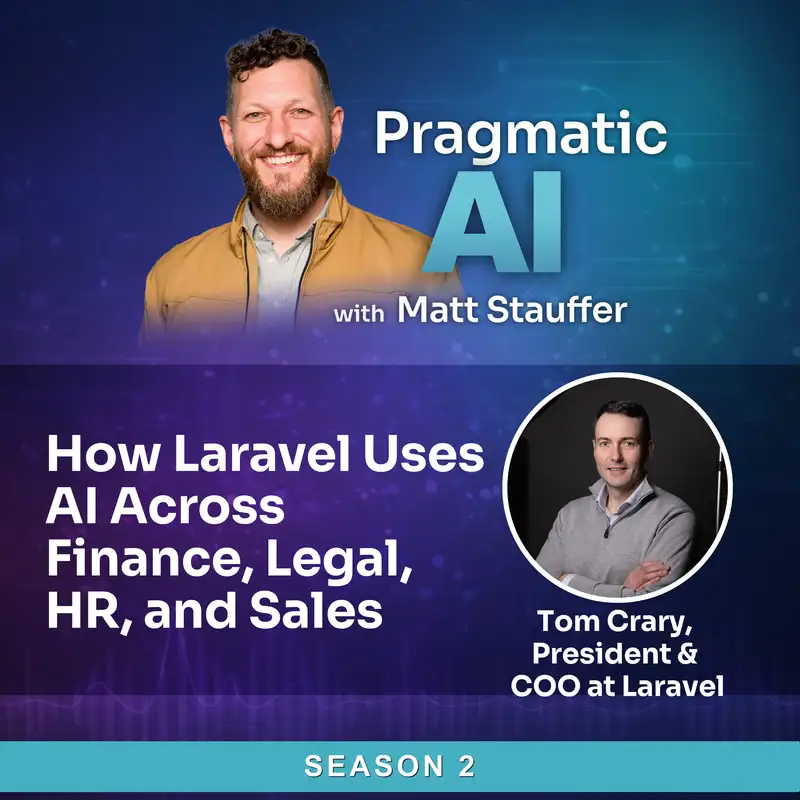
How Laravel Uses AI Across Finance, Legal, HR, and Sales
The Pragmatic AI Podcast is sponsored by Tighten.
T-I-G-H-T-E-N.
We will take your AI ideas, prototypes, or even vibe-coded apps,
and we'll take them to production.
Scalable and secure. Check us out at tighten.com.
Hello and welcome back to Pragmatic AI,
where we're working to bring a clear-eyed
look at how AI interacts with
the real world. And my guest today is my
friend Tom Crary the president
and chief operating officer at Laravel.
And if you've been listening to this
podcast for
at all you already know about Laravel but
you don't know Tom necessarily.
So Tom, would you mind saying hi to the
people and tell them kind of what
is your role at Laravel? What do you
actually do day to day so we can kind dive
into
how AI actually interacts with that?
Absolutely. So let's see, Tom Crary
President COO here at Laravel.
I've been with Laravel since ~ January of
twenty twenty four,
so close to three years now. ~ and I'm ~
Taylor's business partner.
So I do all of the stuff on the business
side from you know,
finance and accounting to HR to ~ sales
and go to market.
~ you know, a lot of company
communications and strategy and things
like that.
So wide variety of stuff.
Yeah. And for those who don't know,
Taylor Otwell founded Laravel and it was a
really kind of small team
of under like eight ish people.
And then there was a really big inflection
moment where he decided
to partner together with Accel a PE firm,
and grow the company significantly and
build new products.
And Tom was like employee one core of that
new world.
And so one of the first things that
happened in those early days was Tom comes
on as president.
Taylor becomes CEO and Tom has really kind
of helped lead a lot of this
new growth that's happened. So if you are
familiar with the story
of Laravel's history, Tom has been there
and very kind of architectural and
a lot of that stuff happening.
So, Tom, you are a president and a COO ~
of a,
you know, probably 100 plus person at this
point tech company.
And I say P E back because I do think that
there are elements to a P
E back company that make your interactions
with communication different,
with finances different. ~ also means
you've had this kind of rapid growth
and there's a lot on your plate.
And so I've been curious. I've been super
curious.
And we've never had this conversation
before.
Some people who come to the show,
I've had the whole AI, you and I have
never talked about it.
I I wanna start with the business side.
What on earth
allows you to do all the things that are
on your plate well.
And is AI a part of that? Are you using it
to help organize your life?
Are you using individual tools?
Like where where is your rebounc your your
broad responsibility
set and AI interacting and overlapping
right now?
Yeah, yeah. ~ yeah, I mean all of the
above,
although probably in some of the least
creative ways you could imagine,
right? So
Okay.
I ~ I've I've heard a couple of the
episodes where people were running their,
you know, their multi threaded agents and
stuff and loops and all sorts
Sure.
of things that I don't fully understand.
I'm pretty basic. So I I pretty much I use
several AI tools and I'm mostly
do it all through like chat interfaces.
So kind of the old school approach to
doing things.
Okay. Yeah.
But I think I got a lot of value out of it
and I've never really felt the need
to go beyond that.
~
to have my agents talking to one another
and things like that.
Although a lot of that does happen at
Laravel for sure.
Yeah. Yes.
You we have to have a
lot of AI pilled ~ enthusiasts here at
Laravel that are using
Yes.
that, especially on the coding side as you
can imagine.
But but we use it, I mean, throughout the
business.
I don't there's not a function at Laravel
that isn't ~ you know heavily invested
in ad and and
Mm-hmm.
you know fast adopters of of AI.
So I can certainly talk about the stuff
that I do.
I can talk about some of the things I see
other people doing.
~ you know, as I mentioned, some of my
responsibilities across
the business front may be a little
different than some of the people you've
talked
to. So happy to dive into
Yeah.
any those areas ~ in terms of how I'm I'm
using it day to day.
Yeah, I would say the first start.
So we've talked about, you know,
various guests talk about, here's how I'm
using it in programming.
And they've got their own, you know,
Claude CLIs and solo running. And we've
talked about people who
are thinking about the way that AI impacts
their broader,
you know, industry and ecosystem.
But I haven't really talked to anybody yet
who says I'm using AI in business.
And I know that AI and business is huge,
right? And people are always talking about
the connectors that they have and the way
you let's say Gemini, because they're
Google people,
whatever. But I don't still think like I
have a really good handle for
how a super AI forward manager of business
operations,
like cause you do operations, right?
Yeah. Mm-hmm.
So we're talking
HR and we're talking about finances and
stuff like that.
How much are you building custom systems
when you're doing that?
How much are you working on existing
things?
What what agents, you know, just kind of
like what's actually enabling
you to do your day to day work better
because of AI?
Yeah. I think the first like leap that
companies need to make is
the security and privacy, you know,
Okay.
trust issue, right? Because and I know a
lot of the bigger companies
are a little slower to adopt this because
they're worried about their proprietary
data or just like, you know, chat
Yeah.
sessions feeding into models or getting
exploited somehow.
And I think, you know, for us obviously
we've taken all the the security
protocols,
you know, we have, you know, a custom
agreement with
anthropic, for instance, that makes sure
that we're data's not being trained
on and it's all in a in inside a a safe
environment.
Now, it's still of the internet,
to be fair, right? So it's not like we're
running,
Yeah. Yeah.
you know, open or own open claw
environment here and we're locking it down
to that level, but we are working with,
you know, under agreements that at least
protect our our data.
So I think that's the first thing we
always thought about is like,
okay, if we're gonna do this, we gotta
make sure it's,
you know, relatively well protected from a
legal point of view.
With all the tools we work with.
So and Laravel, we mostly use Claude.
I would say like eighty percent is Claude,
maybe another ten or fifteen percent is
kind of open AI and Codex,
although that's growing with the latest
Astro release.
Everyone's really excited about that.
And so people are starting to to turn
their attention back there.
~ and then there's a small cohort of
cursor fans as well internally that
are using cursor quite a bit. So those are
the three tools we use.
I almost exclusively, at least at work,
I also use some other tools more
personally,
but
At
work I mostly use Claude because that was,
you know, our master subscription and it's
very easy.
And I'd say like, you know, the most
valuable thing I've done is just feed
context
into my environment. 'cause then it gets
to really know you,
your workflows, and ~ all of the people
that are around you and even some
of your business challenges that are in
front of you.
So like a good example to start with one
is like when we do our board reporting,
right? So we have quarterly
report ~ quarterly meetings with our board
of investors,
we're writing a lot of our ~ materials
with AI now.
You know, AI is very
Mm.
good at like taking a thesis that you give
it,
you know, through a prompt and flushing it
out into a set of slides
and talking points that you can use.
So, you know, what used to take,
you know, I don't know, it probably used
to take at least for me personally,
I won't talk about the entire team,
but for me personally, it would take,
you know, 30, 30 hours or so to write a
board,
board deck and get it ready to ship.
Yeah. Yeah.
~ and then obviously
you present it.
And that's probably down to less than,
you know, less than eight, I would say.
which is a substantial savings.
Wow. Yeah.
because anytime
I have to write a slide, I'm giving it the
talking points and I'm letting
it kind of flesh it out. It's kinda like
having your own little associate,
like in the sort of like
Yeah.
at least on the business side,
like you know, you'd have like an an an
associate,
a business development person or a ~ you
know,
an a an analyst that you'd give these
slides to to let them hash it out.
Well, I used to have that. Now I have
Claude that does that for me and
it does a pretty good job and it does it
in
you know, five minutes instead of a day.
Yeah. Yeah.
So the turnaround time
is much faster.
Okay. So I imagine that part of that is
research.
You can say, Hey, I want to know like how
the financials have gone up and down,
how much you know, you probably have it
connected to linear and you've
got like you know big broad movements and
everything like that.
You're also probably using some kind of ~
like claw design for designing
the the the decks too, or like okay,
We still have designers that give us
templates.
so Okay, that's what I was wondering,
~ so and
yeah.
then the layout happens, you know,
via Claude once they have sort of the
templates
Okay.
and the design system implemented.
Mm-hmm.
So we
do connect the the design system in,
so everything is fairly uniform across our
team and that that's a really a
Nice.
great I mean that that was probably the
biggest unlock.
Once we got that into Claude, it would lay
it out
Mm-hmm.
in a very similar way across the team.
So that was really
Very cool.
useful.
But yeah, we have all of those sources
connected.
So at Laravel, we use obviously the Google
Suite quite a bit.
Everything runs through Google Suite.
So that's connected. So your calendar,
your email, things like that. ~ you know,
we use Linear for for project management.
We use Notion for longer form as well.
So all of those sources are definitely
connected in and you can as
Mm, mm-hmm.
and Google Drive as well for other files.
So you can kind of pull in a lot of
context very quickly because they're
Yeah.
already connected. So you just gotta point
it in the right direction and say,
use this context, this context,
this context, and pull it together into a
thesis.
This is what I want to talk about.
So you're still controlling the narrative,
of course. You can't just like let it run
wild because it will definitely
run down weird areas. But like if you
kinda give it the direction to go,
I'd say it'll get eighty to ninety percent
there,
you know, pretty quickly. And that's very
useful,
you know.
Well, appreciate the fact that you
mentioned because when you started with
trust,
I was actually like, I'm sitting there in
my head,
I'm like, it it it's interesting that you
chose to start with trust
and you've instantly proven me why,
because ~ I have been very reticent to
give AI access to any of
my personal private information.
And most of the folks I know, and
especially in the normal world,
not the business world, like, yeah,
I'm not letting AI touch anything.
Mm-hmm.
And then the moments where I've given it a
little bit of access,
for example, a Claude Cowork, I finally
gave it read only access to just
a couple things.
One of them being my calendar and another
being my meeting notes.
And the moment it had read-only access to
those two things,
its value to me just blew up. Just
unbelievable amounts of value once it
has all the context. And I was just like,
~ yeah, if it knows all this stuff and you
can trust it to know this stuff without
leaking it all to anthropic or whatever,
your your
benefit out of it is just incredible
because it's ~ it's as you said it's it's
I have an an executive assistant a virtual
assistant and she has access
to all those things and she's able to give
me insight at a level that
no computer ever could. And I don't need
to replace her.
I need I need her to have more time to do
her human things.
And so if I take some of the things she's
doing and just say give that same level
access to this tool it's incredible.
But terrifying, right? So so leading with
privacy and trust really is valuable.
Is there
Any part of you that says, Yeah,
they said that they are gonna keep our
stuff private,
Yeah.
but we don't really know, or you like,
you what,
like we got it locked down. This is just a
part of doing business at this point.
I I think mostly the latter. ~ you know,
I think we we stop short of giving them
access to any kind of money,
of course. Like they don't have access to
our bank accounts or like
our Stripe account or any of that type of
stuff.
So because that's that I think that's
where things obviously can get out
of hand and obviously the alignment of ins
alignment of incentives
and risks starts to outweigh itself.
But like if you if you if you're really
focused on like,
you know, like you said, product
management issues and,
you know, short term, medium term roadmap
type issues,
or even longer term roadmaps, like
You know, the the value isn't in the idea.
It's not in the words. It's in the
execution,
right? So, ~ you know, ultimately we have
to outrun our competition,
whether they know what we're doing or not.
And frankly, we're pretty public about it,
because we're on all these podcasts,
you know, maybe not me, but lots of other
people are,
Yeah, that's true. Yeah.
right? So we're
pretty we're pretty public about what
we're shipping,
what what's coming next and where we're
going.
So, ~ so th there there's not that much
that's truly proprietary about what we're
doing, where I feel like, ~ if someone had
access to this,
we'd be at risk as a as a company.
Money of course
Mm-hmm.
aside and some of those other types of
things I think are are different.
But ~ but yeah, so I I I'm I'm largely
over that hurdle and I think that's
the advantage of being a smaller,
more nimble company is if is being able to
take advantage of that because
I know a lot of bigger companies that I
have friends that work at have
not been able to tap into to the to the
benefits of AI and that's,
you know, unfortunate.
Yeah. ~ okay, so you do quite a few things
where,
you know, you mentioned the deck being one
of the things that you're doing,
but you have a lot of other
responsibilities that I imagine ~ there's
lots
of individual things that you have to do.
And granted, you have teams underneath you
working for a lot of those things,
but I also imagine that splitting
responsibility across a lot of things
is one of the costs of having somebody who
has so many kind of like working pieces.
Have you found that AI is helping you
organize your life better
or structure what you're working on?
Are you using it more like a virtual
assistant?
Or is that not viable for you because
there's still teams underneath
you doing most most of that work?
Yeah, I find I find that my day to day is
too unstructured to have
it structure my life, you know.
There's literally
Yeah, yeah.
too many things that come up every day.
I mean, obviously beyond just regular
calendars and and invites and that kind
of stuff, I do use AI for that.
~ but like not not in terms of like,
Hey, what should I be working on this
particular moment?
Like there's
Uh-huh.
stuff that just comes up during the day,
overnight, that you're gonna react to,
respond to, and either like, you know
Give it to somebody else to work on,
or I'm gonna work on it. And so I'm I'm
constantly jumping in and jumping
out of stuff. But each of those individual
tasks,
I feel like you can use AI, you know,
to help, you know, more than half,
most of them, frankly, can get the benefit
of of AI.
I mean, we use it for contract review as
another example.
~ you know, some contract writing even.
I would say I've reduced my use of lawyer
time by 70%.
Wow.
You know, because
a lot of the first drafts can be drafted
by ~ by Claude.
huh. Yeah.
A lot of the first
level reviews and even like simple
negotiations can be handled by Claude.
~ you know, in my pre previous life I used
to pretend to be a lawyer in a way,
right? So I used to do small
Me too. Yeah.
you know, obviously we all do small
contract changes and like now they
can be done faster and better than I could
do by myself.
And so obviously I still we still have a
number of lawyers on on on call,
but like
We don't have to use them nearly as much,
so there's there's real dollar for dollar
savings there.
You know, you know, I would say at least
ten ten,
fifteen thousand dollars a month of
savings because we're using lawyers left
less.
Yeah. That's incredible.
I'm I am doing the same as well.
~ and I I appreciate the fact that you
defined it as I'm not using AI
for any work legally that I would have
previously used lawyers for.
I'm using AI for legal stuff that I would
have done myself before because it's
now me plus AI. We're gonna do a little
bit better job than just me would have.
And the moment it needs to go to a lawyer,
I'm still calling the lawyer. Lawyers are
still getting the work.
~ but the the Yes.
Yes, but but with a draft in hand of like,
hey, let's start with this because I can
have all of the
Yeah.
context in there. I don't have to do a two
hour phone call with them
You're not wasting Yes.
to take them through that journey.
It's like here's the draft,
now you can actually kinda refine it.
So it's it's saving on both sides,
both work that I wouldn't send to the
lawyer,
but also the work that's sent to the
lawyer and is in,
you know, eighty percent of the way there
already.
Not a unique use of their time.
So Exactly, exactly.
Yeah. Yeah, that's really good.
~ one of the things that I say a lot on
the podcast and publicly is that
AI is best used when it's not doing
something uniquely that you're uniquely
capable
of doing, and it's also best used when
it's stuff that nobody actually really
likes
doing.
and so I'm just like, if it's if it's what
I'm uniquely good at,
it's what the lawyers are uniquely good
at,
if it's stuff that, you know, people
actually enjoy doing,
their brains are present, the humanities
are present.
I don't want AI to do that. But we all
know that there's big pieces of
all of our lives that are not fitting
those categories.
I'm like, AI, please. So
Yep. Yep. And and you're still
okay. So
driving it. Like that's the other thing is
you can't you can't lose contact with it.
You can't just you know, feed it into a
machine and take it verbatim.
You definitely have to stay on top of it
because it you know,
it's it's still wrong quite a bit.
~ you know, it's just
Yeah. Yeah.
in terms of its focus area. If you give it
the right focus,
you give it enough context, it'll get it
right.
But like, you know, you you're probably
never gonna do that.
Like if you don't read it, you're gonna g
make mistakes.
And I could even give you some examples of
mistakes we've we've made using AI.
~
Yes.
Yes, please. What do you got?
Yeah, maybe you like this
one. So, well, I mean, here's another area
we've used it.
So this is kinda in the contract realm,
but like with our sales team, for
instance,
a lot of our ~ sales forecasting and sales
compensation plans were drafted with
the help of AI as an example, right?
Okay. ~ huh.
And that's
been really useful because that's another
project that would have taken,
you know, me and my team eighty hours to
to draft up,
especially for the first time 'cause we're
relatively new to sales in
the last year or so.
So now we have kind of our first or now
second and third iterations
of our sales comp plans. Well,
when you're drafting the first one,
you're bound to make some mistakes.
And you know, you just hope you catch
them.
Well, in this case, AI made some mistakes
as well.
Literally,
Yeah.
you know, some mathematical errors.
And it was like and
no.
it wasn't that simple. Like it was it was
a complex situation because like
we have people that are starting mid-year,
and so they don't get a full year target.
Maybe they get a thir a a thr a nine month
target.
So you have to gross it up and then,
Yep. Yeah.
you know, do a lot of mathematical
adjustments and then have it all flesh
through the
the comp plans. And quite literally it
messed it up,
right? So it was you know, used the wrong
percentage rate that was applied
and so people were getting paid different
amounts than what they thought they were
gonna get paid. So and it got through the
review of me and you know
my head of finance and head of sales and
everybody else who looked at it.
So an fortunate situation obviously we'll
will we didn't cost us much money,
but like, you know, we're gonna make make
good to our employees.
But like, you know, you there there is
still you have to be monitoring things
really
closely.
Or things can go wrong.
You know.
And since we're being honest here,
I've had the exact same issue happen not
with AI.
And it got through me and it got through
the director.
Yeah, of course.
You know, and so
like because when when you have those
things that it's like just looking
at the number does not tell you enough to
know if that number is good or not.
Right. Right.
It's so
that's and that's not to excuse AI for
making mistakes.
We need to review their work, but
sometimes it's more like to excuse
the humans reviewing, because like if
somebody else generated this,
whether that's somebody else is an AI or
human being,
we can review it.
as best as we can and sometimes you just
don't know because what I
see is just sixteen different numbers
lined up next to each other that look
generally correct, right? That's so yeah.
Totally. Yep. Yep. Yeah. Now we've all
made
those mistakes, whether they were
originally drafted by AI or not.
So it's entirely right. I mean it's our
job is to be critical reviewers,
right? Whether it's code or it's financial
records,
whatever it happens to be, you know,
that's still the human job in a lot of
ways.
And if you outsource that to the AI,
you know, then you've lost lost the
thread.
~ so you define your own AI usage,
but I I imagine that you also play a
little bit of a role and you can tell
me how much in defining the AI like usage
of your team and the company broadly.
So, first of all, I wanted to ask like
that question you just talked about.
Like, how do you make sure humans are
staying in the loop?
How do you make sure people are not
outsourcing their critical thinking?
And then the second question is broadly,
how do you define healthily patterns and
policies that are flexible,
but then also
not so flexible that you guys are ended up
like shooting in your foot yourselves
in the foot more and more. Like how do you
draw that line?
Yeah. Yeah. I mean it's been a journey
obviously since we've adopted
it as aggressively we have, probably over
the last,
I don't know, eighteen months or so,
you know, we've been using it pretty
aggressively at Laravel.
And ~ you know, there's been there's been
a few ups and downs along the way.
I think the biggest advantage we've had is
we have almost all senior level people,
right? So we don't have almost any junior
level developers,
probably people at all. We've kind of
purposefully
Mm-hmm.
hired much more towards you know,
senior and above.
And so I think both because they were
trained that way,
~ in terms of like, you know, hand coding
code for a long you know,
hand rolling code for a long time,
we haven't had a lot of like big mistakes
or problems.
I'm sure everybody has their their small
ones that they could they could fess
up to inside the company, but we've been
relatively free of any like
big gotchas that have come come through.
I it was been interesting though,
like early days, like if you go back a
year and a half ago,
~ we were really trying to encourage
everyone in the company to
adopt AI because we knew that there this
was something we all had to do
or else we'd fall behind both in
productivity as well as just awareness
of you know dog fooding our own the
technology that's around us.
~ and it it took a little bit of time.
I think like most people, right?
Like, you know, we all talk about towards
the end of last year
as the inflection point of how things
really just clicked with AI
and and everyone can see it working.
So, you know, especially in 2026,
it's been you know, everyone uses it ~
aggressively.
What's been interesting from a business
perspective is like,
you know, we we originally had very little
guardrails on terms of like the spending,
and it got out of control fast.
Mm-hmm. Really.
Within a few months, like it went from
like, you know, very small numbers to
very,
very big numbers, you know, you know,
fifty plus thousand a month kind of thing
within,
you know, from zero to fifty thousand in
like a course of like three or four
months.
And we're like, okay, let's slow down a
little bit.
So we've had to put some guardrails in and
like make sure that like you know.
Just using it efficiently. ~ you know,
this is actually one of the costs of using
the enterprise versions
of these things is they're the pricing,
the token pricing is just way,
Yeah, you don't get the subsidization the
rest of us are getting.
way higher. Yeah. Exactly.
Yeah.
Exactly. So we've been more pragmatic
about that.
speaking in in ~ AI pragmatism.
~ you know, just like, well, does everyone
need to have the enterprise plan?
Maybe we need enterprise plan for some of
these features,
but some of them could be the team
feature,
you know, ~ because there's a lot more
value to be had there.
~ and then just having some sensible
limits of like what the expectation
is like ~ you know, and some people will
use more than others based
on their their jobs and their roles,
but ~ you know, there's a limit to you
know what what ~ what we should just
be aware of how people are using it so we
don't stay,
you know, it's not just writing a check
and just being like,
this person's uber productive.
~
Yeah. So there's no leaderboards approving
people using the most tokens they
but one of the challenges
possibly can?
No, definitely not. I I we we don't want
to reward that 'cause that's
a bad behavior. Like you can definitely
send it down yeah,
Yeah. It's a terrible metric. Yeah.
down down
down really bad paths that way.
and it's it it's really it actually is
hard.
Like I don't know, from from my
perspective,
I'm not obviously a developer,
but you know, when I when I looked at the
list of like how much people were spending
per person, you know, and line them up to
the names,
I was like, would I say my most productive
engineers are are using
the most amount of tokens or not?
And it was just very mixed. Like it was
like
Yeah,
okay.
I I I couldn't draw any correlation to be
like,
okay, my best people are definitely
spending the most tokens or my worst
people
Yeah. Yeah.
are spending the
most tokens. It was just like completely
all over the place.
Seemed like a a random walk. So ~
Interesting.
anyway, so there's more to obviously
figure out there.
We h we haven't nailed it, but like ~ we
really just ~ ultimately we really want
to have a posture of like AI adoption
though.
So if someone wants a second tool,
we're gonna give them the second tool.
I know a lot of people are starting to do
that too,
have you know, the agent thing,
one reviewing the other and working in
parallel.
So we're trying to get into some of those
workflows.
~
So there's some of that going on.
We're testing our way into that as well.
Yeah. I just saw a thing, I'm trying to
remember who it was,
but some prominent company is doing work
at like a probably pretty expensive
~ engineering level to ensure that they
can build systems that minimize their
token
spend. And I was just sitting in here and
I was just like,
does it matter that much? But now I
remember the way that enterprise teams
are paying. I'm like, yeah, it does it
does matter that much.
Yeah, it does.
You're talking tens of thousands
of dollars. So wow. ~ okay.
Yeah, it was we we
I would say it was roughly a factor of
ten,
maybe even twenty higher for the same
amount of like tokens.
So that's my
Wow.
rough
order of magnitude difference on pricing
for enterprise versus non enterprise.
With a few extra bells and
Okay, so
whistles that you get in that plan,
but like twenty times more is a lot.
Uhhuh. And we've talked we've
talked about you know, your developers,
but are you seeing pretty heavy AI usage
on the non developer side as well?
Okay.
Yeah, I mean rarely does a
di a non developer run up a developer size
bill.
~ you know you know, I would say our
average developer on enterprise would
spend
between one and two thousand dollars a
month.
And our average non developer would
probably spend between a hundred
and two hundred, maybe three hundred
dollars a month.
Okay, got it. So it's really it's a lot of
code that's that's really what's shar
So still yeah, the the cause it's you
know,
okay. Mm-hmm.
it's all the context, right? So the more
more you store the contacts, the deeper it
has to look.
It it can run up a pretty big bill.
But even like our
Yeah.
non developers, to be fair, are shipping
apps.
Cause of course we're an app company.
Yeah.
So and you
can see this on social media from ~ Sam,
~ Sam Sappenfield and what she's doing,
Say ~ yeah. Mm-hmm.
~
building marketing apps and Haley and the
demand gen side.
Even Paulina, our head of finance,
is is is shipping AI is shipping workflow
Nice.
improvements, you know, on cloud of
course.
~ and it's
Uh-huh.
and it's amazing and it's
It's great because we're getting
productivity out of it.
It's also because we're using our own
tools,
like, you know, including Laravel Cloud to
host all these apps.
So ~ we really love to encourage it.
But every time someone ships their own
personal app,
you know, for their business use of
course,
it's it's it uses a lot of tokens as well.
So you see some spikes when Paulina is
shipping some ~ some AI finance
Yeah.
tool. So but it's great.
What's I know a lot of people are afraid.
We've talked about this a bunch.
People are very afraid of the impact of AI
on their industries and their jobs.
And there's often very good reason for
that.
You know, we're hiring at Tighten right
now,
and the number of people I've talked to
who have been out of work for over a year,
I'm I'm like, there's there's things going
on in the industry,
but I can't necessarily point them all to
AI.
It's it's hard to know are these changes,
are these things AI related or not?
~ you are, you know.
You guys have been hiring like crazy for
the last few years.
You were also very high on AI adoption.
Do you feel like there's any either roles
~ or functionalities within
a company that runs like Laravel does,
where you're like, we just don't need this
at all because of AI?
Or is it mainly just taking existing
roles,
existing people, and just making them more
productive?
I think mostly the latter. ~ you know,
I there there might be a small impact on
the total amount of hiring that
we would have otherwise done, you know.
~
Right.
you know, we have about a hundred and ten
people now.
You know, I can imagine we might have a
couple more if we if there was
no AI tools to help. But I think it's
mostly about productivity at this point.
~ you know, and trying to get more more
out of less.
To be honest, we we've been slower to hire
not because of AI and trying
to force AI into the system, ~
slow to hire. I know we've we've added a
hundred people in the last two years,
but ~
Uh-huh.
but slower of this year actually.
Our our headcount this year has only gone
from about a hundred at the start
the year to ~ to a hundred and ten.
I think we're just under a hundred at the
start of the year.
So we've only added a net ten or fifteen
this year,
which is slow by our standards.
Yeah. Relatively, yeah.
And
it's more culturally driven. Like we just
want to like make sure we've
got really good systems for communicating
and working together because
if you grow too fast you can just lose
lose control of the ship in a way.
And so we're just taking a little bit of
time to like,
you know, kind of settle into our our new
larger size.
~ but but I'm sure we'll we'll continue to
hire for sure.
Yeah, I love that. ~ I could talk to you
about this all day,
but we have an entirely separate topic
that I am fascinated to talk about that
I didn't even know was gonna be on the
docket until we we chatted right
beforehand.
You said that you're using AI for
biohacking.
So first of all, I all I know about
biohacking is,
you know, people measuring, you know,
their all their various things and
figuring out what,
you know, medicines and fitness ~ wow,
Yeah, all of that. Yeah. They got the the
whoop and the Apple Watch.
It's just as far
okay. So so I
I have like the
Fairest level of understanding of this as
a concept,
let alone AI being a part of it.
So you gotta start us from ground zero.
Give the pitch. You are sitting in a I
don't know what biohackers do.
You're sitting in hot tub after a long
something,
I don't know, you're in a cold freeze with
somebody and he's like,
Yeah.
Tell me
about biohacking. I gotta learn about
this.
Teach us, teach us what we need to know.
Even before the AI. Just like what is what
does that even mean to you,
biohacking?
Yeah, yeah.
I mean I I got into I got into biohacking
about five years ago.
~ you know, and like many people,
it's when you hit your first like health
challenge in life.
~ and
Yeah.
it makes you like, Hey, what can I do to
prevent this from happening again?
And and for me it was actually relatively
minor,
but like it was my knee. So I've had ~
five ACL tears in my left knee,
~ from from playing sports. And I got to
the point about five years
ago where I could barely walk
And I couldn't even ride a bike.
Like my knee just would not go around on
like a Peloton bike.
And I was like, okay, this is this is
going nowhere.
So I started searching for, you know,
alternative treatments and there was you
know,
and started following the circuit,
you know, podcasts and ~ you know,
reading books and stuff like that and and
social media where people
are talking about biohacking for
alternative ways of of working.
I found a doctor out in California who I
continue to work with five years later
who got me started on peptides and like
stem cell treatments for my knee.
~ and my knee, long story short,
is like I would say ninety percent or
eighty five to ninety percent to
of like my right knee, which is,
Wow. ~ huh.
you know, has never had an injury.
So went from probably
call it fifty percent functionality to
eighty to ninety percent over the course
Amazing.
of a couple of years. So I've had a lot of
success that but that just
got me down this rabbit hole of like
learning more and more about like
alternative
What else could I do? Yeah.
treatments. Yeah.
And like it like I said, it started with
like ~ stem cells and then
got into peptides, who my doctor also got
me started with about five years ago,
and I still use that today, ~ as well as
supplements and you know,
lifestyle things. I mean, I always say
with people like by far
the most impactful things are the basics,
right? So sleeping well, exercising,
eating well is like eighty to ninety
percent of the battle.
Yeah. Yeah.
The the last ten or
twenty percent. So I always don't want to
oversell the biohacking piece
of it because you know, if you don't do
the basics well,
then nothing else matters.
But I do think there's some really cool
stuff that's here and that's coming soon
in the biohacking ~ realm. And and one of
them is powered by AI,
right? So ~ you know, I think there's so
much in our biology that
a human can't possibly understand and
correlate,
right? So it's a multivariate ~ analysis
that needs to happen.
What's what's better for AI than that?
~ you know, so basically, ~
I've been using AI for the last year or so
~ to upload my up my biology.
And this is everything from, you know,
starting with my whole genome sequencing,
right? Which is a massive file that has
all 20,000 genes and all of the different,
you know, ~ gene changes there to
understand like what am I,
you know, predestined towards or pre ~ you
know ~ you know accustomed to.
So I have that in there. I'm feeding in my
blood work.
data. So I do like quarterly blood testing
and things like that.
So it has more of a real-time indicator of
how I'm performing.
I've got all my my my wearables that's
feeding into here.
And basically I'm having it help manage
like my supplement protocols,
my my diet and exercise type protocols to
get enough recovery and ~ you know,
~ you know, strain as well as ~ you know,
peptide protocols and and things like
that.
So most recently I had a back injury that
I'm recovering from and I've
had coaching me through that too.
with again s you know, specific peptides
and supplements to kinda get through that,
as well as, you know, right right types of
exercises to kind of rehab
and things like that. So it's like having
a doctor on staff,
but has access to a whole lot more data,
can do like, ~ you know, correlations that
no human would have enough time to do,
frankly. So I think that's where the
future's going.
Obviously it's still very like I'm doing
this in Gemini and Chat GPT,
~ you know, personally and
Like most things, it's all about the
context.
So the more context you can feed into it
and store,
Uhhuh. Okay.
the more
valuable it can get. So like I take all of
that stuff and turn
it to structured data, right? So that it
can then go back to it because it'll
always
Mm. Yeah. Yes.
forget the context window, whatever number
number
of days later, but it has to go back and
say,
Okay, I'm gonna go look up your blood
testing because it's now
in the structured data format.
So that's where the sort of developer part
comes into it is like,
okay, I can just
Yeah.
feed into this, you know, blood testing
report,
but it's gonna forget about it thirty days
later.
I better turn into like a structured data
format that it can go back to.
So, you know, things like that are are
really useful.
So anyway.
I I got I gotta learn more about this.
So first question is, what what is this
all?
Is this a project in Claude that just has
all this data or is there
a specific tool for it?
Yeah, so in ~ I use Gemini and ChatGPT or
and and a ba I do have like
a little bit of an agent battle there,
so I have them checking each other,
right? So ~ but I started with Gemini and
I like Gemini because one,
I thought it was the easiest to jailbreak.
This is the part of but this is the other
Okay.
thing. It's like, you know, if you don't
jailbreak it,
it's gonna just give you the generic like
doctor recommendations.
Well the FDA hasn't cleared this and you
know,
there is no double blind placebo
controlled sample that tells you that this
is real,
you know. I I'm past that. I don't wanna
hear it.
Right. Yeah. Yeah,
I know, I understand. I wanna hear
I have
Google.
Mechanistically,
what is useful to me for maybe thinking
about,
right? So so you have to kind of get past
that.
And you have to tell it you're you're
working with a doctor,
which I am, to be fair. And ~ you know,
and and then it will give you its actual
real life thoughts.
And Gemini took like that to get past
that.
And then since then it has never
questioned at all whether or
not there's enough evidence to like go
after this.
It'll still tell you the counterpoint,
but it won't be like lead with that every
single time.
~ so that's why I started with Gemini
because I thought it was
the easiest to jailbreak. But I use the
I think it's called the project feature in
Gemini,
which has a longer context window.
so it keeps the keeps the data much much
fresher ~ than it does the ~ you know,
if you just use a chat, a regular chat,
which is much more transient. I think it
has a f a few hours of context.
So and then same thing on chat GPT,
And so you're able to basically go ahead.
I think has like a same feature as well,
like a project feature as well.
So
Yeah. So you're upload so you said this
pretty quickly,
but for the non developers, you are taking
data that's coming in lots
of different formats. I imagine some of it
even like PDFs,
and I assume you're using probably Chat
GPT or whatever else
Mm-hmm. Yep.
to convert that into some text based,
probably like JSON or CSV or something
like that.
Yeah even yeah, very basic. It's it's just
Excel sheets or Google Sheets
Yeah. Okay.
Mm-hmm.
or whatever.
So it's just columns and rows,
you know, of data so
Uh-huh.
that you can it can basically go back to
it whenever it needs to.
~ exactly.
Okay. Cause I was gonna say
some of these projects they limit the
number of documents you're allowed to
upload.
So are you putting these in Google Sheets
and just giving it links
to those Google Sheets so it's not your
Gemini that's holding the data,
but Google Sheets that's holding the data
for you?
Correct. Exactly. The Google Sheets is
holding the data.
that's big brain. Uh-huh.
That's the storage. And then and then it
and then you have to c occ occasionally go
back to and be like,
hey, go back to the sheet again,
read it again
Yeah. huh.
and rema and then ask the question again.
So it's still,
Okay.
you know, ultimately I think all this
memory issue stuff will be solved,
right? but that's still
Yeah. Mm-hmm.
like anything we do, it's all about the
context window.
It seems to be the the limiting factor.
Yeah. ~
~ so that's
how I kind of get around that.
And the same thing with like genetics and
and all my whoop data.
It has to kind of
be stored as structured data so you can
kinda go back to it whenever you need to.
So ~ I've got an aura ring, I you know,
had an Apple Watch in the past,
and I never know who's actually gonna give
you your data.
I also got a ~ Ancestry.com DNA scan.
I have no idea if I could even get that
stuff out in structured ways.
Have you found that all those people make
it accessible and you have to be tricky,
or are there certain vendors that make it
easier for you to get your data
out and actually do what you want with it?
they're they're all a little they're all a
little different.
Like Apple Health is an interesting one.
You know, you can ~ upload that as a point
in time or download that as
a point in time and then upload it in.
Mm-hmm.
~
or you can I think there's some a public
APIs out there that you can
pay a small subscription for, I think like
five bucks a month,
and then you can have a live feed.
So you just have to choose what you wanna
do.
You wanna do the manual approach or the
API approach.
But
Yeah, each one has its own little thing.
I mean, the genetics is really,
really, really powerful. I mean,
that's probably the one that I think has
the most future into it because it's just
so data intensive. I mean, we're talking
files that are,
you know, hundreds of gigabytes to
petabytes or to terabytes,
I should say. Giga hundreds of gigabytes
to terabytes in
Wow.
scale. So like you can't just upload that
stuff.
You have to find ways to abstract it and
get it in there.
But it's it is all available. ~ you know,
usually if you go to the sites,
there's like a files and a download type
feature so you can get it out.
But can the AI read it? You may have to
have like an abstracted version
of it depending on how much genetic detail
you have.
but I think the the comp No,
Are you hand cobbling that all together?
Sorry to interrupt you. Yeah,
well, A AI is. AI is in a lot of cases.
yeah.
The genetics one actually the the the
service I use has different levels of
reports.
So and I actually
Okay.
gave it three different levels of reports.
Individual files were, you know,
in the tens of tens of meg tens like t
hundreds of megabytes to gigabytes
to low gigabytes, maybe ten, fifteen
gigabytes.
And so it was all uploadable and then the
AI was able to c combine those into three
different views that kind of come
together.
~ but that's the most powerful thing is
like if we can get our genetics data,
like you have so much the richness of
understanding of like,
you know, what you're pre pre disposed to
is really,
really powerful. And it explains so many
things,
like either in your blood work,
like I'm very I have very high like,
you know, cholesterol markers and things
like that.
And, you know, I don't know. There's lots
of various things that we all have
and you always wonder, why can't I get
this number down?
you know, why is my cholesterol always
high even though I'm eating perfectly?
And, you know, the the genetic stuff can
explain a lot of that.
So I think it's the future is like,
you know, bringing all this data together.
So and I know there's a a lot of products
that are coming to market ~
to help make this more accessible to
everybody,
but but for now I'm doing it all in,
you know, my own little chat interface and
Yeah.
it's working really well.
Okay. If if someone were interested
getting started in biohacking,
where would you send them?
Hmm. that's a good question.
~ I there's a lot of different entry
points.
~ I mean ~ you know, I I think I I think
the most the the most useful thing
for anybody is to do regular blood blood
work,
you know, and comprehensive. Like,
you know, if you just go to the doctor,
they're probably gonna test like ten
biomarkers and then you're gonna be left
with
a whole lot of questions of why.
And so I always recommend to start with a
more comprehensive blood work panel.
I mean, here in the United States,
for example, there's a there's a group
called Function Health,
and I think it's like
$250, $300 a year, you get two blood tests
and it tests a hundred biomarkers.
That's fantastic. You know, a tremendous
value to really get started.
And then you know a lot of stuff.
~ so I think that's a great way for almost
anybody to get started.
And I'm sure like most countries there'll
be there'll be other other services.
We have a little biohacking channel here
at Laravel that ~ you know,
and and obviously we're a
Course you do.
very global team, so we we talk about this
stuff and people are from
all over the place and we're we're trying
to find similar sources
in different countries to do that.
Nice, that's very cool. okay,
so let's get over to your speed round.
So for you know it's a set of pre
established questions,
and for every single one of these
questions,
I'm gonna give you one minute.
All right, so your first question is what
is your AI tool of choice?
Hmm. man. Interesting question.
I use Claude the most, obviously,
for the for company business. ~ almost
Mm-hmm.
entirely. I I am I have to say I'm
particularly annoyed by its writing style
though.
Like I can't even read anything that comes
out of Claude It's just it's so
Yeah. Yeah.
poorly the I I can't can't stand it.
So I do prefer Chat GPT or or Google
Gemini for for writing.
but unfortunately I'm doing most of my
company stuff on on Claude so that's what
I do most most of the time. I think it's
very good at data.
And analysis. Obviously it's good on the
coding side as well,
so
Yeah. So those three, you got Claude,
Gemini, ChatGPT, are your main three
drivers.
And Claude
Yeah.
mainly for work, because that's what you
guys who use at Laravel.
Okay. ~ your second question is,
have you ever cussed out an AI?
~
no, I I don't think I have. I mean I I
obviously understand the the limits
of of what it can do and I always look at
it as like,
Hey, this is better than having nobody to
ask a question to,
you know, and those are the types of
questions I I tend to feed it
as like things that I'm like, Okay,
this is gonna take a lot of work to figure
out.
Let's get some a quick read on like,
you know, what the
Uh-huh.
landscape is. Maybe it's a a legal
question or ~ you know,
like a sales comp example, like what would
be the norms in a
in a particular industry or something like
that.
So I think it's
I think it's really good for what it is,
but you know, it's it's it's still mostly
about the context you give it.
The more context you give it, the more
right it's gonna be.
And so if it didn't c if it didn't come
out right,
it's probably 'cause you didn't right ask
the right question,
right?
That's very mature and responsible answer.
All right. ~
Yeah.
your next one is what is one pro usage of
AI that more people should be using?
~
I th I think I think it's all about the
context window,
right? So I you know, I don't I don't I
don't even know the right answer
to this question, like how you can store
longer form,
longer term ~ context of like an
environment.
But this is one of the reasons I
personally use the the the ~ you know
~ like keep it keeping all of my context
around ~ the strategy we have at
Laraville,
what we're working on, who the team
members are.
~ the direction we're going, I feel like
has been really powerful
to getting quicker, more appropriate
answers.
So ~ centralizing your topics probably in
one one tool,
~ and making
Okay. Yeah.
sure that, you know, like I said,
maybe the structured data thing is also
really useful.
Like if you have something you really want
to keep for long term,
turn it into structured data so you can
come back to it.
That's really good. All right,
your next one is Is AI going to ruin the
world?
Yes and no. ~ yeah, no, I mean I think I
no,
I mean I think ~ I think the world will
adapt to it.
I I have some fears that the pace of
change,
you know, may if it if it does continue at
the pace it's been on,
and I don't think it will for that matter,
I I believe that
Mm-hmm.
the the f you know, the last mile problem
is real in all parts of life,
and I think that will come come into play
at some point in the in the
AI adoption as well. I mean there's still
very few percentages
small percentage of the world that's
actually using AI at this point.
So we're we're on the bleeding edge of
this in the in the in the grand scheme
of things. ~ and we see how useful it can
be,
but we also see all the challenges.
You know, especially when you talk about
like physical,
~ you know, robotics and things like that.
Those problems are just massive.
And that'll take, I
Yeah.
believe, at least a decade, if not
multiple decades,
to to work its way out. So no,
I don't think it's gonna w ruin the world.
I think there's gonna be a lot of great
things come from it,
some some challenges that we need to work
through.
But ~
But I think it's gonna be it's gonna be an
interesting few years for sure.
Yeah. And your last ~ speed round question
is what is the most controversial take
you have about AI?
~ and I should have listened to these
questions beforehand,
huh? What is the most controversial take
about AI?
~
Yeah, I mean I think I think you have to
you have to sort of take you know take
the good with the bad with AI and if you
if you expect it to to repla
to replace all of your thought then that's
gonna that's gonna ruin yourself,
right? I think like if we become useless
as humans and you know,
then then what is left? ~ so I think I
don't know if that's controversial at all.
I think we kind of all agree with that.
~ you know, but ~ I Yeah.
Not a lot of people are saying it though.
So Yeah.
Yeah, for
sure.
That's great. ~ all right. So if people
are fascinated by Tom first of all,
thank you. Excellent work in your speed
round.
if people are fascinated by Tom Crary want
to learn more about you,
hear about what you're doing, ~ how do
they follow with what you're up to?
Yeah, I mean I I'm on I'm on the the X
app.
~ I'm T Money one three seven one.
~ I'm not a big chatter though,
so you probably won't see too many posts
from me.
But definitely ~ definitely check me out
there and then also on LinkedIn as well.
So, you know, old school businessman as
myself.
So I still I have I a
See, I was gonna
say, you're a business guy. Do you hang
out in LinkedIn?
I try to. I I try. I know I'm supposed to.
I don't p
I honestly don't post much on social media
at all.
I'm just
Yeah.
very focused on like my in person like you
know,
you know, relationships. So I try and
spend as much time like actually reaching
out to people as possible in my network.
I do post, you know, you know,
from a c occasionally when there's when
there's something interesting.
I always respond to to, you know,
clap for people who are, you know,
seeing their promotions and doing well.
But
But not I'm not a big poster, so you but
you can find me a a little
bit on on LinkedIn and and X. I probably
post more on X on on LinkedIn to be
honest,
but not much more.
Yeah. Well we will have those links in the
show notes.
Tom, I know you were extraordinarily busy.
This was so much fun. I really appreciate
you hanging out today.
Awesome.
My pleasure. Great to see you,
Matt, as always. Talk soon. All right,
You too, man. And first you we will see
y'all next time.
take care.
All right, bye.
Creators and Guests